

Dear reader,
Last Thursday, we published the first RO Long Read. In it, RO writer James Mahon explores the links between Japanese capital and the African startup scene. Part I is out here, and part II & III will be released in the upcoming weeks.
Today’s article is an exclusive interview with Francisco Puente, co-founder of Chilean startup Wherex.
Wherex specializes in B2B e-commerce. While less “visible” than your classic B2C e-commerce platforms, the sector drives gargantuan transaction volumes. Wherex sequentially built products for LATAM B2B e-commerce, starting from simply digitizing the procurement process to now offering financing products to its customers.
Wherex claims to coordinate over $2B in annual transaction volume.
In this 3,000+ word interview, we cover Francisco’s personal maturing as a founder, why Wherex started in a small fishing town, how AI is imbricated into its products, why its different revenue streams are complementary, and what sales processes look like when selling to LATAM’s largest companies.
This article is for RO paid subscribers exclusively. A subscription costs €9/month.
Current paid subscribers include people at global-minded VCs such as Speedinvest, InDrive, Sturgeon Capital, Seedstars, Shorooq Partners, Octerra Capital, VKAV, Endeavor Catalyst, Reflect Ventures, Razor Capital, Cento, i2i Ventures, Alaya Capital, Goodwell, Carao Ventures and more.
You can join them by becoming an RO paid subscriber through the button below.
Existing paid RO subscribers: thank you for your trust, and enjoy the article.
Biography
Francisco Puente is the co-founder of Wherex, a Chilean B2B procurement marketplace. Wherex coordinates over $2B in annual transaction volume.
Through Wherex, companies can request custom quotes from suppliers, access industry-specific procurement data, pay suppliers, get financing, and more. Wherex is used by 150 companies, and hosts 70,000 suppliers.
The company raised a $7M Series A back in 2021, topped by another $7M round in 2022.
Prior to Wherex, Francisco worked in Mexican private equity, real estate, and launched a YC-backed startup (Viya). He holds an MBA from MIT.
You were a “late” co-founder to Wherex. How did you incorporate the team?
I’m a civil engineer by training, but quickly understood that construction wasn’t my path. During my MBA at MIT, I became friends with multiple Chileans (I’m Mexican), a detail that’s important for later. I realized how culturally similar people from Monterrey and Santiago were.
In 2020, I launched a co-living startup in Mexico (Viya). We went through YC, got to $1M ARR in six months, raised $3M, and were renting out 150 rooms.
The pandemic didn’t play out well for us. Our customers, mostly students, foreigners, and people from out of state, vanished. We were crushed. I had the painful task of delivering three versions of bad news to three different stakeholders.
I had to tell investors we were closing (although we returned 80 cents on the dollar to them). Many are now investors in Wherex. I had to tell the landlords we worked with that we were cutting our leases short. Lastly, I had to announce to our team that we were closing and thus soon-to-be unemployed.
While humbling, the Viya experience didn’t demoralize me. I had energy bottled up and Nazca, a Mexican VC, introduced me to the Wherex team. They were bootstrapped, disciplined, and growing like clockwork.
I liked the problem they were solving, and quickly recognized the immensity of the market (B2B e-commerce is much larger than B2C e-commerce). Procurement in LATAM was murky. The problem the Wherex team was solving wasn’t going away any time soon. I joined them in 2021.
Wherex’s beachhead market was a fishing town in Chile. Why?
Our first market was Puerto Varas, a small fishing town in the southern tip of Chile. 30,000 people, looks like a fairy tale, and houses an unlikely concentration of salmon exporters. 20 salmon companies were based in the town, each making ~$500M in annual revenue.
One of Wherex’s co-founders was the CEO of a local salmon company association. Members complained about bribes happening during the procurement process (for packaging, maintenance services, etc).
At the time, most of these companies’ procurement processes were limited to getting three different quotes and calling it a day. That isn’t competition. If we could get buyers to obtain a larger amount of quotes (via a “sealed-bid tender”), more transparently (rather than just their friends), competition would be stronger and bribery would decrease.
We chose to focus on onboarding suppliers that sell goods and services every company needs (uniforms, packaging, personal protection, logistics…). We estimate that these “indirect spend” transactions make up 80% of procurement transactions and represent 20% of spend. They can amount to between $100M and $500M of annual spend in the types of companies we serve.
This approach enabled us to be industry-agnostic and aim for a large TAM. We now have over 70,000 suppliers selling products in over 900 categories.
You claim AI is (actually) a gamechanger for your product. How so?
We won an award from the Chilean government for our AI work back in 2017. We’ve always recognized it as a fantastic propellant for our product, and started working with it way before the current hype. It’s been in our product DNA for years.
Here are three examples of how it helps us.
First, AI reduces the operational burden on buyers during a request-for-quote (RFQ) process. In complex tenders, suppliers often submit dozens of clarification questions, many of them repetitive. Answering these manually is time-consuming and low-value work that distracts procurement teams from more strategic tasks.
Now, our AI helps buyers respond to those supplier questions more efficiently. It analyzes the RFQ and prior responses, drafts structured answers, and streamlines the clarification process, allowing procurement teams to focus on evaluation and negotiation instead of repetitive back-and-forth.
Second, AI helps us correctly catalog and standardize the thousands of SKUs traded on the platform. Buyers and suppliers often describe the same product differently, which creates fragmentation and weakens competition. By normalizing those variations, we can reliably invite the most relevant suppliers to each RFQ. That increases participation per process, strengthens liquidity, and drives more competitive outcomes for buyers.
Third, AI helps buyers make purchasing decisions. Our AI gives the buyer guidance on the different quotes they have received based on their own purchasing history, preferences, etc.
From a more macro perspective, our AI materially improves liquidity by increasing match precision between buyers and suppliers, a North Star metric for a marketplace.
An AI is only as performant as the data it is fed. Our AI is compounding into an ever defensible moat as it is trained on 2.4M+ historical quotes and $5.3B transaction volume processed on Wherex. A new entrant simply cannot shortcut the historical data we’ve accumulated and continue to accumulate day after day.
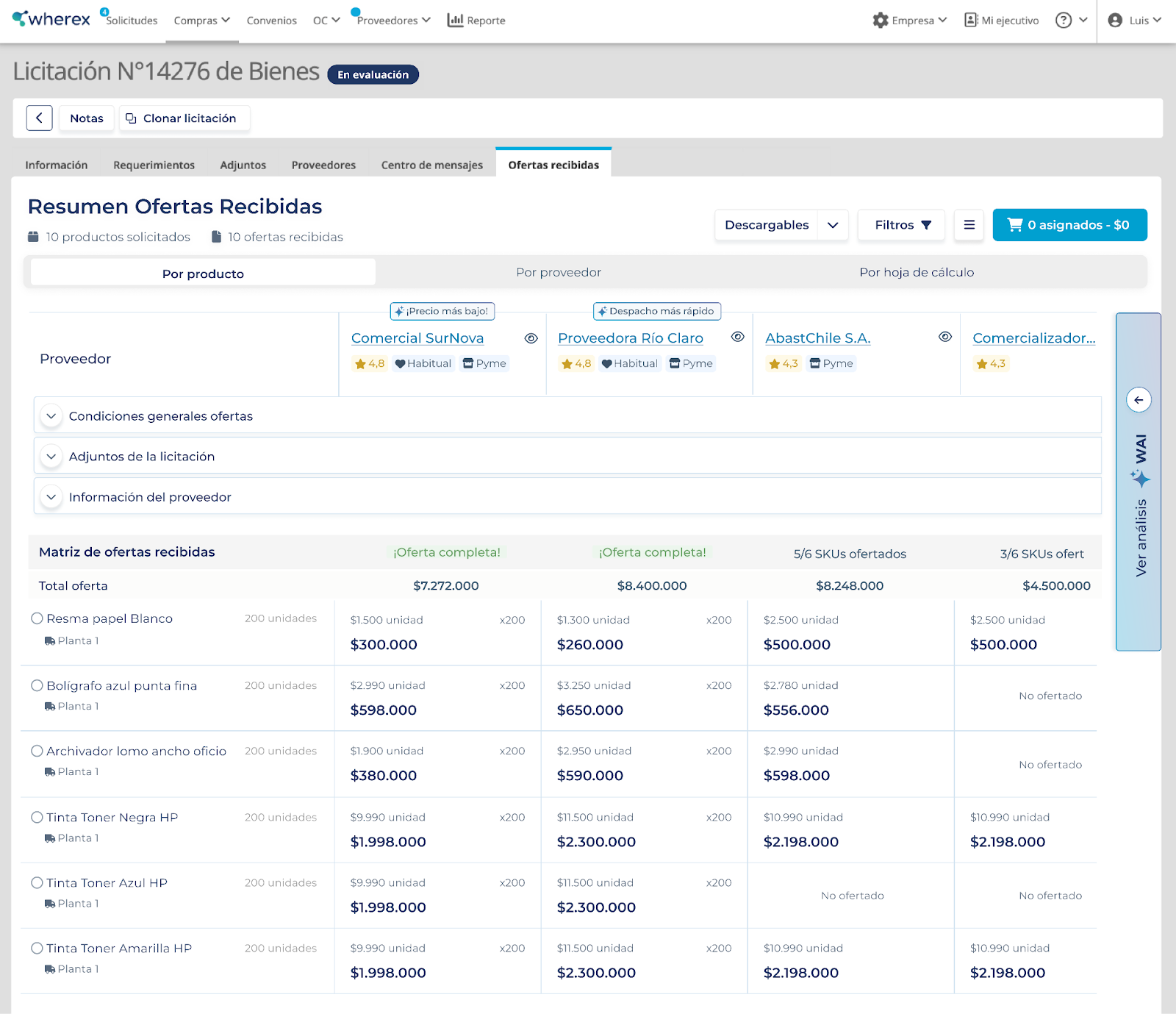
A screenshot of the Wherex platform, buyer side
What type of buyers and suppliers are most represented on Wherex?
On the buyer side, manufacturing, mining, and retail.
On the supplier side, suppliers that sell packaging, personal protection (hard hats, boots, etc) and logistics (suppliers in this category sell a service, not goods).
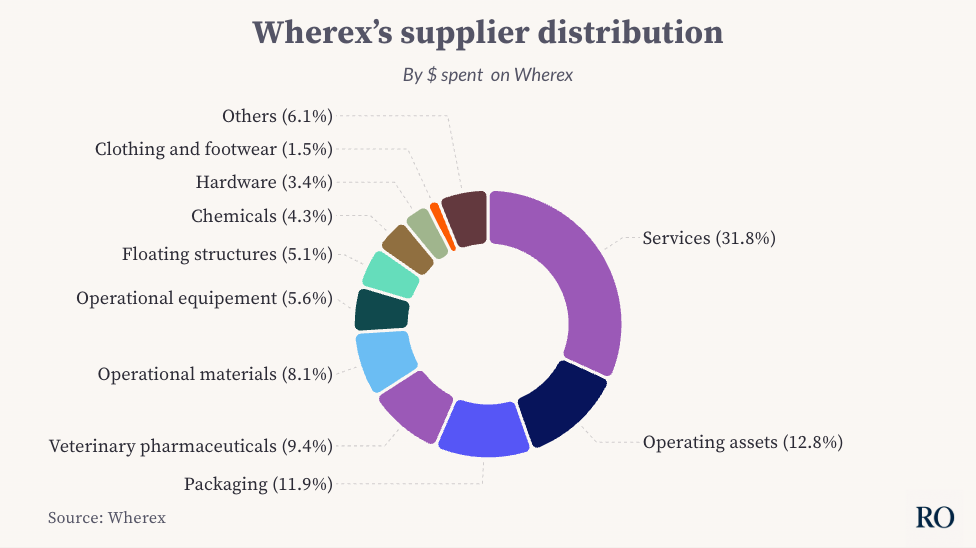
Note: operating assets refer to equipment and machinery required for daily operations, such as forklifts, cranes, fleet vehicles, generators, and industrial pumps.
Source: Wherex
An evident large procurement client would be public institutions (schools, military, etc). Do you serve them?
We used to work with two municipalities, but the law changed and they had to stop working with us. In Chile, for example, procurement for public institutions has to go through a separate platform (MercadoPublico).
We do serve a handful of universities in Chile. We don’t actively seek government clients, but we serve them if they request it.
How does Wherex make money?
We now have three different revenue streams, which we introduced sequentially.
The first is a SaaS fee buyers pay to use the platform. We charge between $3,000-$6,000 per month. This structured and digitized buyer demand.
Then, we introduced a take-rate per transaction, generally between 0.8% and 1.6% of the order value. This is our fastest growing revenue stream. We didn’t charge these fees at the beginning as we wanted to get the flywheel going.
Once transaction volume picked up, we added financing, where we do invoice factoring for suppliers (80%) and reverse factoring for buyers (20%). We want to push into the latter, as we’d prefer to collect debts from large buyers we know well rather than a scattered network of small suppliers across the world.
As we’ll cover later, data from growing the first two revenue streams powers the financing part.
RO Insights: invoice factoring / reverse factoring explained.
Both products are well-known solutions to assuage temporary working capital gaps.
Here’s how William Steele, co-founder of US/Mexican startup Supply Pay, explains invoice factoring in his context:
“Farmers in Mexico who sell their produce to the US get paid months after their produce is delivered. This creates a working capital hole, generating stress and hindering their ability to invest in their business.
Supply Pay funds that working capital hole by “buying” farmers’ outstanding invoices, providing farmers with the cash they’re owed while we collect payment from the end client in due time. This is known as invoice factoring.”
And here’s how he explains reverse factoring:
“It’s the inverse concept, on the importer side. For example, an importer might need a line of credit to extend the payment terms it had promised a farmer. Or, it could need a line of credit to quickly pay a farmer who produces a rare good, and thus prioritizes buyers who pay fast.
Everybody has a good reason to need cash-flow and liquidity, no matter where they sit on the supply-chain.”
Excerpt from Supply Pay: trade finance for Mexican farmers, originally published in The Realistic Optimist
From what I assume, suppliers can’t pay to be promoted to buyers?
We’ve gotten the request from suppliers, but need to think of a way to do it without putting competition at risk.
How have you set up the financing product?
We generate the leads and do the underwriting. Our underwriting data is unique, as it’s based on real procurement and transaction history from a buyer/supplier’s Wherex activity. The marketplace serves the financing product. The latter couldn’t exist without the former.
We pass those leads on to banks and other financial institutions, who extend the financing themselves. We split the interest from the resulting loan. Convincing these lenders that we’re reliable underwriters is a long and arduous process.
In the last couple of years, we’ve extended $200M in financing, with only <0.03% of that amount uncollected.
RO Insights: raising debt as a startup, to then extend financing to customers.
Wherex’s financing offering is embedded in its procurement products.
Wherex doesn’t define itself as a fintech. However, offering a financing product comes with its own peculiarities.
Lending money raised through equity is dangerous, as scaling the lending product implies further equity raises and thus founder dilution.
There is an exception to this if the lending products’ payback periods are extremely short (such as cash-on-delivery financing), meaning money can be quickly redeployed without the need to raise more.
As a founder used to raising equity, switching into a ‘debt fundraising mode’ necessitates a mindset shift.
Here’s how Sebastian Kreis, co-founder of Chilean fintech Xepelin, explains:
“You have to understand how debt providers make decisions. It’s not about you: it’s 100% about them.
Debt providers are more prosaic than equity investors. They’re not buying a dream nor a vision. They’re buying a coherent, predictable, scalable source of revenue.
You need to show debt providers results early. They can’t anxiously wait 12 months to see if their decision was the right one. Xepelin’s products are adapted to that, since they have quick payback periods. For example, our invoice factoring product has an average payback period of 45 days. Then, the challenge is proving scalability: can you consistently repeat early cohorts’ good metrics?
We also built custom tools for our debt providers. We came into the market, explained the opportunity of lending to Xepelin SMEs, and built custom dashboards for debt providers to follow our financing products’ performance. That goes a long way in generating trust and getting over the initial hump.
Our debt providers include international banks, hedge funds, local asset managers… We generally start with smaller players before moving onto institutionals once we have some solid historical data.”
Excerpt from Xepelin: raising $300M to finance LATAM’s SMEs, originally published in The Realistic Optimist
Another long and arduous process must be sales. How have you gone about it?
You are correct. The buyers we serve are large companies and the process we’re addressing is mission-critical. Enterprise procurement sales cycles are long by nature, but once trust is built and workflows are embedded, switching costs become meaningful.
Take Mexico. We recently signed three very large companies there (Grupo Lamosa, Prolamsa, Coflex). Behind my celebratory LinkedIn post hides an almost five year long sales process.
I knocked on these companies’ doors back in 2021. We ran a proof of concept, but our product was immature (I was still contacting the suppliers by hand) and our supplier base was too thin. The experience for these companies was unsatisfactory, but it got the ball rolling.
We continued speaking with them. We launched a community called procure.latam, and invited them to our events. We ran supplier negotiation workshops and invited them. We connected them with relevant parties in the ecosystem. At some point, I asked them how it was going with the legacy provider they’d chosen over us. They said it was not good.
We did another proof of concept, this time with a much better product and pre-existing trust. We ended up signing them.
This multi-year, patient relationship-building is a moat for Wherex. New entrants, should they try, simply cannot shortcut it.
RO Insights: sales strategy for procurement products.
Prima is a Mexican startup that provides manufacturing and construction solutions to USMCA (United States-Mexico-Canada) enterprise clients.
Similar to Wherex, their clients are large companies making important procurement decisions. The complexity of those sales demand an advanced, professional, technically-literate sales force. You can’t send 10s of junior SDRs and hope for the best.
Here’s how Juan Pablo Ramos, co-founder of Prima, explained it to us:
“Our prospects are making consequential procurement decisions. Sales cycles are long, technical, and complex. They require contractual sophistication and financial engineering.
We’ve assembled a team of senior and experienced business development executives. Additionally, we’ve built a deep network of commercial ambassadors composed of industry veterans. That boosts the generation of trust, this industry’s bread-and-butter.
Contrary to a classic SaaS product, every sale is different. We don’t come in with a product, run a demo, and get the prospect to buy. We’re either competing on an RFQ, or granularly scoping a new project with a client. Metrics like CAC and LTV are hard to measure. Establishing a repeatable and predictable sales process is difficult. On the flip side, once you deliver a project on time and in full, that same client will likely place future orders.”
Excerpt from Prima: revitalizing Mexico’s manufacturing industry, originally published in The Realistic Optimist
What does expansion look like for Wherex?
We serve 150 buyers today and want to get to 1,000. Local e-commerce giant MercadoLibre has recently entered the LATAM B2B segment, which grows and educates the market for what we’re selling.
We’d like to attain $10B in transaction volume by 2030. This demands more than just “logo growth”, but also increasing transaction/financing volume per existing client. This can be achieved by growing the categories of products/services we offer, as well as intentionally expanding “within” existing clients’ organizations.
We aim for the Wherex product to become a “source-to-pay” solution, serving all parts of the procurement process. In Chile, we already have all the core building blocks live: supplier portal, structured RFQs, three-way match (which ensures that what a company ordered, what it received, and what it’s being billed for are aligned before money leaves the company), and financing. We’re expanding to other markets with those same blocks, instead of reinventing the wheel every time.
From a product perspective, we’re not trying to become a fintech. Our financing product simply increases transaction liquidity and monetizes transaction flows that are already happening on Wherex. Moreover, it would be wasteful not to use the goldmine of unique underwriting data we’ve accumulated.
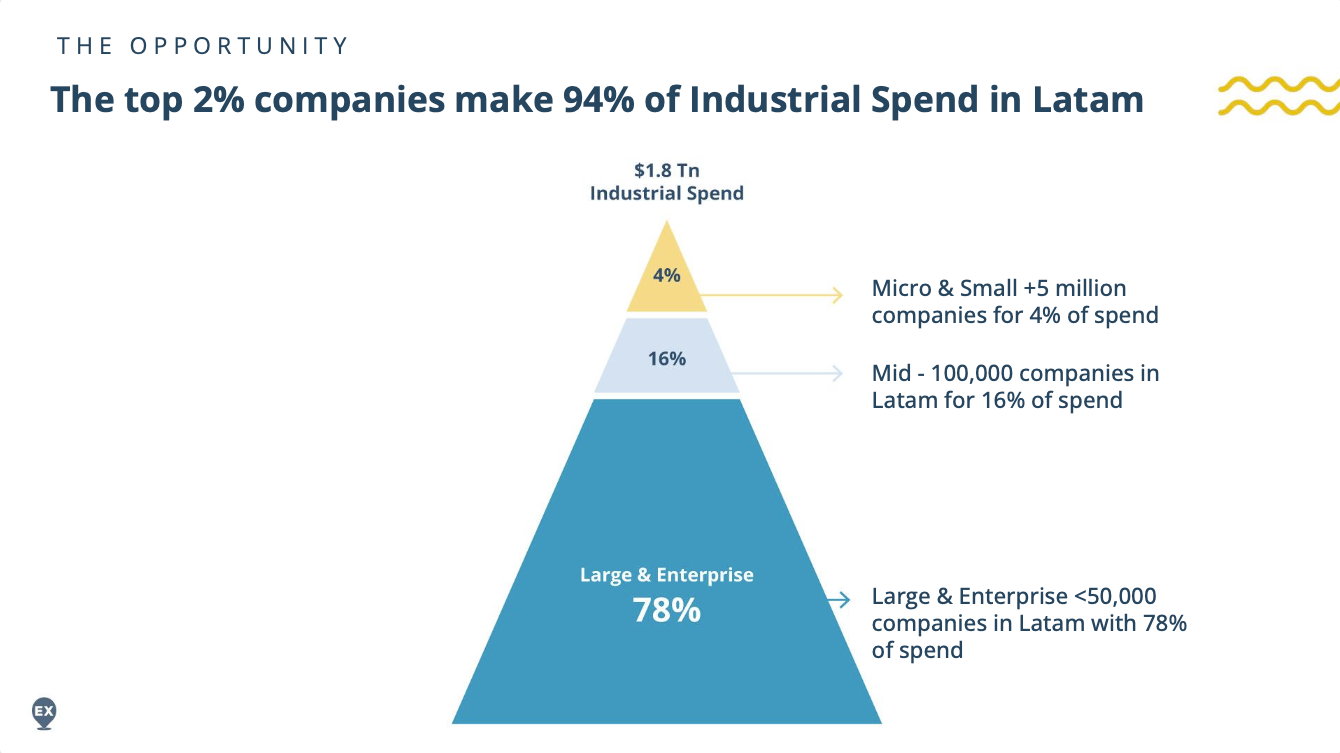
Source: Wherex, old deck
Wherex was started to reduce bribes in the procurement process. Has that held up?
The advantage of a transparent procurement software accessible by the entire company is that it’s harder to hide bribery. Wherex helps teams notice irregularities in their procurement processes more efficiently.
I do want to state that corruption is not a LATAM-only phenomenon. It also happens within large American companies’ procurement processes.
What’s your thorniest operation challenge?
Handling the deluge of quotes we get from suppliers.
The sheer volume is a challenge, but the tougher challenge is structuring complexity. We process millions of quotes across hundreds of buyers, multiple countries, and hundreds of categories, many with highly specific SKUs. Turning that into clean, comparable data is a hard technical problem.
We’ve invested heavily in automation and AI to categorize products, normalize specifications, and guide decision-making. Most of the workflow is automated today, but we still have a team of about 15 people who handle edge cases, supervise quality, and continuously train the system.
The real challenge is turning massive amounts of unstructured commercial data into structured economic intelligence.
You’re a marketplace. Do you take care of the actual delivery for goods sold on Wherex?
No, we don’t handle logistics today. That’s intentional. It's in the pipeline, for soon.
Our roadmap has always been sequential: first digitize procurement, then build marketplace liquidity, then structure transactions and financing. Logistics is a logical next layer, but we’ve prioritized building the informational and financial infrastructure first.
What’s been your international expansion strategy so far?
All of our buyers are in LATAM (in Mexico, Chile, Colombia, and Peru). We’re not opening new markets for now. If we were to expand to the US on the buyer side, we’d need to raise a chunky Series B.
On the supplier side, we’re much more international. We have suppliers in 60 countries, including the US.
What’s been your biggest strategic mistake?
Delegating the opening of the Colombian market to a country manager. As a young company, opening a new country from scratch is so hard that the founders simply need to be on-site to kickstart operations.
What’s the most common investor pushback you get?
That we shouldn’t be a marketplace, but rather a “procurement operating system” for buyers.
We say that for a procurement operating system to exist in the first place, we need a marketplace. That’s what aggregates supply and demand, and gives us the underwriting data which powers the financing product.
The marketplace is our moat. Meticulously crafting a large, trusted base of suppliers on a single platform is something a new entrant cannot replicate immediately. The proprietary underwriting data our marketplace gives us strengthens that moat.
As a founder, what are you doing drastically differently at Wherex compared to your previous startup?
The first startup I founded (the YC-backed, co-living one) wasn’t mature. Our focus was pure velocity, assuming we’d figure out structure later.
At Wherex, I think much more about sequencing. What has to be true before we scale something? What foundation needs to be in place so that growth compounds rather than creates fragility?
I’m also more conscious about building systems instead of reacting to opportunities. That applies to hiring, product development, and even geographic expansion. We don’t grow for the sake of growth, we grow once the underlying unit works.
The biggest shift is that I now think in terms of durability. We’re building infrastructure for procurement in LATAM. That requires patience, discipline, and long-term alignment, not just speed.
We have a board, which helps with the planning. We’re diversified geographically and revenue-stream wise which helps with organizational resilience.
What’s something I should’ve asked you which I didn’t?
The Mexican market truly seems to be the hardest in LATAM. I’ve spoken to many other founders who share that opinion.
In B2B specifically, Mexico is an intensely hierarchical market. Decisions come from the very top. Mexicans don’t know how to say no, so sales processes are long and ambiguous. In Mexico, my current strategy is simple: build trust with prospective buyers, period. Another quirk: Mexicans love having meetings in person.
Mexico is also not as digitized as one would think, despite its proximity with the US. In our sector at least, we’ve found Chile and Peru to be more digitized, leading to shorter sales cycles.
Disclaimer: all internal company metrics shared in this article are claims from the interviewee. They have not been independently verified. Do your own due diligence.
The Realistic Optimist’s work is provided for informational purposes only and should not be construed as legal, business, investment, or tax advice.