
Dear reader,
As a European myself, our VC ecosystem's tendency to deify the US one is frustrating.
The US and Europe have made fundamentally distinct societal choices. Our economies aren't organized the same. The values our respective governing bodies stand for blatantly differ.
The question this RO Long Read seeks to answer is: how can Europe create a late-stage VC ecosystem that fits European values rather than blindly replicating the US' methods?
Answering this question starts with precisely understanding why US late-stage seems to overwhelmingly "dominate" European late-stage today.
Without further ado, please enjoy part I of this RO Long Read.
Biography
This article was written by RO’s Europe Correspondent, Hélène Ghosn.
Based in Paris, Hélène knows the startup ecosystem from both sides, having worked as a VC analyst at Serena Capital and as the CEO's right hand at Virgil.
This RO Long Read draws on months of interviews with investors, founders, and institutional actors. Serena is among the funds discussed in this piece; this article was produced independently and reflects no commercial or editorial partnership of any kind.
A common narrative holds that Europe’s late-stage ecosystem lacks the financial depth to compete with the United States’.
However, if the issue is lack of capital, how can we explain the launch of the €5B Scaleup Europe Fund, or the $1B funding round raised by AMI? If Europe has the capacity to finance late-stage ventures, why does the transatlantic gap persist?
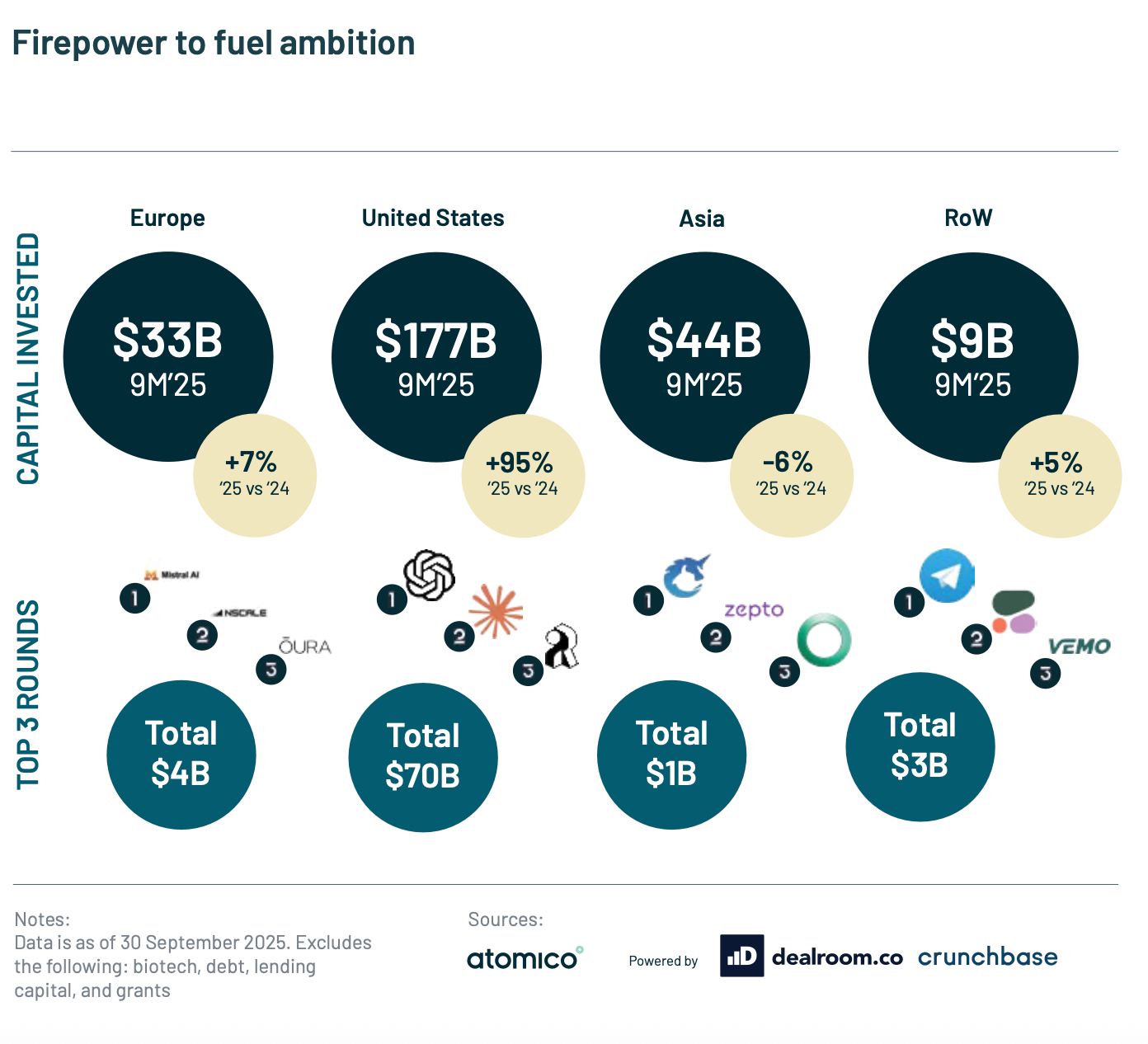
The issue is a difference in sheer volume rather than a lack of capital. The US ecosystem simply enjoys deeper capital pools than the European one. That translates into higher investment capacity. Numbers back this claim: in the first nine months of 2025, the US attracted $177B in VC, whereas Europe raised only $33B.
But this would miss a significant part of the explanation. The divergence isn’t solely quantitative, as the two ecosystems also differ in nature. The US and Europe organise and mobilise their resources differently, and these institutional differences produce different economic outcomes.
This is particularly visible in VC. In the US, the innovation ecosystem is intertwined with a defence-driven model and sustained by vast pools of private institutional capital. In Europe, by contrast, welfare structures have shaped both pension systems and public-private capital formation.
It thus makes little sense to assess both systems with the same standards. Europe’s late-stage dynamics cannot be understood without examining how its capital is structured, how long-term risk is financed, and how its institutional configuration differs from the American model.
The purpose of this RO Long Read is to explore how Europe’s unique architecture shapes its late-stage trajectory and what this implies for its ability to compete on its own terms. To do so, we’ll scrutinize multiple angles:
- Is Europe’s reliance on American investors at later stages a structural weakness or market logic?
- Should Europe compete head-on at late stages, or lean into its early-stage strengths?
- Is the EU’s version of the AI race about scale and speed alone, or about shaping systems aligned with European priorities?
Is Europe’s reliance on foreign capital a structural weakness or market logic ?
The prevailing belief points to a paradox at the heart of Europe’s tech ecosystem. The continent benefits from a robust early-stage environment, supported by a dense network of local investors. Yet once rounds exceed €100M, domestic funding becomes harder to secure, and founders increasingly turn to foreign capital.
In the European Union, more than four out of five scale-up deals are led by foreign investors, mainly American and Asian funds. This dependency is particularly visible in capital-intensive sectors such as AI infrastructure, quantum computing, aerospace or climate tech (aka the most strategic ones).
This fuels recurring concerns about sovereignty and technological control. The apparent inability to retain ownership at scale is often interpreted as a structural weakness, a sign that Europe builds but does not ultimately finance its own champions.
On the founder's side, the logic is often more rational than political. At that scale, capital availability tends to outweigh geopolitical alignment. As a German founder raising a Series B in nuclear energy told me: “When you’re trying to build a startup, especially when scaling up, you look everywhere. You just try to get the money.”
For founders, the widely assumed trajectory remains to build in Europe and scale in the US. This sequence is not necessarily driven by European capital deficiency alone. It also reflects a market reality, as the US remains the West’s largest market in terms of liquidity and customers. Regardless of European late-stage’s vigor, ambitious European founders will likely, at some point, set their eyes on the US.
Framing foreign capital’s presence in Europe purely as a symptom of fragility oversimplifies the dynamics at play. Two forces are conflated. One is a genuine late-stage funding gap, linked to the structure of European institutional capital (which we’ll explore). The other is the expected internationalisation of high-growth European startups.
For European founders, taking US capital can therefore both be a response to structural constraints and a rational strategy in a competitive global environment.
The institutional roots of Europe’s early-stage ecosystem
The market logic case rests on a foundation that is often underestimated. Europe's early-stage ecosystem is a genuine competitive asset, built deliberately over decades through institutional choices that progressively shaped a public policy architecture for venture financing.
The cornerstone of this architecture can be traced back to the European Investment Fund (EIF). Established in 1994, it was designed to address structural financing gaps for SMEs and innovation across Europe. Acting as a fund-of-funds investor, it became an LP in many leading European VC funds (EQT in Sweden, Partech in France, Project A in Germany) de-risking the asset class, and de facto helping these VCs raise from private investors.
By 2014, EIF-backed investment activity represented 41% of total VC investments in Europe. This was complemented by a direct leverage effect, as every euro committed crowded in roughly 4x as much private capital. Today, the EIF manages €143.7B in assets, making it Europe's largest LP.
Building on this model, member states developed their own national equivalents. France’s Bpifrance (2012), Germany’s KfW Capital (2018), and Italy’s CDP (2020), mobilized public balance sheets and domestic savings to anchor funds.
Over 2013-2023, Bpifrance invested €10.5B in VC, with ~66% of all French VC funds that raised capital between 2013 and 2021 counting it as an LP. 80% of French startups that raised funds have received Bpi’s support at some point.
But institutional capital alone does not explain the depth of Europe's early-stage ecosystem; it is also powered by a structurally dense scientific workforce. Europe has 2.7M technical/engineering employees, 1M fewer than the US. Tellingly, 8.5% of engineers in European deeptech firms hold a PhD, vs 7.4% in the US, with Switzerland peaking at 18%.
This pool of technical talent is rooted in Europe’s broader social and institutional model. European welfare states structurally reduce the individual risk of long academic trajectories, making advanced scientific training socially sustainable. Take a doctoral researcher at one of Europe's top universities - for example, a German PhD candidate. Theoretically, he or she has no tuition, a salaried public-sector contract with healthcare and pension automatically included, as well as 3 years of guaranteed funding.
In contrast, their counterpart in an American STEM PhD program depends on a system where support is assembled through a patchwork of teaching assistantships, research grants, and fellowships rather than publicly guaranteed. Moreover, entry into these programs typically requires a strong undergraduate degree obtained in a high-cost system, resulting in potentially ballooning student debt. As a result, doctoral training in the United States rests on a pipeline where financial risk is often borne upfront by students rather than collectively absorbed.
This is not to say the US government is absent. It does fund higher education substantially through direct subsidies and competitive research grants from agencies such as NIH, NSF, and DARPA. However, this support lacks the structural guarantees that characterize European public funding, as Harvard's ongoing legal battle with the Trump administration has made plain.
US federal funding for higher education is also concentrated in a small tier of leading institutions. Elite institutions (Harvard, Stanford, MIT) also deploy endowment funds, built from private donations, to supplement their federal support. By doing so, they replicate, for a minority of students, what a welfare state would have provided structurally. This feeds the talent pipeline for firms like Google, Meta, and OpenAI.
Europe's model was never designed to produce such a handful of superstar researchers but to produce talent at scale. Europe’s higher share of PhDs clearly reflects a societal choice in which the production of knowledge is embedded within the social fabric, generating a talent base that is both broader and more accessible than financial incentives alone could produce - yielding a uniquely deep and affordable technical talent pool.
The European investment ethos reshaping the continent’s attractiveness
Beyond Europe's institutional foundations, a subtle force is at work. The ecosystem is also shaped by an investment ethos that places operational depth and long-term accompaniment at its core. An approach that, in an evolving VC landscape, increasingly constitutes a comparative advantage.
Across the continent, a growing number of funds materialize this ethos by building structured operating teams alongside their investment activities. French funds such as Serena, XAnge or Newfund have been among the most explicit in doing so, but the model extends well beyond from Speedinvest in Vienna to EQT Ventures in Stockholm.
While some leading US funds were the first to have their own operating platforms, most notably a16z which pioneered the model as early as 2009, the nature of that support differs meaningfully. The US platform model tends toward scale with media, network access, and recruiting infrastructure designed to serve a large portfolio.
European funds have instead prioritized proximity with former founders sitting with portfolio companies regularly, working through sales processes, hiring decisions, and organizational design. Serena, a French VC fund where I interned, offers a telling illustration of the model’s impact as it reports a 75% Seed-to-Series A conversion rate in its portfolio, against 29% for the broader market.
What's more, this model has diffused far beyond a handful of flagship funds. In France alone, 84 funds had embedded operating professionals as of early 2025, up from 47 in 2019. That may seem modest compared to the US, where 92.7% of funds above $1B in AUM run a platform function, but a comparison in volume would not make much sense. These platforms are built around go-to-market support, marketing and network access, not operational proximity, and the model has been replicated so widely that it is no longer a differentiator. The European version of operational accompaniment, which bets on depth over scale, still is.
This distinction becomes particularly consequential in the current market environment, as the traditional VC model built on capital scarcity is coming under strain. Global PE and VC funds had already amassed a record $2.62T in dry powder as of mid-2024 meaning capital abundance is now the norm rather than the exception. In this environment, the ability to write a large check is no longer a sufficient differentiator.
Combined with Europe’s deep talent pool and strong institutional backing, this investment ethos is increasingly positioning the continent as a credible base for founders from around the world. For years, securing a US VC on their board was the holy grail for European founders. According to an investor at Bpifrance Digital Venture, a marginal but real share of founders are no longer interested in US funds with close ties to the current US administration, or are simply put off by the broader political climate.
In some European founders’ eyes, the US’s aura is timidly beginning to fray. This is new.
This dynamic is also manifested in the decisions of global technology leaders. Yann LeCun's decision to base AMI in Paris after years leading AI research at Meta is perhaps its most high-signal illustration. His move, coupled with the company's record-breaking $1B+ funding round, suggests Europe is an increasingly credible locus for frontier AI entrepreneurship.
Whether this marks a durable rebalancing remains to be seen. But continent-wide efforts such as France's “Choose France for Science” to Germany’s “Global Minds Initiative” show Europe can attract world-class talent, including from the US. The question is whether it can scale this momentum.
Is foreign capital invading or validating?
This strength does not go unnoticed.
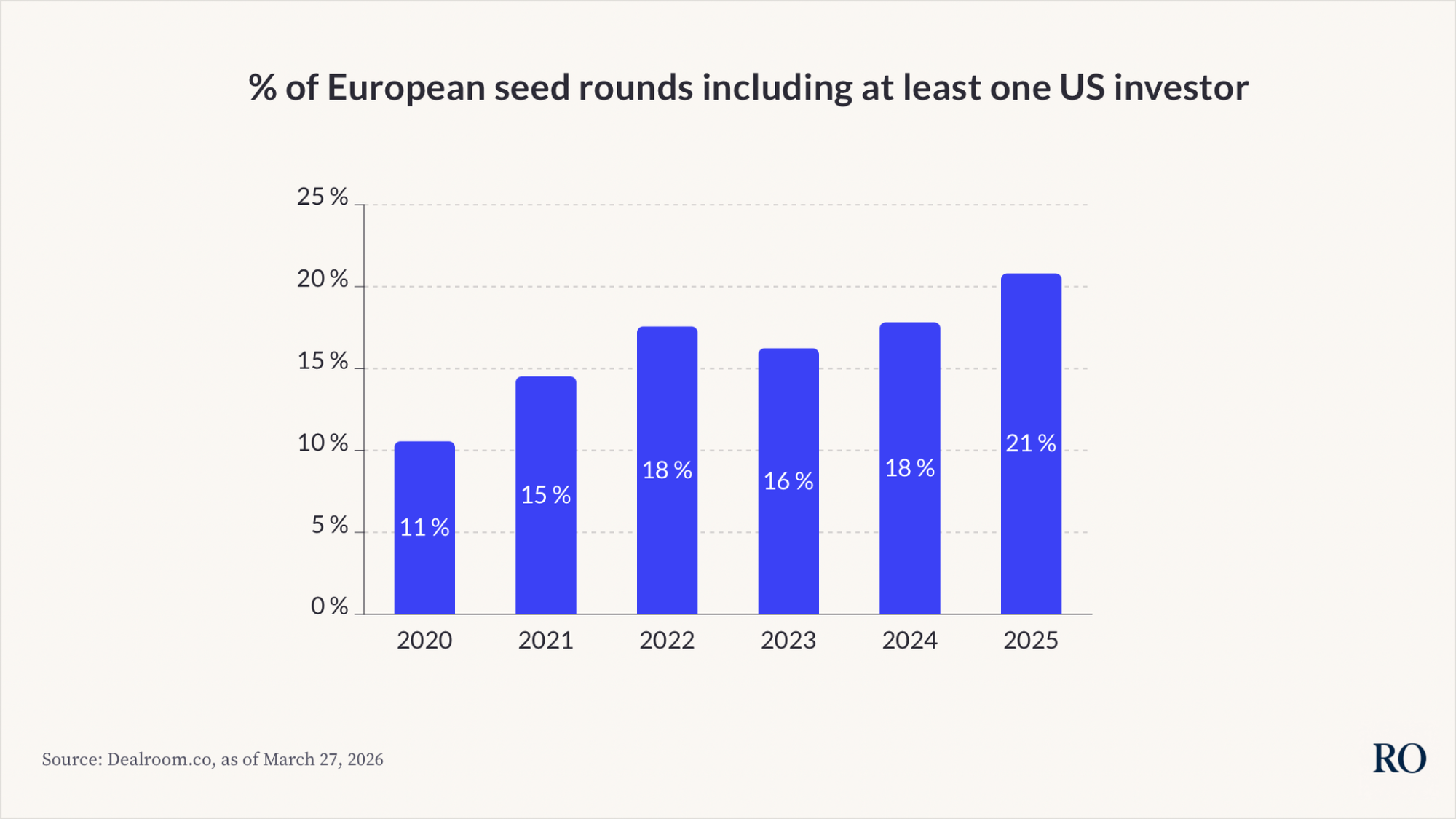
The most telling signal of Europe's early-stage edge comes not from within, but from the investors increasingly drawn to it. What was once primarily a late-stage financial dependence is progressively becoming an upstream competitive dynamic. US presence in Europe is no longer confined to scale-up rounds, as US funds increasingly compete in seed and Series A financing. A French VC analyst recounted losing seed deals to US funds such as Headline (a US fund operating dedicated European teams) or Base10 (a San Francisco-based fund) in 2025, outbid on check size and US market access.
The drivers behind this upstream shift are due to US markets being increasingly saturated at the early-stage since the 2021 boom and subsequent collapse, which left a crowded pipeline of undifferentiated bets. In the context of the AI race, European seed rounds, priced at a significant discount to their US equivalents, offer better risk-adjusted entry points into world-class talent.
That General Catalyst, one of the world's largest VC firms with over $40B AUM, has explicitly targeted pre-seed and seed in Europe, and that Sequoia - which backed Google, Apple and Airbnb - includes Europe as a priority in its newly launched $750M Series A and $200M seed fund, speaks to the scale of this reorientation.
One could be tempted to see this as a form of American encroachment into Europe’s most promising companies. But the same dynamic can also be read as the glass half full, namely as a recognition of the quality of Europe’s early-stage ecosystem.
Samuel Boggio, investor at Hexa Scale, explains it well :
“There’s a real early-stage edge in Europe. The density of high-quality companies is strong, and the average level of founders - especially in AI - is extremely high. That naturally attracts American capital. When you see firms like General Catalyst or Sequoia in the hottest French seed rounds, it’s a sign of the quality of the assets being built rather than a weakness. We should welcome that.”
Source: Dealroom
Seen through this lens, Europe’s reliance on foreign capital appears less as a binary sign of structural fragility but more as the consequence of its integration into global capital markets. The sovereignty question remains legitimate (we’ll get back to it later), but the underlying mechanisms are more complex than financial insufficiency.
An ecosystem built for depth, not for scale
So the market logic case is real, but only tells half the story. The same welfare state foundations that make Europe strong at the seed (ie: built to distribute risk collectively rather than accumulate it) produce the opposite effect at scale, preventing the patient capital that late-stage requires from forming. The result is a continent increasingly unable to finance its own champions.
Take the story of Aleph Alpha. Once hailed as Europe's answer to OpenAI at the seed stage, the German startup raised €500M in a Series B with strong participation from domestic industrial players. But by late 2024, it had to abandon the LLM race entirely. Strategic missteps played a role but so did its pale €500M against the billions raised by Anthropic and OpenAI.
The difference is that American funds can repeatedly deploy checks of hundreds of millions across multiple companies, fully embracing a power law strategy. European investors, by contrast, face tighter capital pools and more limited firepower, reducing their ability to back potential champions.
The gap is even more striking at the top end: the 3 largest US rounds alone account for $70B, compared with just $4B in Europe. While American investment grew by +95% year-on-year, Europe expanded by only +7%.
Source: Atomico’s State of European Tech report
A tale of two retirement systems
Part of the explanation lies in how European economies are organised. They rely more heavily on public intermediation, sporting a more coordinated variety of capitalism than the US. One where the state, not the market, is the default allocator of risk. This is particularly evident in how both continents approach how they fund their citizens’ retirement.
Most continental European economies built their retirement systems on a pay-as-you-go (PAYG) model, where the contributions of today's workers directly finance the pensions of today's retirees. Designed after 1945 as an instrument of intergenerational solidarity, it is a transfer mechanism rather than a capital accumulation vehicle. Germany, France, Italy and Spain are emblematic of this model.
The US made a structurally different bet.
Alongside its public social security system (which is itself PAYG), it developed a vast ecosystem of funded pension plans where workers accumulate capital throughout their careers, which is then invested in financial markets over decades. The PAYG pillar remains substantial, but capital, not the state, became the primary vehicle for retirement security.
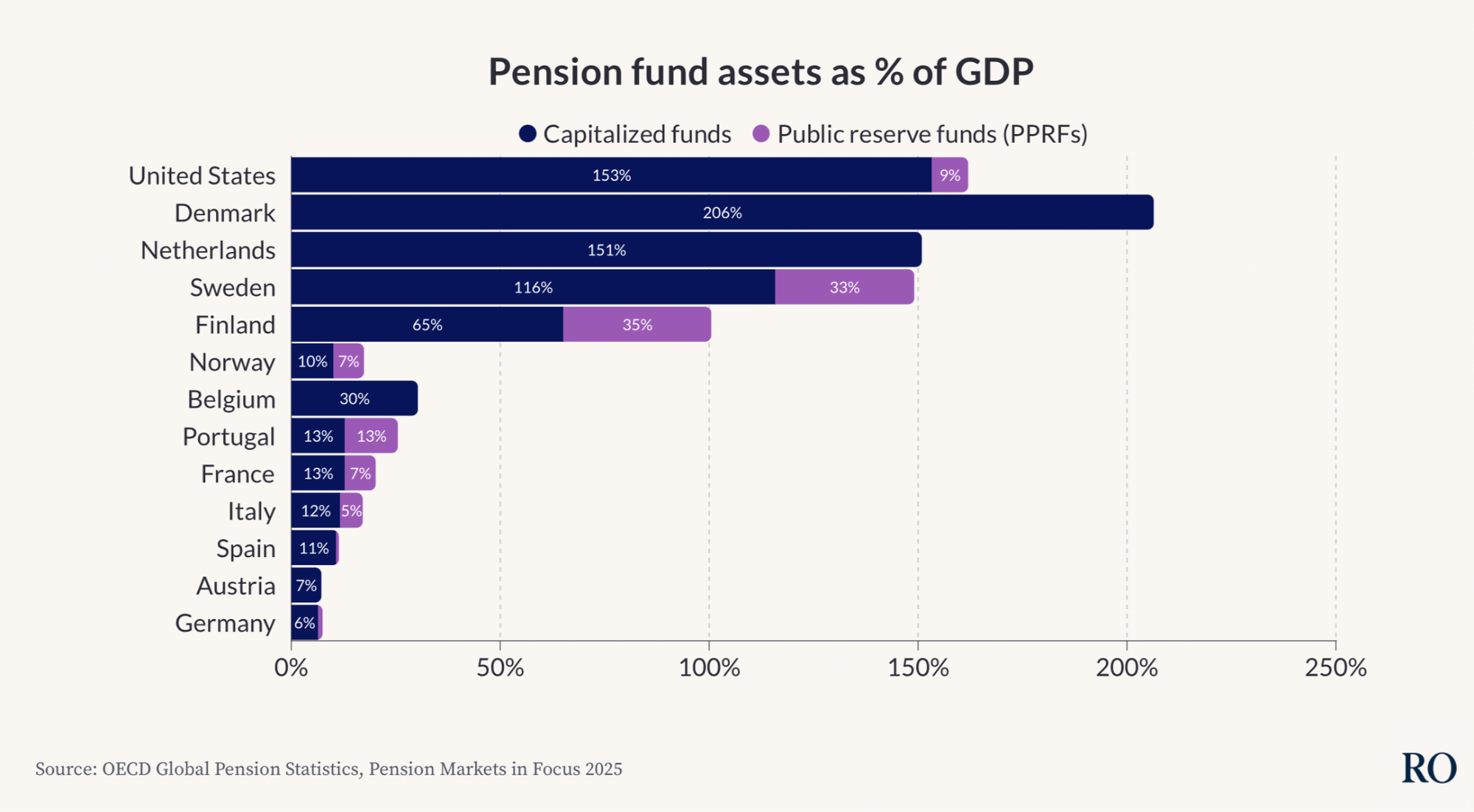
Denmark, the Netherlands, and Sweden occupy a hybrid position between these two models of governance structure. They borrowed the US's capital accumulation logic (making funded pensions the primary vehicle for retirement income) but embedded it within collective governance structures.
Source: OECD, Pension Markets in Focus 2025
Note: Capitalized funds accumulate workers' contributions in financial markets over decades, generating investable pools.
Public reserve funds (PPRFs) are state-managed buffers designed to smooth demographic shocks within pay-as-you-go systems, functioning as a stabilisation tool, not a capital accumulation vehicle.
A non-specialist reader may wonder why we got this far into the architecture of retirement systems while writing about European late-stage VC. The answer lies in a structural peculiarity: pension funds are uniquely suited to VC precisely because their liabilities are long-dated, paying out pensions decades into the future, which allows them to lock capital into illiquid investments and wait years for returns.
Whether a society builds its retirement system around capital accumulation or intergenerational transfer strongly impacts how much patient capital exists to fund its young, innovative companies.
The ERISA legacy
The structural fit between pension funds and VC, however, was not historically guaranteed.
In 1974, the US passed the Employee Retirement Income Security Act (ERISA). Among other things, it required US pension managers to invest as “prudent men”, effectively steering them away from new or unproven ventures.
At the same moment, the VC industry was taking shape, with firms such as Sequoia and Kleiner Perkins raising their first funds. They lobbied hard for regulatory change, and the 1979 amendment to ERISA's prudent man rule is widely credited with unlocking the institutional capital that made Silicon Valley possible.
Europe never had its ERISA moment, at least not at scale. Northern Europe, unlike France or Germany, did succeed in building funded systems. ABP and PFZW in the Netherlands, APG, ATP in Denmark, or Sweden’s AP funds rank among the world’s largest institutional investors. But capital, even when it existed, did not automatically flow toward innovation finance.
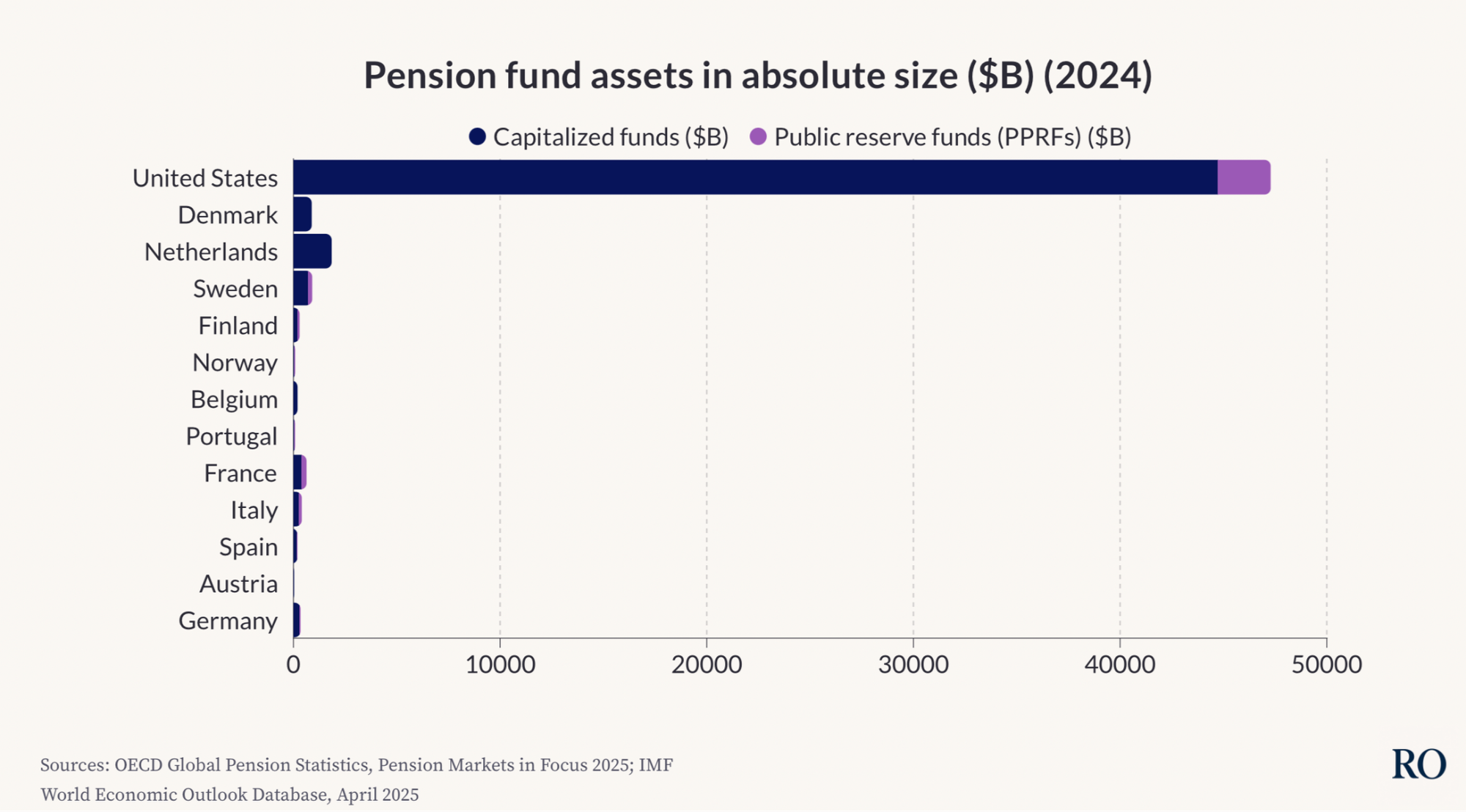
This explains why US pension funds allocate proportionally far more to VC than their European counterparts. Funds like CalPERS - $500B assets under management (AUM) - or CalSTRS - $350B AUM - now allocate roughly 10-15% of their portfolios into private equity, investing around 3x more into VC than their European peers. In 2024, European pension funds invested only 0.009% of their total AUM into VC, compared with 0.028% for US pension funds.
This proportional gap is compounded by an even starker difference in absolute scale. Against a US pension base of nearly $47T, a difference of 0.019 % in VC allocation translates into billions of dollars in additional firepower.
Sources: IMF World Economic Outlook Database, OECD Pension Market in Focus 2025
Find our full calculations here.
The structural gap, therefore, is twofold.
For most continental European economies, the problem is upstream as a PAYG-dominant system never generated the investable pools that capitalized pension funds produce, leaving little institutional capital to deploy into venture in the first place.
For Northern Europe, where funded systems do exist, the pools remain a fraction of US levels in absolute terms, for the simple reason that the underlying economies and populations are incomparably smaller. And even this capital does not flow freely into VC as the constraint is not only one of scale but also one of regulation.
The prudent man's continent
For European pension funds, the regulatory framework operates on a prudent person principle (PPP), which one could liken to ERISA before its amendment. EU member states are free to add rules on top of that doctrine, and the variations are stark.
The European Commission noted that the principle has been "interpreted and implemented very differently across member states, which has often constrained pension schemes in their ability to diversify investments, in particular in equity".
The range is wide, from Finland capping unlisted equity investments at 10% for occupational pension funds, to Belgium imposing no hard limit, operating purely on the PPP.
That the European Commission felt the need to issue a clarification (to encourage more equity allocation) is telling. The current legislation (IORP II) left room for interpretation which was filled differently depending on the country, more often with caution than with freedom to invest in unlisted equity, more precisely in VC.
Where pension funds face an interpretive constraint, insurance companies face an explicit one. This results in the same outcome: capital that could flow into European VC doesn’t.
Under Solvency II, the EU prudential regime for insurers, every €100 deployed into VC required an additional €49 immobilised in reserves - making it prohibitively expensive relative to government bonds with zero charges. Solvency II is also being amended to assuage these issues. The stakes are significant as insurers are Europe's largest pool of long-term institutional capital, with over €10T in AUM, and are, like pension funds, natural long-horizon investors.
The remaining LP sources made of sovereign wealth funds, family offices, and endowments contribute far less. Sovereign wealth funds account for less than 1% of European VC fundraising. Family offices are more volatile and represent only 18% of Europe's long-term investor base. As for endowments, they have no real equivalent in Europe at scale because European universities are predominantly state-funded, leaving no tradition of large private philanthropic pools to invest in venture.
These regulations, coupled with fiduciary obligations toward retirees and an ingrained culture of capital preservation, results in Europe’s unfilled VC potential.
The absence of large domestic exits only deepens this reluctance to commit. In 2025, Europe’s IPO activity reached one of its lowest points since the 2009 financial crisis, according to Bloomberg. The M&A market remains structurally thin, with deal volume across Europe falling 23% year-on-year in the last quarter of 2025.
Capital without conviction
Europe's public funding architecture compounds rather than compensates for this deficit. Support for innovation is dispersed across a constellation of instruments, EU-wide and national-specific, each operating under distinct mandates. The EIC Fund, InvestEU, EIF vehicles, Bpifrance, KfW and CDP all pull in different directions, with no unified strategic logic governing their deployment.
By contrast, the US relies on centralized agencies such as the Defense Advanced Research Projects Agency (DARPA). Established in 1958, it has had the sole mission of financing breakthrough technologies for defense purposes, such as GPS, the internet, or space programs. It is a deliberate industrial policy which results in a coherent pipeline from publicly funded research to industrial deployment.
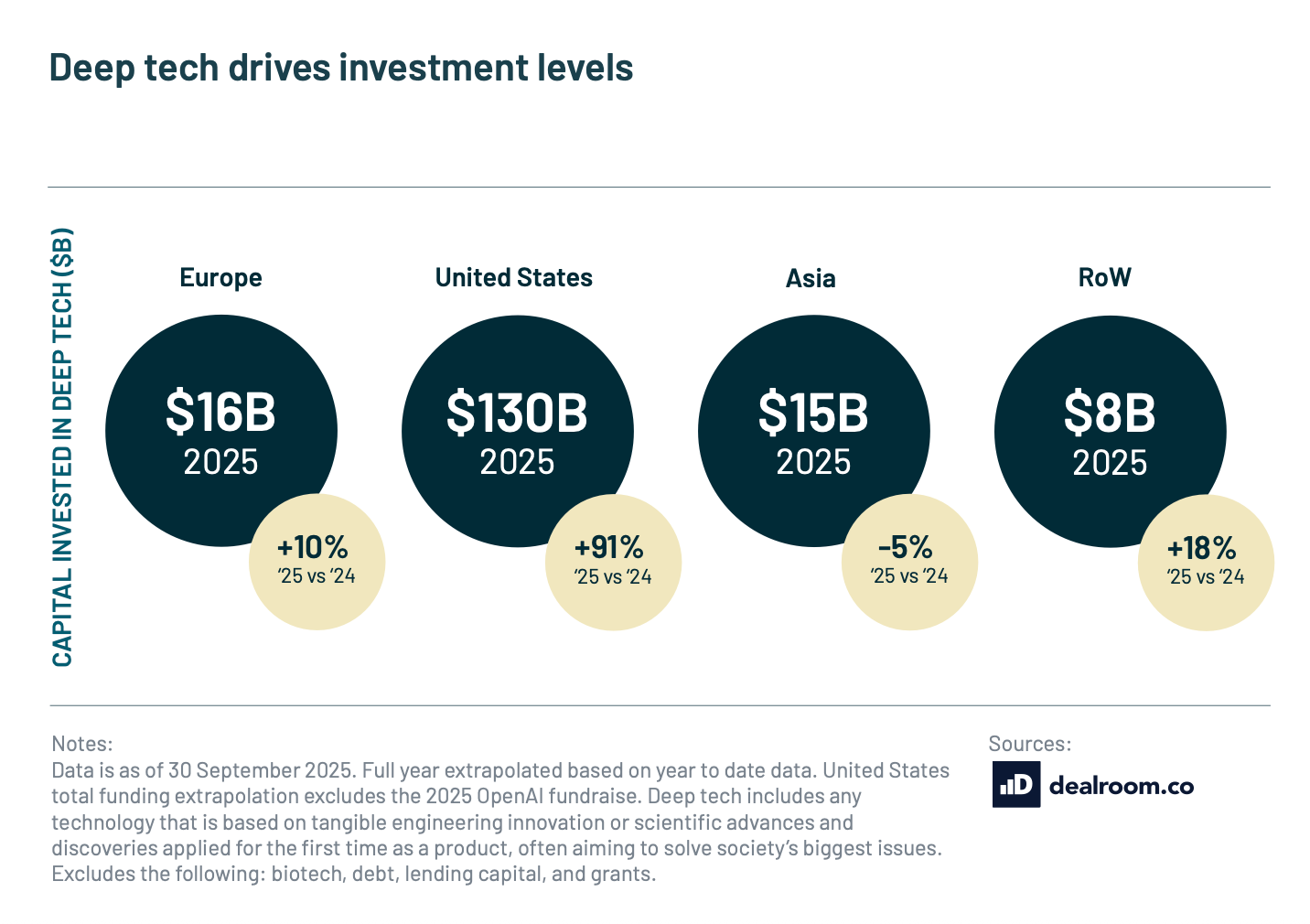
The consequences are most visible in deeptech, where the stakes are the highest. In the first nine months of 2025, US deeptech investment reached $130B, more than 8x the $16B deployed in Europe.
Europe's deeptech venture ecosystem, compared to the US, also has less powerful industrial anchors. These are necessary to de-risk the technology as well as act as early customers and strategic investors before institutional capital follows.
Source: Atomico’s State of European Tech report
Moreover, European stock markets (Euronext, Deutsche Börse, Bolsas y Mercados Españoles) remain nationally fragmented and unable to offer the depth of capital and growth-oriented valuation logic that high-growth tech companies require. America’s Nasdaq, which houses investors accustomed to backing companies on future potential rather than current earnings, can.
That’s probably why both Pasqal and IQM, two of Europe's leading quantum startups, have announced plans to list on it.
Pasqal is adding a Euronext follow-on to reassure its French backers; IQM is considering a Helsinki dual-listing to remain accessible to EU investors. Both moves look more like a concession to their EU backers than a vote of confidence in EU markets, since the scale and revenue multiples they need can only be found in the US. It shows that European capital markets cannot yet support the scaling ambitions of the companies Europe's own research base produces.
In September 2024, Mario Draghi's report on European competitiveness attributed this lack of direction to a structural unwillingness to act collectively, stating that Europe must "start acting less like a confederation and more like a federation."
The (potential?) end of “building in Europe, scaling abroad”
Europe's reliance on foreign capital now clearly appears as a structural weakness more than simple market logic. This was not always problematic. In globalised open markets, the "build in Europe, scale abroad" equilibrium became a workable division of labour between European depth and American scale.
Of course, it raised questions about sovereignty. But these concerns remained secondary as long as the system that made the equilibrium possible held together.
The erosion of the post-1945 open trade system
That system was a deliberate American construction.
Before 1944, imperial powers fought over trade routes, food, and territory, generating +100M deaths in two world wars. But the US-led Bretton Woods conference in 1944 ushered in an exceptional period of globalised trade and capital mobility in which the origin of capital mattered less than its availability. In that system, accessing the American market was structurally easier for founders than integrating the fragmented European one.
Starting in 2013, Europeans gradually understood that their openness had generated asymmetric dependencies with the US, as the Snowden revelations exposed the extent to which US intelligence agencies were intercepting European communications.
In 2018, the EU's General Data Protection Regulation (GDPR) translated that discomfort into regulatory architecture, and Trump's first trade wars made clear that American market access was not unconditional.
As Joel Wajsberg, Senior Mandate Manager at the EIF, explained in an interview for the RO, the Covid pandemic then functioned as a "testing ground" that made the cost of these dependencies suddenly tangible. Previously abstract geopolitical risk was materialized by missing chips and broken supply chains.
Six years later, globalisation is clearly giving way to more regionalised economic environments.
The US itself is retreating from its founding commitments, a result of a decades-long structural shift embodied by both Democrats and Republicans. Biden's CHIPS Act and Inflation Reduction Act poured hundreds of billions into reshoring domestic manufacturing, before Trump's 2025 tariffs made the break with the post-WWII free-trade order explicit.
This regionalisation is shortening supply chains and forcing governments to prioritise technological autonomy. In Europe, this was illustrated by the European Chips Act (2023), aiming to double EU semiconductor production by 2030 and the ReArm Europe plan (2025), unlocking up to €800B in defence spending.
Innovation, once largely driven by global market dynamics, is increasingly shaped by geopolitical considerations. In the semiconductor case, that explains why the US has restricted China's access to Nvidia's most powerful GPUs, the Netherlands has limited ASML's lithography machine exports, and China retaliated by cutting exports of various rare earth elements.
This dynamic is reshaping investment logic within the VC ecosystem. Funds like Plural increasingly frame their mission in extra-financial terms, backing companies like Helsing (Europe's leading defense AI company, now valued at €12B) as evidence that geopolitical conviction and financial scale are not mutually exclusive.
Regrouping
Responding to this new entanglement of geopolitical competition and capital flows would be challenging for any advanced economy. For Europe, it is particularly acute because its openness generated vulnerabilities at every level.
Europe's digital stack remains almost entirely American. Amazon, Microsoft and Google control more than 70% of the European cloud market, while European providers hold under 15% of it. European firms innovate within ecosystems defined elsewhere, ceding intellectual property, data, and scale advantages to foreign players.
This dependency is a reflection of a market that never gave European alternatives the scale to compete. Even within its own borders, European scale remains structurally harder to achieve than in the US.
Doctolib, France's leading healthtech unicorn valued at nearly $6B, knows this friction well. When it launched in Germany in 2016, it took years to gain meaningful traction not because of competition but because of market structure. Indeed, Germany's federal system requires navigating 16 Länder, each with its own healthcare regulation, while established medical software incumbents lock physicians into closed systems. Expanding into a neighbouring European country seemingly proved nearly as complex as entering the US continent.
Multiple attempts have already tried to correct this market failure by delivering a workable pan-European company form. The most recent, EU Inc, proposed by the European Commission in March 2026, goes a step further by allowing any founder to incorporate across all 27 member states in 48 hours for under €100. However, whether it can deliver on its promise without becoming a social dumping mechanism, and whether incorporation reform alone can fix a fragmentation that runs far deeper, remain open questions.
Even if that market fragmentation were solved overnight, Europe would still face a deeper, slower-moving constraint that no regulation can quickly fix. Demographic aging is compressing Europe's future capacity to compete on both capital and talent. As of 2023, the EU is expected to lose around 1M workers each year until 2050, with working-age populations already declining in 22 member states.
As the pool of working-age contributors shrinks, fiscal systems come under strain, leaving governments with less room to fund industrial and technological bets.
A shrinking workforce also means a shrinking talent pool. The competition to attract and retain talent is becoming as consequential as the competition over capital.
For European policymakers, the challenge is therefore to ensure that companies emerging from Europe's ecosystems retain meaningful economic anchoring in Europe. And more importantly, to build the conviction to back them at scale.
Conclusion
Much of this article has mapped Europe's early-stage strengths and its late-stage’s structural constraints. It is important to mention that these constraints exist for reasons.
The same PAYG systems that generate little investable pools for VC also mean that European retirees' wallest are arguably less violently affected by market cycles.
The same prudential rules under Solvency II and IORP II that limit institutional exposure to venture were built to prevent European insurers and pension funds from taking irresponsible investments risks, with the intention of protecting their beneficiaries.
The same regulatory fragmentation that makes scaling across 27 member states so costly is also what forces companies operating in Europe to meet each country's own labour and consumer standards. Without it, a single permissive incorporation jurisdiction would be enough to operate everywhere under weaker standards, systematically undercutting the protections that European citizens have spent decades building.
And finally, the same demographic pressures that compress the talent pool are, in part, the consequence of the welfare systems that made Europe one of the most liveable regions in the world.
The things that make Europe less competitive in VC are, in many cases, the things that make it worth competing for.
Part II will thus set out to answer the following question: how can Europe effectively compete at late-stage without sacrificing its unique societal model?
It will be published in a few weeks. If you'd like to receive it and don't have an RO subscription, feel free to grab one here.
Disclaimer: we have done our absolute best to verify the veracity of all facts we mention. Some facts are more subjective than others and are thus prone to dispute. If you find errors or disagree, please email tim@realisticoptimist.io