

Dear reader,
Tropical.
When you read that word, what comes to mind? Warm weather? Beaches? One too many mai tais in a coconut shell?
Tropical countries are also great places to use the sunlight to produce electricity. As is the case with the startup we cover today. In fact, the “sun” is so essential to their value proposition that it’s in their name.
SunFund helps Filipino homeowners and businesses transition from fossil fuel to solar by financing their solar energy setup.
With just 10 employees, SunFund has financed rooftop solar installations worth PHP 67.84mn (~$11.6mn) in 2025. They recently raised a $500K seed round to expand operations.
I was surprised to find out that the cost of electricity in the Philippines is one of the highest in Southeast Asia. Solar energy, cheaper and more sustainable than fossil fuels, is essential in reducing Filipinos’ electricity bills.
Below is our exclusive 4,000-word+ interview with SunFund’s co-founder John Altomonte.
The full article is available to RO paid subscribers only.
A subscription costs €9/month.
Existing RO paid subscribers work at Endeavor, Seedstars, Sturgeon Capital, Speedinvest, Goodwell, i2i Ventures, Octerra Capital, Razor Capital, Alaya, BFC...
You can grab yours below. We'd be honored to welcome you.
Let’s dive in.
Biography
John Altomonte is the co-founder and CEO of SunFund, a startup providing financing for Filipino households and businesses to install rooftop solar power systems. SunFund recently closed a $500,000 pre-seed round led by Kaya Founders, a Filipino VC.
Before SunFund, John was the president of Verne Energy Solutions, a sustainable energy consultancy firm, and was a consultant with the World Wildlife Fund (WWF). John is an environmental scientist by training.
You’ve been involved in clean energy for over a decade. What led you to identify solar as the space to build a company in?
Before founding SunFund, I ran Verne Energy, a sustainable energy consulting firm. We helped companies reduce energy expenditures and governments improve their renewable energy policies. By 2023, it was clear that the timing, economics, and policy environment had aligned in favour of solar energy in the Philippines.
At a global level, the climate imperative is unavoidable. We need to transition away from fossil fuels toward renewable energy at scale. Among renewables, solar stands out decisively. On a purely economic basis, solar now has the lowest levelized cost of energy of any power source. It’s cheaper than coal, oil, or gas, even without subsidies.
In the Philippines, the case for solar energy is strong. As a tropical country, the Philippines benefits from strong and consistent solar irradiance across the year, with very few geographic constraints (no snow cover, absence of long winters, and minimal seasonal sunlight variation).
Simultaneously, the Philippines suffers from paying some of the highest electricity prices in Asia, especially relative to its GDP per capita.
The combination of a cheap electricity source for a market where electricity is expensive made solar an obvious opportunity for us.
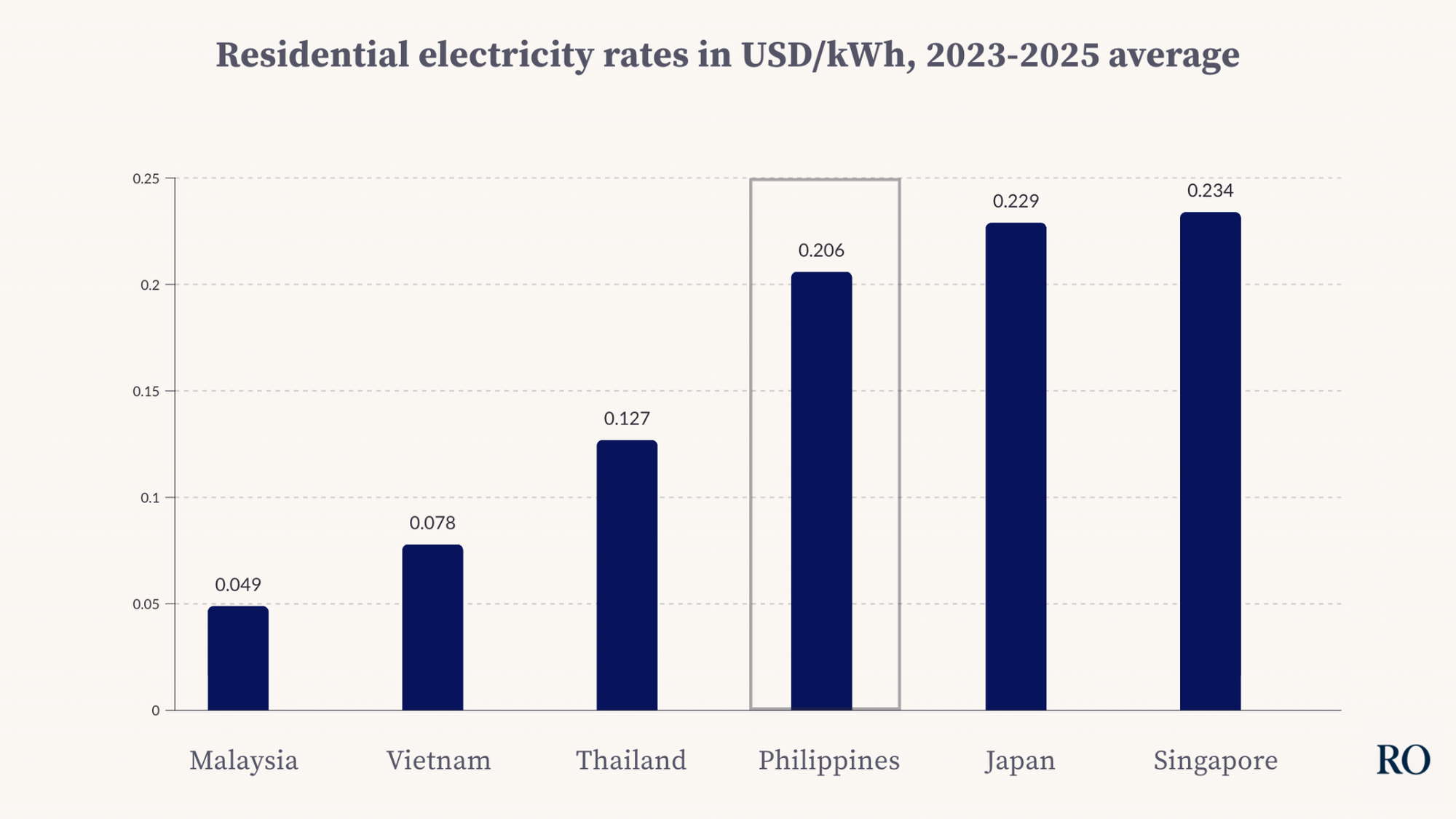
Source: GlobalPetrolPrices – Electricity Prices by Country
How is solar energy perceived by the average Filipino?
A decade ago, solar energy was largely perceived as a new and expensive technology. At Verne Energy, we tested the market early and found significant skepticism. Solar was seen as costly, heavily constrained by regulation, and not a practical alternative to conventional power. Selling it at the time was extremely difficult.
That perception has changed dramatically. Today, solar is far more mainstream. Most people are familiar with it and know someone who has installed a solar panel. Or at the very least, they know it can deliver cheaper electricity. As a result, there is much less need to educate consumers from scratch or convince them of solar’s basic value.
RO Insights: Solar's rise in the Philippines was driven by market failure.
For much of the last decade, solar struggled to scale in the Philippines. The constraint sat upstream in the power market. Electricity procurement relied on long-term fossil fuel contracts. Competitive bidding was limited. Fuel and foreign-exchange risk were passed directly to consumers.
This structure protected incumbents and reduced pressure to lower generation costs. It slowed the adoption of cheaper alternatives.
Meralco, the country’s largest distribution utility, sat at the center of this system. It holds a monopoly over Manila and has exposure across distribution, retail supply, and generation.
According to the Institute for Energy Economics and Financial Analysis (IEEFA), this weakened incentives to pursue the lowest-cost power. These dynamics shaped electricity prices for end-users.
Rooftop solar operates downstream of this system. When grid power is expensive, customer-sited solar becomes more compelling.
The structure has begun to change. Legal challenges pushed utilities toward transparent and competitive procurement. Coal prices rose, and imported fuel became more costly. As these pressures built, solar adoption accelerated.
This shift matters for rooftop solar providers like Sunfund. High electricity prices are the outcome of upstream inefficiencies. Even with higher financing costs, solar can deliver savings because the grid is structurally expensive.
What data points informed the way you designed SunFund?
Two data points stood out: the high electricity prices in the Philippines and the declining cost of solar energy. This mismatch stood out to us. Particularly in the residential segment. On paper, solar should have seen far wider uptake than it did. Yet rooftop penetration remained surprisingly low.
When we looked closely, we realized that the key barrier was financing, not awareness or technology. In other markets with similar dynamics (high electricity prices and cheap solar), consumers have access to multiple financing options. These can be either through banks, development finance institutions (DFIs), or policy-backed incentives. In the Philippines, the dominant option was to pay the full solar system cost upfront in cash.
For Filipino households, that meant prepaying 15–20 years of electricity bills in one go. This wasn’t feasible for most people.
SunFund was built specifically to address this bottleneck. We wanted to tap the demand for cheaper energy (through solar) that already existed, but couldn’t be realized because financing wasn’t available.
Does the Filipino government offer incentives to offset the upfront cost of a solar panel?
For the average homeowner, no, there are currently no government tax breaks or direct fiscal incentives for solar installations in the Philippines.
The primary available incentive is net metering. Under this scheme, households can sell excess electricity they generate back to the grid. This improves the overall return on solar investment, even though the buy-back rate is lower than the retail electricity price. Net metering helps shorten payback periods and makes solar more attractive. But it does not reduce the initial capital cost.
Compared to other markets that offer tax credits, rebates, or accelerated depreciation, the Philippines remains limited on this front. Net metering itself has also faced regulatory friction (approval timelines can stretch up to two years). Whereas in neighboring countries like Malaysia, approvals can take just a few days.
Net metering is a positive and important provision. But the absence of upfront fiscal incentives and regulatory delays is a barrier to faster solar adoption here.
RO Insights: energy startups & administrative friction
In regulated energy markets, startups have to remove the friction placed by incumbents. In the power industry, incumbents are often state-owned.
Take Mexico, where the Comisión Federal de Electricidad (CFE), a state-owned entity, provides the majority of energy to the country.
Niko, a startup financing and distributing solar hardware to households and businesses in Mexico, is reducing the friction created by the CFE.
Raffaele Sertorio, co-founder of Niko, told us:
“One of the administrative complexities of switching to solar is dealing with the CFE. Generally, houses are connected to CFE’s grid. At the end of the month, CFE calculates how much you contributed to the grid versus how much you consumed. You are charged accordingly.
The difference with solar is that you now have a house that produces electricity and can contribute to the grid, so the equation flips. Your house’s CFE meter needs to become bidirectional to account for that change. In many cases, your house’s meter is out of date and needs to be replaced.
This entire process represents a 3-6 week administrative process (including the potential installation of the new meter), which we take care of for our clients.
Excerpt from Niko: scaling solar panels in Mexico, originally published in the Realistic Optimist.
What is SunFund’s solar panel financing model?
The model is designed to remove the upfront cost of going solar and replace it with a simple monthly payment structure.
Instead of asking customers to purchase a solar system outright, SunFund installs the system on their home at no upfront cost. The customer pays a monthly amount for the solar energy they consume. This turns solar into an electricity subscription.
As mentioned earlier, the gap between grid electricity prices and the cost of solar is high. Even after factoring in financing costs and SunFund’s margin, the customer’s monthly payment is still lower than what they would have paid to the grid.
In practical terms, solar displaces a portion of the household’s grid consumption. At the end of each month, the customer’s total electricity bill is lower than it would have been without solar. This is great for the consumer because they see immediate, tangible savings from day one.
How do you assess the creditworthiness of the client?
We use an in-house credit risk assessment framework that we’ve developed specifically for the local market.
In the Philippines, this is more challenging than in many developed markets because a large share of consumers are unbanked or underbanked. The credit data ecosystem isn’t detailed or reliable. This is a common issue for fintech and consumer finance in the country.
As a result, we use a blended approach. We start with standard credit risk indicators (loan repayment histories, payslips…) where available, but we also incorporate factors that are specific to solar and infrastructure finance. These include the characteristics of the property, the quality and suitability of the electrical infrastructure, location-specific factors, and the performance and durability of the solar system itself.
While the full model is proprietary, the key point is that we don’t rely on traditional credit scores alone. We combine conventional credit assessment with asset- and system-level risk factors to arrive at a more accurate view of borrower risk in the Philippine context.
Who is SunFund’s main ICP?
SunFund’s core ICP is homeowners. Specifically, households that own the house and the land where the solar system is installed. This is critical because our contracts are long-term (between 5 and 20 years for homeowner contracts, commercial contracts are longer). Homeownership significantly reduces relocation and counterparty risk.
This is a large and attractive segment in the Philippines. More than 60% of Filipino households own their house and lot, yielding a broad addressable market. Within that group, we’ve worked with a diverse mix of household structures. This includes single-income families, dual-income households, and families supported by Overseas Filipino Workers (where the primary earner works abroad and sends remittances home).
The Filipino government classifies consumers based on income levels from A (high income) to E (low income). We focus on the B and C segments, i.e., the emerging middle-income segments. These households have meaningful electricity consumption, feel the burden of high power prices acutely, and benefit immediately from monthly savings.
While energy is a universal need, our ICP combines three key criteria: homeownership, stable household income (including remittance-based income), and strong sensitivity to electricity costs. This allows us to scale while maintaining credit and operational discipline.
RO Insights: Consumer segmentation in the Philippines.
The customer segments mentioned by John are a useful framework in the Philippines. It is used by startups (like SunFund) and investors alike.
As Raya Buensuceso, the managing director of Kaya Founders (a Filipino VC), puts it,
“The Filipino government uses a consumer classification based on income levels. It segments consumers from A (high income) to E (low income). For us, as investors, only consumers in the A, B, and C1 and C2 segments are realistically monetizable. These are consumers with sufficient spending power.
Aligned with Lightspeed’s 2024 report, we split Filipino consumers into two meaningful segments: convenience-focused A and B power users, and value-focused mass-market consumers.
For startups, this creates two viable pathways to build a meaningful business. Startups can either build for the top ~5% or for the mass market. But “the mass market” in the Philippines has very different spending power from the mass market in the US or China.
Some industries, and the different companies serving them, illustrate this difference.
In coffee, the premium option is the $3 per cup Starbucks, while the mass-market equivalent is something like Pickup Coffee, which sells coffee at $1 per cup. In mobility, Grab costs $4–10, while motorcycle taxis like Angkas are closer to $1. You can build for either segment, but the key is aligning price points and unit economics.
We have made investments in both kinds of businesses.
On the premium side, we have a company called Kindred, a women’s health clinic network. They opened their first branch in Fort Bonifacio (a premium Central Business District outside Manila). Now, they’re looking to expand across the country, with 10 clinics and counting. Their customers generally fall within the A and B classes. Looking at future plans, they’re focused on capturing a larger share of these women’s “health span” by expanding beyond tele-consults and HPV vaccines into services like maternity care and beyond.
On the mass-market side, we have Tomo Coffee, a coffee company that’s similar to Pickup Coffee. They’re priced at around $1–2 (50–100 pesos), and located in hospitals, schools, transit hubs, and BPOs, rather than business centers. Their mass positioning is clear.
Excerpt from The Filipino ecosystem, explained by a Filipino VC originally published in the Realistic Optimist.
What part of the customer journey do you handle?
We’re tech agnostic. We work with EPC (engineering, procurement, and construction) partners who install the solar systems. Once the system is installed, we retain ownership of the solar panels for the duration of the contract and take full responsibility for operations. This includes monitoring the system, after-installation maintenance, customer support, and billing.
One feature of the Philippine market is that it already has a very large number of registered solar installers. This is despite relatively modest overall solar penetration. The EPC segment is highly competitive and operationally intensive, involving inventory management and logistics. We made a deliberate decision not to compete in that space.
Instead, we partner with some of the largest and most reputable solar EPCs in the country who handle system installation and technical execution. This allows us to work with high-quality, trusted operators while keeping our internal focus on what we do best: structuring, underwriting, and scaling solar financing.
This model lets SunFund stay asset-light, avoid unnecessary complexity, and scale faster by leveraging existing installation capacity in the market.
Where does SunFund operate geographically, and how is its activity split between residential and commercial solar installations?
SunFund operates across the Philippines. We’ve installed solar power systems in all three major regions: Luzon, Visayas, and Mindanao. We’re not geographically constrained because we partner with EPC companies.
Most of our residential installations are concentrated in the Greater Metro Manila area. This is largely due to regulatory practicality. Net metering approvals tend to be faster and more predictable in Metro Manila compared to other regions. While we are open to installing anywhere in the country, these regulatory differences influence where residential demand is currently easiest to serve.
The number of installations is higher for residential properties than for commercial properties. But in terms of installed capacity (i.e. electricity output), the split tilts more towards commercial properties. This is because a single commercial system can be equivalent to the size of 30 residential installations.
Strategically, our primary focus remains residential solar. The residential segment is significantly underserved when it comes to financing options. Commercial projects typically have access to bank financing and other capital sources. Our goal is to address this financing gap in the residential market, which is where we believe SunFund can create the most impact.
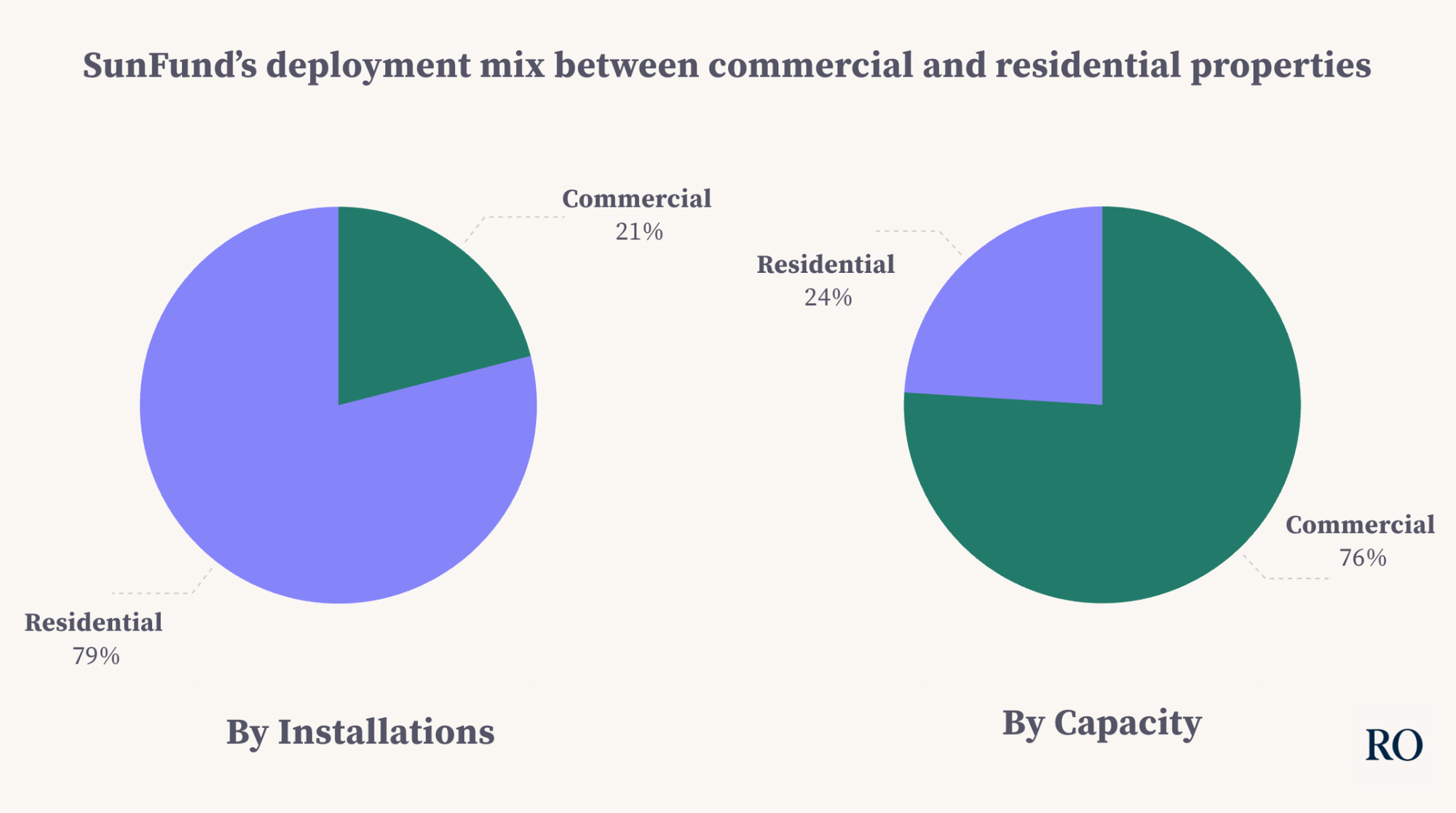
Source: SunFund
RO Insights: Solar startups using EPC providers as lead-gen.
SunFund uses EPC providers to remain asset-light. But EPC providers also provide another key benefit to solar financers: lead generation.
Rivy (formerly Payhippo), a solar finance startup in Nigeria, uses solar installation companies to install solar equipment in Nigerian homes and businesses. These installers are a crucial growth lever. They recommend Rivy to homeowners and businesses looking to finance solar equipment.
The installers’ recommendations work so well that Rivy focuses its sales efforts on acquiring installers.
As Dami Olawoye, the CEO of Rivy, said,
“Working in tandem with installers (...has been our most efficient growth lever). These companies, which we serve via the inventory financing product, are the largest lead generation driver for our asset and microgrid financing products.
As a result, a lot of our sales efforts are focused on acquiring these installers, since they are the kernel of our business model.”
Excerpt from Rivy: financing solar in Nigeria originally published in the Realistic Optimist.
How does your pitch change from a commercial property owner to a residential property owner?
With commercial property owners, the conversation is largely financial. Decisions are driven almost entirely by economics (the savings of solar versus fossil fuels). The focus of the pitch is on clear, measurable financial outcomes.
With residential customers, savings are still the core value proposition, but additional factors play a much bigger role. Energy security is another important consideration, especially when the systems we offer include battery storage. This helps households manage power interruptions and outages (which are common in parts of the Philippines). Sustainability is also a meaningful driver, as many homeowners want to make a conscious shift toward renewable energy.
How does the battery component fit into SunFund’s revenue model?
SunFund’s core business remains the financing of rooftop solar installations. That is the primary entry point for customers and where the majority of our focus is.
However, we’re seeing increasing interest from existing customers in post-installation upgrades such as system expansions and battery add-ons. These are evaluated on a case-by-case basis, depending on a customer’s consumption patterns, energy usage profile, and overall economics. Batteries are core to post-installation upgrades.
We view batteries and other after-sales services as potential revenue extensions rather than the foundation of the business.
RO Insights: The commercial importance of batteries for solar energy.
The critique against solar is lack of reliability and consistency. Solar energy works when the sun is shining. But after sunset, when demand for electricity peaks, it isn’t reliable. This has reduced its attractiveness for consumers.
According to BloombergNEF’s analysis (The Philippines’ Path to Clean and Affordable Electricity), pairing solar with four-hour battery storage makes solar competitive with new coal and gas plants. Batteries eliminate fuel risk and price volatility (of coal). The report predicts that by 2030, solar energy with batteries would be the cheapest dispatchable power generator.
An excerpt from the report reads,
“In addition, the Philippines can accelerate the deployment of small-scale standalone batteries and rooftop solar-with-storage by residences and businesses. This can be done initially through subsidies and rebates. In the longer term, market-based mechanisms such as ensuring electricity consumers are paying the real cost of energy are more financially viable.”
Solar energy facilitators bridge the “reliability” gap with batteries. Which is precisely why SunFund has added it to its product suite.
When do customers start requesting upgrades or additional capacity?
Upgrade requests tend to arise after customers begin experiencing savings from solar. When electricity becomes cheaper, households tend to increase energy consumption. This is known as “energy lifestyle creep.”
As demand rises, some customers realize their original system no longer fully meets their needs. This triggers system expansion requests. We’ve seen this pattern repeatedly: lower energy costs lead to higher usage, which then drives demand for upgrades.
How large is battery adoption within SunFund’s customer base?
At present, batteries are not yet a large part of our installed base because they’re expensive. Moreover, they don’t generate savings. In many cases, the total cost (financing + battery) is roughly at parity with grid electricity, or slightly higher. That is why our pitch when selling batteries is for energy security rather than cost savings.
Our residential customers are concentrated in the Greater Metro Manila area, where the grid is reliable. Here, households are unwilling to pay a premium for backup power when outages occur only a few days per year.
We do expect this to change over time as we expand outside Metro Manila, where power interruptions are more frequent.
What is your biggest operational challenge?
Access to capital. Our model requires significant upfront financing to fund solar installations. Scaling thus requires raising consistent capital.
Demand is not the issue. Our project pipeline is almost always larger than what we can immediately fulfill. The real bottleneck is ensuring we have enough capital to finance those assets. This involves working continuously with financial institutions, private equity funds, venture capital firms, and other capital providers.
The challenge is amplified by the high cost of capital in the Philippines. The weighted average cost of capital for solar projects in advanced economies ranges between 5 to 6.5%. In the Philippines, we’ve found that cost to be around 12-20% for us (because of higher currency risk, regulatory uncertainty, and more expensive local financing). That gap directly affects project economics.
How much has SunFund raised so far, and what is that capital being used for?
We raised a pre-seed equity round of $500,000 led by Kaya Founders. This will be used to support operations, growth, and product development.
The capital to fund solar installations comes from debt capital. I can’t disclose the exact amount of debt raised. The separation of the equity versus debt utilisation is deliberate. Debt funds the hardware and installations. Equity supports the company’s ability to scale sustainably.
Our contracts are long (between 5 and 20 years). This gives us time to build a long-term client-facing business and a team that scales as our client numbers grow. Equity capital supports hiring, systems, and operational capacity to manage these relationships.
Beyond core operations, part of the equity is also being deployed toward strategic expansion. We’d like to add more revenue streams, including after-sales services, virtual power plants (VPPs), community solar, and energy efficiency offerings in partnership with energy service companies (ESCOs). These initiatives depend heavily on how the regulatory environment in the Philippines evolves.
I look at SunFund as a distributed energy utility company. One that manages consumers and prosumers, and delivers sustainable power across the Philippines.
What are your future expansion plans?
In the near term, our focus is on the Philippines. We aren’t looking to expand into other markets because energy systems across Southeast Asia are different. In many neighboring countries, electricity is dominated by state-owned utilities. Transmission and distribution of energy are less fragmented. If we had to enter those markets, we would have to build a company from scratch.
The Philippines offers a large and underpenetrated residential rooftop solar market. Realistically, we expect to spend the next three to five years focused on deepening our presence within the Philippines.
RO Insights: Utility-scale solar vs rooftop solar.
Utility-scale solar and rooftop solar look similar. They work differently.
Utility-scale solar is built at scale with large plants at central locations. Power is sold into the grid. Costs are low because projects are standardized and benefit from size. This makes utility-scale solar ideal for lowering wholesale electricity prices and replacing fossil fuel generation at the system level.
Rooftop solar is installed at the point of use (eg, homes, offices, factories, etc.). Power is consumed directly where it is generated. In rooftop solar, costs are higher per unit because systems are smaller and customized.
SunFund focuses on rooftop solar paired with storage (through batteries).
When looking at different markets, what macro factors do you focus on?
The most important factor is the cost of electricity. We also look at the residential market size and the fragmentation of the energy system.
In the Philippines, households pay nearly double more for power than households in Malaysia, Indonesia, or Vietnam. That large price gap is what allows our model to work. We can absorb a relatively high cost of capital, maintain margins, and still deliver savings to customers.
If we took our current cost of capital and applied it to those lower-cost power markets, our value proposition wouldn’t work. We wouldn’t be able to guarantee savings, which is core to our model.
Unless the economics support clear customer savings, expansion doesn’t make sense.
What is foreign investors’ perception of the Filipino renewable energy space?
It’s broadly positive and improving.
The Philippines has recently opened its renewable energy sector to 100% foreign ownership. This reduces structural risk by removing the need for joint ventures or local co-investment arrangements. It makes the market more accessible and attractive. Investor confidence is up because of strong macro fundamentals (high electricity prices, growing power demand, and competitiveness of solar energy).
In the next three to five years, we’ll see more foreign direct investment into the Filipino renewable energy space.
Disclaimer: all internal company metrics shared in this article are claims from the interviewee. They have not been independently verified. Do your own due diligence.
The Realistic Optimist’s work is provided for informational purposes only and should not be construed as legal, business, investment, or tax advice.