

Dear reader,
On one hand, you have the high-brow, frontier AI research. For mere mortals like myself, that field is difficult to intellectually engage with.
On the other hand, you have the implementation of AI in brick-and-mortar industries. Here, my interest is piqued. That process is tangible, messy, intensely human. Stuff we love to write about.
Today, we publish a deep-dive on Sanii, a Brazilian startup focused on the elder care market.
Sanii represents what running an "AI-powered" company means in a "human-powered" space - elder care. On the same day, Sanii's team is developing AI agents and dealing with an angry client who felt that their careworker was rude to them.
Sanii is also pioneering a new form of startup-building: an "AI roll-up". Or in more pagan terms, acquiring existing service businesses (in their case, small Brazilian home care agencies), and improving them with AI.
Sounds antithetical to the VC ethos? Maybe. Maybe not. I'll let you judge. Enjoy the read.
Biography
Michael Kapps is the co-founder of Sanii, a Brazilian startup providing home care for the elderly. Sanii onboards careworkers onto its platform, puts them in touch with families needing their services, and intermediates the relationship between them.
Sanii raised $2.5M in pre-seed funding and expects to provide more than 500,000 caregiving hours in 2026. It is currently active in 5 Brazilian cities, including São Paolo and Campinas.
Prior to Sanii, Michael founded Vitalk, a mental health startup acquired by WellHub in 2022.
What does Sanii do?
We’re an “Uber for home careworkers”, a managed marketplace of sorts.
We have a roster of vetted careworkers that we connect to families needing home help for their elderly. We manage the coordination, the scheduling, the planning, the payment, the admin… Families pay us, we take our cut (40%), and then we pay the careworkers.
Additionally, we provide tech tools both for careworkers and for clients. The Sanii team remains involved in solving inter-personal conflicts (such as when a client dislikes their assigned careworker). These need human sensitivity to be handled correctly.
Careworkers generally work 12h to 24h shifts. All families pay out of pocket, as we’re not reimbursed by public nor private health insurance schemes. We sometimes have families selling or refinancing their homes to pay for Sanii.
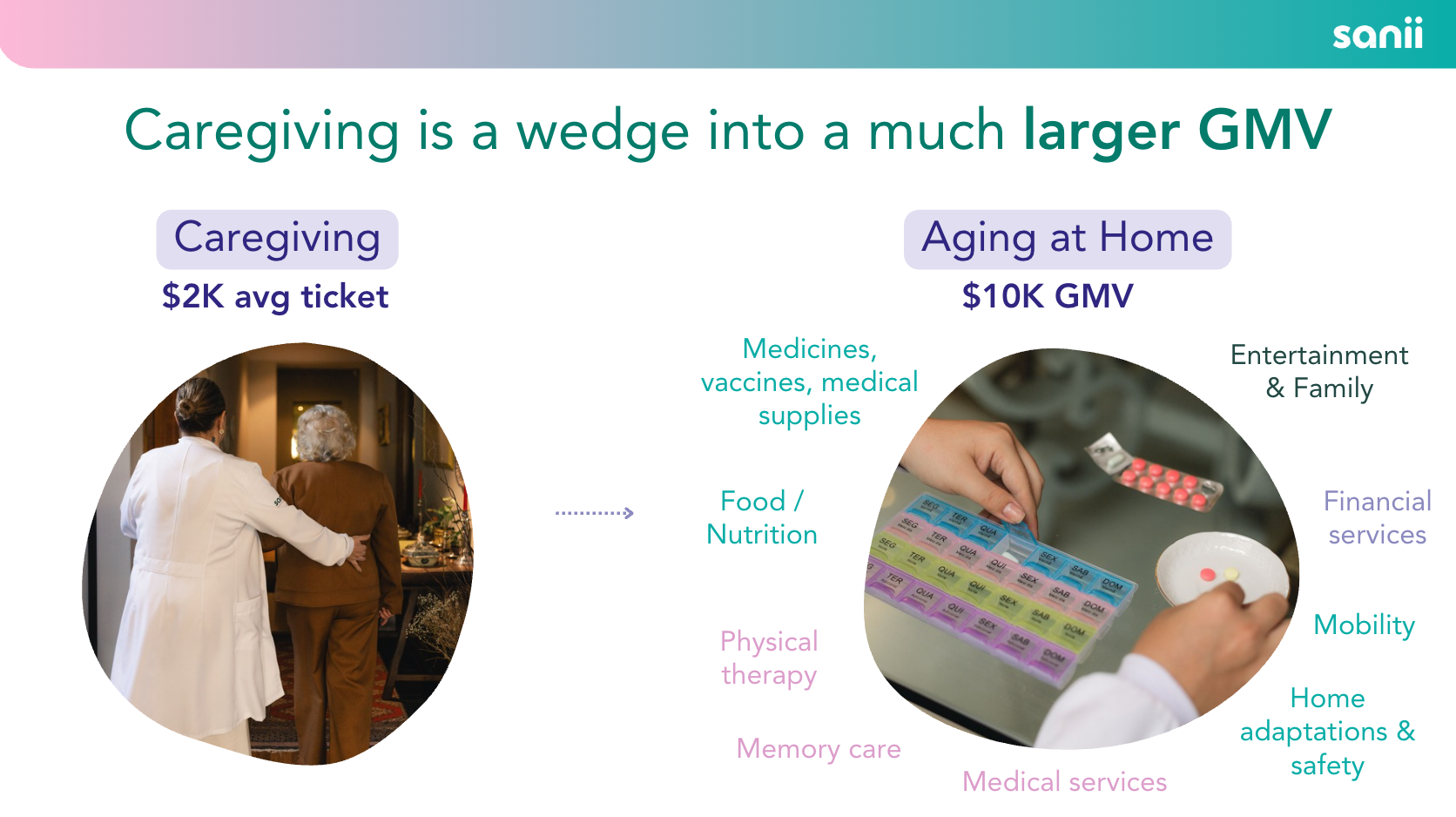
We’re starting with home help but as families trust us, they start asking for other services (going to the pharmacy and buying medicine, retrofitting the home for old age, taking the elderly person to the doctor…).
With time, Sanii will offer a range of services that will transform it into an “aging at home” company.
Sanii started by acquiring a “traditional” home care agency. Why that peculiar choice?
Let’s take a step back.
I founded and sold my first company in healthcare. I wanted to build another company in this space. Initially, Sanii raised VC money on a completely different idea, which centered around longevity. That utterly failed as we couldn’t reach PMF. We were faced with the choice of either returning money to investors or radically pivoting.
We chose the latter, focusing on the elder care market. We estimated that there were more than 3,000 tiny home care agencies in Brazil, mostly operating analog. We thought we could improve these agencies’ operations with tech, rendering better services for their clients and thereby increasing revenue.
No one really wants to “buy” these agencies. As a result, they’re cheap to acquire. One of our co-founders has an M&A background, so we had the skills to do so. We ended up acquiring Senior Services, a 10+ year old agency founded by Margherita Mizan, a psychologist and gerontologist. Margherita remains on the Sanii team in a sales role that leverages her network and credibility.
What we really “acquired” was Senior Services’ network of home careworkers, its client base, and the physicians they partnered with (who refer their own patients to Senior Services).
It’s an unusual way for a startup to launch but I believe it’s the future. AI has made it so easy to build new software that software alone can’t be your moat. A service business, client relationships, and a trusted brand are much more defensible. Sanii’s thesis is to acquire such service businesses and improve them with our tech (including AI).
You can call it an “AI roll-up” of sorts.
One of M&A’s most notorious challenges is unifying two distinct cultures. The culture shock between your techie co-founders and a small, Brazilian home care agency must be stark. How did you handle that?
Margherita had been running this business for 14 years: she knows what she’s doing. We approached the integration with a learning mindset. We observed how they worked and identified which parts of their operations could be improved by tech.
First, we digitized patient and caregiver records into a low-code tool (Airtable). Then, we optimized scheduling, a major headache for agencies. We built a dynamic calendar / scheduling system, replacing their messy Excel sheets and disparate WhatsApp messages.
As soon as we had that working, we started automating a lot of the team’s WhatsApp communications (confirming that the careworker was on their way, if they arrived, etc.). Today, we have AI agents that filter 10K WhatsApp messages per day and Sofiia, our care co-pilot, that generates reports and insights from unstructured WhatsApp data.
This gave us quick wins, built trust with the agency’s team, and allowed us to improve operations in the first 3 months without increasing headcount.
As we grow, we understand what functions to centralize under Sanii and what to continue bestowing to the agencies we acquire. We’ve realized that direct client relationships should remain squarely with existing agencies, while admin for the group can be centralized.
How did VCs react to this pivot? Isn’t a service business antithetical to the VC ethos?
Our initial VCs trusted us.
We also raised an extension round on this new thesis. When pitching new VCs, we conveyed the fact that you can reach close to SaaS margins (ED: some disagree) with our model.
It’s important to demonstrate that we can grow “organically” by expanding the revenues of agencies we acquire, rather than hinging all growth on new acquisitions. We do this by increasing operational efficiencies but also by adding new “aging at home” services (see slide below). These new services go directly to the bottom line.
As I noted earlier, this “AI roll-up” model is gaining legitimacy with VCs. The smart ones recognize that to win, you either build frontier AI or you apply AI to “brick-and-mortar” industries. Sanii chose the latter.
As we think about future fundraising, debt will become attractive. We’re starting to quantify what the “payback period” of acquiring a new agency is. This strengthens our case for borrowing money to do so.
Source: Sanii internal slide
RO Insights: the "AI roll-up" thesis
The idea is simple: service businesses are plagued by analog inefficiencies and thus lose out on revenue potential. By injecting AI & tech into their operations, you reduce costs, improve margins, and eventually, the multiple at which the business is acquired.
Sounds like PE. General Catalyst disagrees. Here’s how they explain it:
“PE roll-ups typically use leverage and cost extraction to create equity value: acquire, consolidate overhead, reduce headcount, service debt. AI-enabled roll-ups invert that logic. We generally invest upwards of $100 million in these businesses and deliberately add costs for technology build, platform development, and integration work, because we're rebuilding the value chain, not optimizing the existing one.
We partner for the long term, unlike PE’s typical three-to-five-year horizon, because real transformation takes time, and compounding requires patience. At the core is a venture mindset: building and operating companies for power-law outcomes that reshape entire sectors.[...]In 2023, we asked a simple question: where will AI have its biggest near-term impact? The answer wasn’t software but services, particularly in Europe’s $4T+ information, professional, and administrative sectors, which run largely on text- and voice-based workflows. In areas like accounting, legal, and real estate, AI expands what these businesses can deliver. By removing repetitive work, it frees professionals to apply more judgment, effectively increasing the value delivered and size of the market itself.”
General Catalyst further explains that AI enables service businesses to streamline grunt work, expand into adjacent services, thus increasing revenue:
“AI transforms what service businesses can accomplish. SaaS tools helped accountants process tax forms; AI processes the forms so that accountants can provide enterprise-caliber financial modeling and advisory work to every small business client on its books while simultaneously growing their client roster. Where legal software previously helped lawyers draft standard contracts, AI can enable them to negotiate complex multi-jurisdictional deals in regulatory environments they've never encountered before, customized for clients that would never have been able to afford Big Law fees.”
What’s the socio-economic background of Sanii clients?
Since all expenses are paid out of pocket, we cater to upper-middle class and upper-class clients. We have a lot of room to grow within that ICP.
That being said, we want to go downstream. If we can make Sanii more efficient and cut unnecessary costs, we can provide a cheaper service and serve a broader range of the socio-economic pyramid.
We grow most with referrals, similar to the pharmaceutical model. We partner with physicians, hospitals, and nurses who refer their patients to us. Some get a commission. 85% of referrals today actually occur without a commission. Medical professionals refer to us because it enables them to provide a true continuum of care, relying on updates from Sanii careworkers to provide patients with better guidance.
When you say Sani helps “cut unnecessary costs” in the agencies you acquire, what do you mean? What are you cutting?
Part of it is reducing the number of admin-oriented employees. We don't need shift managers in every location, since we can do that remotely with the help of our AI agents. Same thing with recruiting and screening careworkers. Some of the work around clinical quality and reporting can also be done with AI.
Part of it is eliminating manual work for existing employees, enabling them to dedicate more “human” time to their patients. More human time increases client satisfaction and ultimately, revenue.
Then, tech’s impact on operations helps the agency avoid costs, by identifying problematic (or promising) careworkers early as well as signs of careworker and/or client churn. Advanced tech enables more precise matching between careworker and clients, which is a major challenge.
And finally, tech makes all marketing, growth, GTM, and referral management motions more performant.
Wouldn’t it dramatically increase your market if Sanii services were reimbursed by insurance companies? Are you doing work on that front?
Yes, but it’s tough to build your business around insurance companies.
You have to convince insurance companies that by reimbursing your service, they’ll save money down the line. We have a good case in that regard, as we can argue that the better the care an elderly person is given at home, the less frequently they go to the hospital. It takes a while to accumulate a convincing track record however.
For now, we’re focused on gaining traction on the customer segments that can pay for Sanii out of pocket. That’ll give us solid grounding. We’ll see how we expand within insurance later.
There is a social impact element to what we’re doing, so we’d like it to be available to the highest number (maybe even providing our tech to public sector actors). We just have to make the model make economic sense first.
RO Insights: integrating with Brazilian insurance companies
Oya Care is another Brazilian healthtech startup. They provide online and in-person services related to gynecology and fertility.
Oya’s founder, Stephanie von Staa Toledo, echoes some of Michael’s points regarding insurance companies.
Here’s how she explained it:
“There are two types of patients.
The first are out of pocket clients, who may be insured but with whom Oya isn’t working with yet.
The second are insured clients Oya is working with. Working with insurance companies is relationship-based: you need a connection to someone inside the company. Luckily, I’ve gotten a few intros from friends, investors…
Insurance companies’ big worry is oversubscribing for a health provider that will lose them money. As we grow and accumulate more and more data, we can start showing these insurance providers that that isn’t the case. We have to prove that by offering Oya to their customers, they make money, not lose money.”
Excerpt from Oya: bettering Brazilian women’s health, originally published in The Realistic Optimist (May 2025)
Are Sanii careworkers employees or freelancers?
They’re all freelancers. The pros and cons of this “Uberized” model have been well-documented. The same applies for us.
Sanii careworkers are free and flexible in how they design their schedule. They don’t ‘report’ to work. If they decide to not show up or cancel, they can do so since we don’t have a formal employee relationship with them. They can decline assignments they don’t enjoy. For Sanii, they’re obviously cheaper from a salary-wise.
It’s a balance. Since they’re independent, Sanii needs to incentivize them, with quicker pay-outs for top performers for example. We’re also doing an “awards ceremony” for the best Sanii careworkers, something quite unheard of in the industry.
How and where do you recruit careworkers?
The pool of quality careworkers within a specific geographical area is limited. Sanii’s job (via initiatives such as the awards ceremony) is to establish a trusted brand that careworkers want to work for.
There are two main types of careworkers, although the overwhelming majority are women in both cases (between 40 and 50 years old). We need more men in care work but that’s an entirely different topic.
The first type are careworkers without any formal education, but that have care giving experience. Some took care of their own elderly relatives, enjoyed it, and decided to make it their profession. We send them on non-acute cases, where the actions required of them are non-medical.
The second type are careworkers that have worked in a medical environment before, either as a nurse technician or a nurse aid. They can carry out more advanced operations like wound care, working with a feeding tube… Naturally, they earn more.
What’s the most important KPI you track?
“Careworker churn”. This is when a Sanii client refuses the careworker we’ve assigned to them.
This matching element is extremely important yet incredibly subjective. A lot of it has to do with personality compatibility between the careworker and the patient, which is hard to “quantify”.
Finding qualified careworkers is our thorniest operational challenge. Ultimately, we’ll need to get into the education realm, to upskill the pool of potential talent that’s just not up to par yet. But as I said, so many of the skills required here are unquantifiable, social, personality skills. How do you create a “school” for that?
For now, we’ve found that new careworkers referred to us by existing Sanii careworkers are much higher quality than average.
What’s been your biggest strategic mistake?
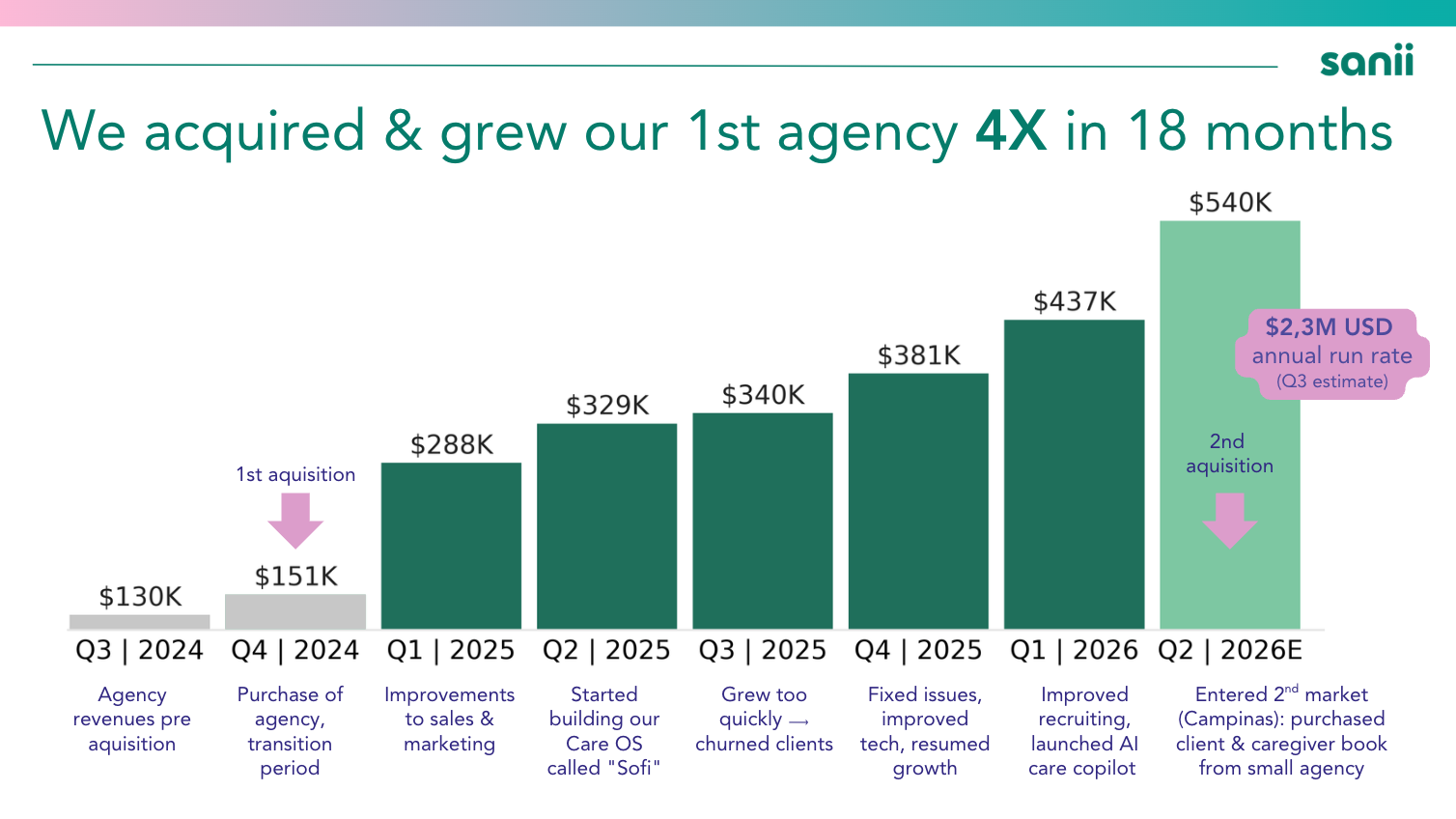
There was a quarter where we significantly grew sales but the rest of the company wasn’t ready for it. During that quarter, every new client we onboarded eventually cancelled. That was a tough conversation to have with investors.
We realized that the first 30 days were crucial: the Sanii patient generally decides whether they get along with the careworker during that period. If they’re still happy with their careworker after the first-30 days, there’s very little chance they’ll want to change thereafter (which is great for us).
There’s a more morbid reason for our need to continue acquiring new clients. Sanii clients, naturally, die while we take care of them.
In the future, we ought to ensure that our systems are ready to absorb that new client growth. Things tend to fall apart every 200K in additional ARR.
Source: internal Sanii slide
Pun not-intented, what’s your “post-mortem” analysis of that bad quarter?
When you add 10 new clients in a single week, you are staffing anywhere between 30-50 new careworkers. These are careworkers who you may have screened, but you don't yet know how they'll act with clients. Will they show up late? Will they be rude? Will they follow directions?
You also don’t have time to know the client deeply, so the careworkers you send are poor matches. In 90 days, those 10 clients will have nearly 2000 shifts, equivalent to ~40K hours of care. If your tech and your internal processes aren’t up to speed, something will inevitably go wrong. Clients complain, careworkers don't show up, conflicts arise... It takes a single bad caregiving hour for the client to churn in the first critical 90 days.
That's basically what happened. We grew too quickly and didn't have the tech/team/processes ready to absorb the demand, staffed the wrong careworkers, and didn't solve problems fast enough. Clients were dissatisfied and churned.
We quickly learned from that and resumed growth in subsequent quarters.
Will Sanii’s growth always be tied to acquiring existing home care agencies?
That’s the path we’ve started with, but there are alternatives.
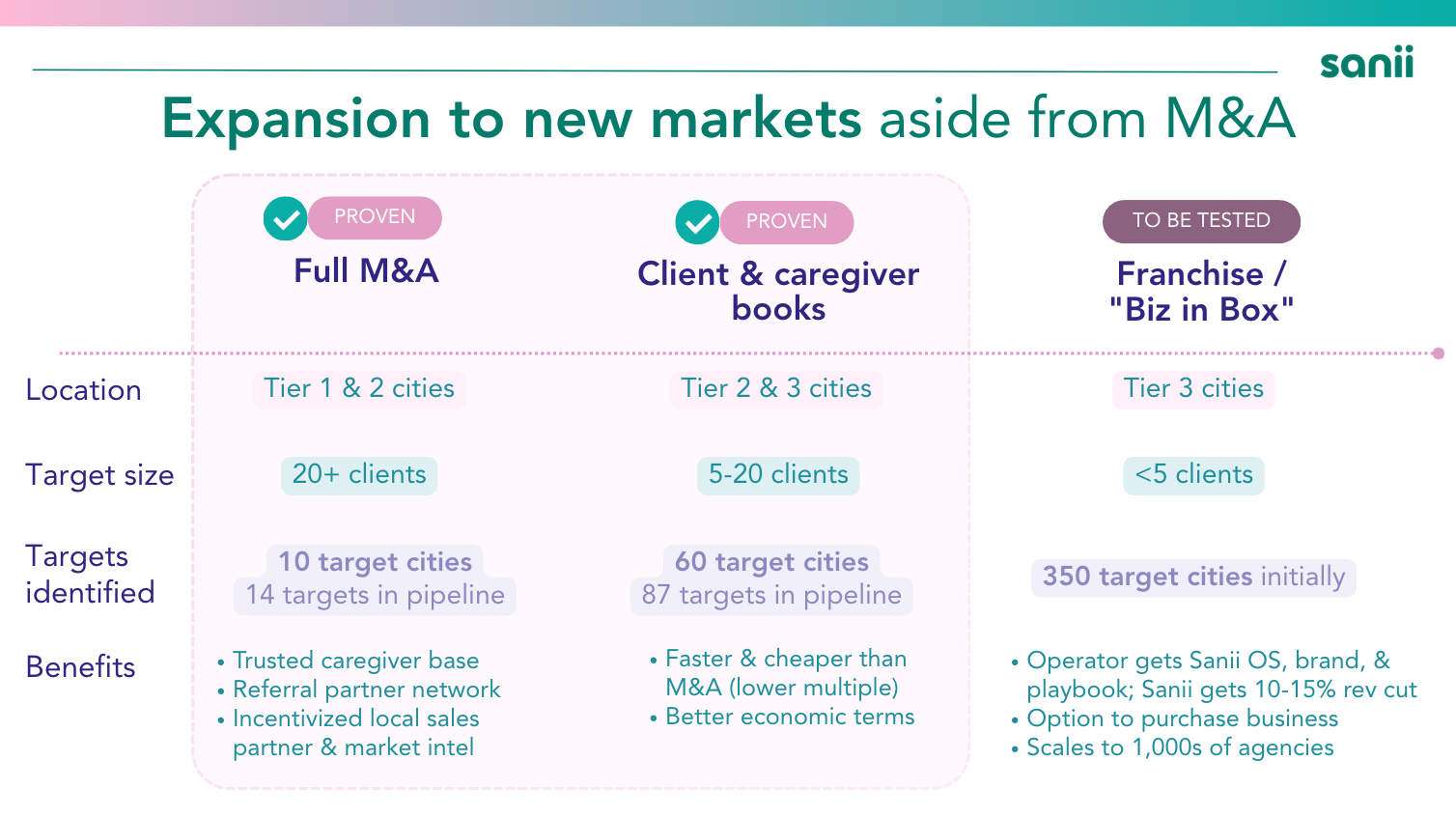
One alternative is purchasing a home care agency’s client/careworker books rather than the entity itself. In this case, we have a separate service agreement with the owner as a local consultant/salesperson/customer support contact. The small staff of the company are transitioned out (and our team takes care of their functions), and the company becomes a shell and is shut down. This is cheaper/faster than acquiring and merging the company into Sanii from a legal/accounting perspective.
Another alternative is similar to a franchise model. Here, a local entrepreneur can kick off a home care agency with Sanii running all the major functions of the company: recruiting, selection, marketing, first-level sales, shift management, care management, etc. Sanii then sets up a revenue share (10-15% of topline) on the local entrepreneur’s total revenue.
Source: internal Sanii slide
Are there foreign “proxies” that inspired Sanii?
Honor in the US (backed by a16z) is an interesting case study. They acquired Home Instead, one of the country’s largest care giving franchises, and integrated Honor’s technology into it. Similar to Sanii’s ethos.
The UK has Cera Care, Canada has The Key, France has Petits Fils… I can’t think of any relevant LatAm proxies as of yet, however.
What’s the most common investor pushback you get?
Some investors don’t like service businesses so that’s a no-go from the start.
As I mentioned above, other investors are regaining interest in service businesses because building good software is now completely democratized. They understand the moat is in branding and trusted client relationships.
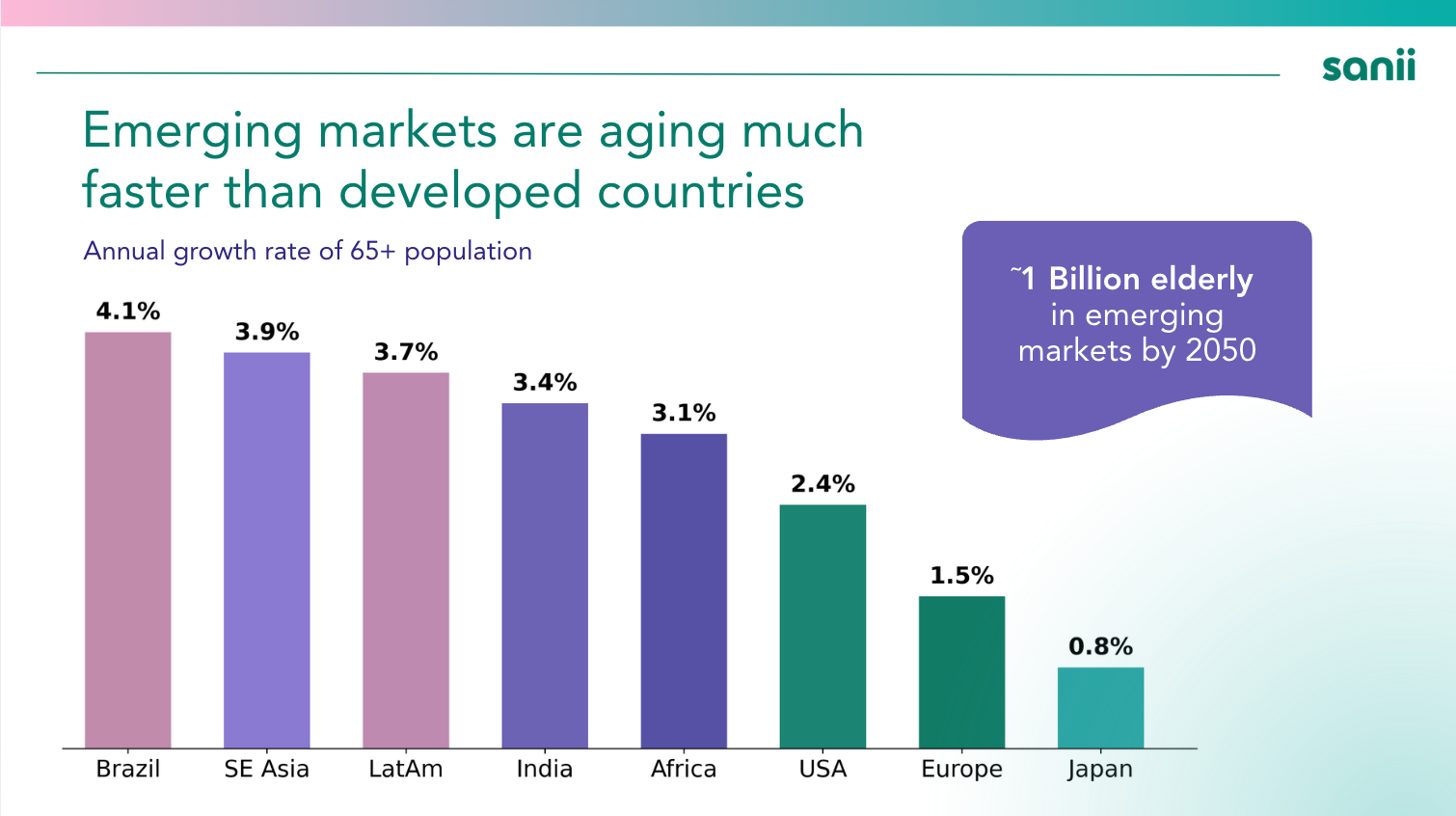
Most pushback revolves around the market size, especially given our current model (high-income clients, out-of-pocket only…). That’s a fair point, but I think our market size will grow as we expand geographically. The demographic growth many emerging markets experienced over the past decades will lead to a corresponding growth of their elderly populations.
The other pushback we get is disintermediation. Once we match a careworker and a client, won’t both parties simply take their relationship and payments “offline” to avoid paying the Sanii commission?
In reality, we don’t have this problem. The small financial gains provided by disintermediation are outweighed by the operational complexity the careworker and the client take on as a result. Sanii careworkers want to keep a formal relationship with us because they are monetarily rewarded for good, consistent performance. Clients work with us to offload the logistical complexity of handling careworkers, especially for long-term cases such as dementia. It makes little sense for them to give that up to save a small amount of money.
Disintermediation sometimes happens very punctually, if a client needs a quick extension from a careworker that they know very well. We turn a blind eye to those. In the same vein, it isn’t worth it to strain relationships with both parties over tiny amounts of money.
Source: internal Sanii slide
What do foreign investors misunderstand about the Brazilian startup scene?
There’s a natural aversion to investing in a market which you don’t know at all. For investors unfamiliar with Brazil, I center my pitch around US comparables: that tends to demystify what we do and increases my credibility.
You simply have to educate folks. We usually seek investors that have already invested outside of the US, because the learning curve is less steep.
The Brazilian ecosystem benefits from a few tailwinds that should help it raise more foreign capital. Nubank’s NYSE IPO and purported US market entry serves as a reassuring case study that Brazilian companies can truly scale within and outside of Brazil.
Notable US VCs have been steadily ramping up their investments in Brazil over the few years as well (Sequoia investing in Enter, a16z investing in Segura, Khosla investing in Comp…).
Disclaimer: all internal company metrics shared in this article are claims from the interviewee. They have not been independently verified. Do your own due diligence.
The Realistic Optimist’s work is provided for informational purposes only and should not be construed as legal, business, investment, or tax advice.