
The Africa-Japan bridge, part I
Africa is often anointed ‘the last frontier’, by virtue of being the last continent teeming with greenfield opportunities across various realms of socio-economic development.
In startup terms, said green fields represent the opportunities to leapfrog legacy technologies straight into digital-native solutions tailored to the continent's realities.
As with other aspects of Africa’s development story, the usual cast of foreign actors - America, China, Europe - have taken on major roles in the emergence of its startup ecosystem.
Make no mistake. Africans have and will continue to be the chief force of ecosystem progress, as covered in great depth here in The Realistic Optimist. Yet, omitting the contributions made by foreign actors deprives us of crucial pieces of context.
Much has been written of China, Europe and America’s involvement. Over the past decade, another major foreign player (well-known to insiders but rarely spoken of) has peeked its head: Japan.
Parts of Japan’s private and public sectors have recently cultivated deep ties to the African startup ecosystem. They have brought a distinct operating model worth investigating.
There have been pockets of coverage, but seldom a holistic analysis of Japanese involvement in the African startup ecosystem. Until now.
This three-part article is an (attempted) telling of an evolving 10-year story chronicling:
- The rise, stagnation, and revitalization of Africa-dedicated, Japanese VC funds.
- Japanese founders building in Africa, for Africa.
- Japanese investors’ abnormal modus operandi (including the blurring of lines between GP & LP status).
- International aid development agency involvement done, seemingly, better than others.
- The present and future of the Africa-Japan startup bridge.
Welcome to the first RO Long Read.
The OGs
Japan’s three maiden Africa-focused funds launched between 2017 and 2018.
Asia-Africa Investment Consulting (AAIC) came first by way of the Africa Healthcare Fund I (AHF I), targeting healthcare startups. Founded by former Boston Consulting Group (BCG) Partner Susumu Tsubaki, AAIC first began investing in Africa in 2013, operating a Rwandan macadamia nut farm before expanding to VC.
That same year, Takuma Terakubo, fresh off stints at Samurai Incubate’s Japan and Israel funds, found himself on the African continent for the first time. Travelling through Kenya evoked observations that shaped his subsequent path. As Takuma told Disrupt Africa in 2021:
“Startups were leading the country and creating the future, from basic infrastructure like power and water supply to logistics and human mobility…In Japan, where I grew up, there are many large corporations and strong vested interests from the past, which makes it difficult to challenge things and create a national system that is resistant to innovation. However, I was shown the power of such African startups to change not only the African continent, but the world at large.”
A year later Samurai Incubate Africa Fund I (initially known as Leapfrog Ventures Fund I) was born with Terakubo leading as CEO.
Kepple Africa Ventures was launched in 2018 by Takahiro Kanzaki, Satoshi Shinada and Ryosuke Yamakawi. Kanzaki was a former founder while the latter duo sported stints in the African wings of Japanese trading houses (the ‘quiet titans’ of the Japanese economy) paired with diplomacy postings and American MBA matriculations.
RO Insights: Japanese trading houses.
Japanese trading houses, also known as soga shosha, are highly diversified conglomerates that dabble in everything “from noodles to satellites”, providing logistics, financing, and risk management.
One example of famous trading house is Mitsubishi. The reader might not grasp the expansiveness of its empire. We encourage you to go down that rabbit-hole.
Some trading houses have thematically/geographically-focused subsidiaries. Germane to this piece is Toyota, through its Toyota Tsusho subsidiary, which you’ll hear about later.
In Africa, these trading houses have evolved from commodity trading roots into bodies that fund and manage critical infrastructure, energy, and retail operations.
These are environments far removed from the typical breeding ground of venture capitalists. However, they offered the perfect setting to connect the dots between Japanese capital and emerging African innovation.
The Kepple trio set out to replicate the benchmark set by East Ventures, but in Africa.
For reference, East Ventures is an Indonesia focused VC firm co-founded in 2009 by two Japanese nationals and an Indonesian, back when Indonesia was viewed as a technological ‘backwater’. Central to East Ventures’ stellar IRR (70%, according to this 2019 source) was a strategy of high-volume deal making across a myriad of thematics. In Africa, Kepple wholeheartedly embraced this ethos, making 100+ investments in three years as it became one of Africa’s most active investors.
Unlike AAIC, Kepple Africa Ventures and Samurai Incubate Africa pursued sector-agnostic theses broadly oriented towards fintech, health, mobility, logistics and agritech. All three funds, with their respective USD $47m, $4.5m, and $18m allocations, executed ‘spray and pray’ strategies.
The other pioneering Japanese VC in Africa: Mobility 54
Toyota has long engaged with the African continent. Present in all 54 countries for decades, Toyota has continuously expanded its Africa operations, including through the acquisition of French trading house CFAO in the mid 2010’s. The acquisition was made by Toyota Tsusho, a trading house subsidiary that oversaw most African operations.
During the latter half of the decade, a wave of disruptive mobility startups began to gain traction such as Nigeria’s MAX, Kenya’s Sendy and Egypt’s Swvl.
Against this backdrop, in 2019 Toyota Tsusho created a new corporate venture capital (CVC) arm, Mobility 54, investing in startups that aligned with its mandate of “MaaS" (Mobility as a Service) and "CASE" (connected, autonomous, shared, electric) tech businesses in Africa. The CVC's name is a cheeky word play combining the fund's core thematic focus with the number of Africa markets Toyota is present in.
Mobility 54 would operate independently from the Toyota Group’s flagship CVC, San Francisco headquartered Toyota Ventures.
RO Insights: Swvl's rocky road.
Swvl (an Egyptian bus-hailing startup) has had a journey that embodies the highs, lows, endless pivots, and sheer chaos that constitute building an enduring startup.
While strong traction was sustained as the company scaled its original B2C-centric business model, the Covid-19 pandemic forced the company to deviate from its original path.
Former CFO and current board member of Swvl, Youssef Salem, recounts:
“Swvl moves people around. When the first lockdown arrived, our revenue dropped to almost 0. It’s as simple and brutal as that.
The continuous waves of Covid and subsequent lockdowns made us transition from a majority B2C to a majority B2B model. The latter yielded longer contracts, was more stable and worked in a pandemic environment. A hospital could pay us to move around healthcare personnel, for example.
The B2B switch helped us realize that some clients were looking for more than just buses, they were also looking for network management (ie. routing, pricing, carbon footprint etc.). We dug deeper into the SaaS component of our value proposition as a result.
Covid evidently complicated private fundraising for Swvl, a transportation company. But it also created the ZIRP environment, as governments sought to revive battered economies. ZIRP fomented the SPAC boom, which we took advantage of. Without the pandemic, Swvl might still be a private company.“
Excerpt from Explaining Swvl's revival, originally published in The Realistic Optimist
The first ever Japanese CVC in Africa, Mobility 54 quickly began deploying by participating in the aforementioned Sendy’s Series B capital raise, as the startup looked to expand from being ‘the Uber for delivery trucks in Africa’ to other delivery vehicle classes.
Mobility 54 was positioned as a ‘strategic investor’, with parent company Toyota Tsusho expanding pre-existing logistics partnerships with Sendy to include auxiliary services such as aftersales servicing agreements.
Forming operational partnerships parallel to Mobility54’s equity investments would become a staple of Toyota Tsusho’s Africa operating model. This “blurring of the lines” between GP and LP is a recurrent theme amongst Japanese corporates investing in Africa.
The 2021 interlude
All four funds launched prior to the African startup ecosystem’s inflection point.
Barrelling into 2021, Africa, like many other emerging startup ecosystems, reached unparalleled velocity as deal count (debt and equity) increased by 82% between 2020 and 2021. This was fueled by the zero interest rate monetary policy from distant America.
Formerly a cottage industry, African VC transitioned into a multi-billion dollar professional asset class. The transition was powered by a virtuous trio of institutional capital seeking high returns, the African ecosystem's expanded depth, and pandemic-induced digitization.
This vindicated the OG Japanese funds’ thesis that Africa was a ripe startup investment destination, in the same way that China, India, and Southeast Asia had come to be.
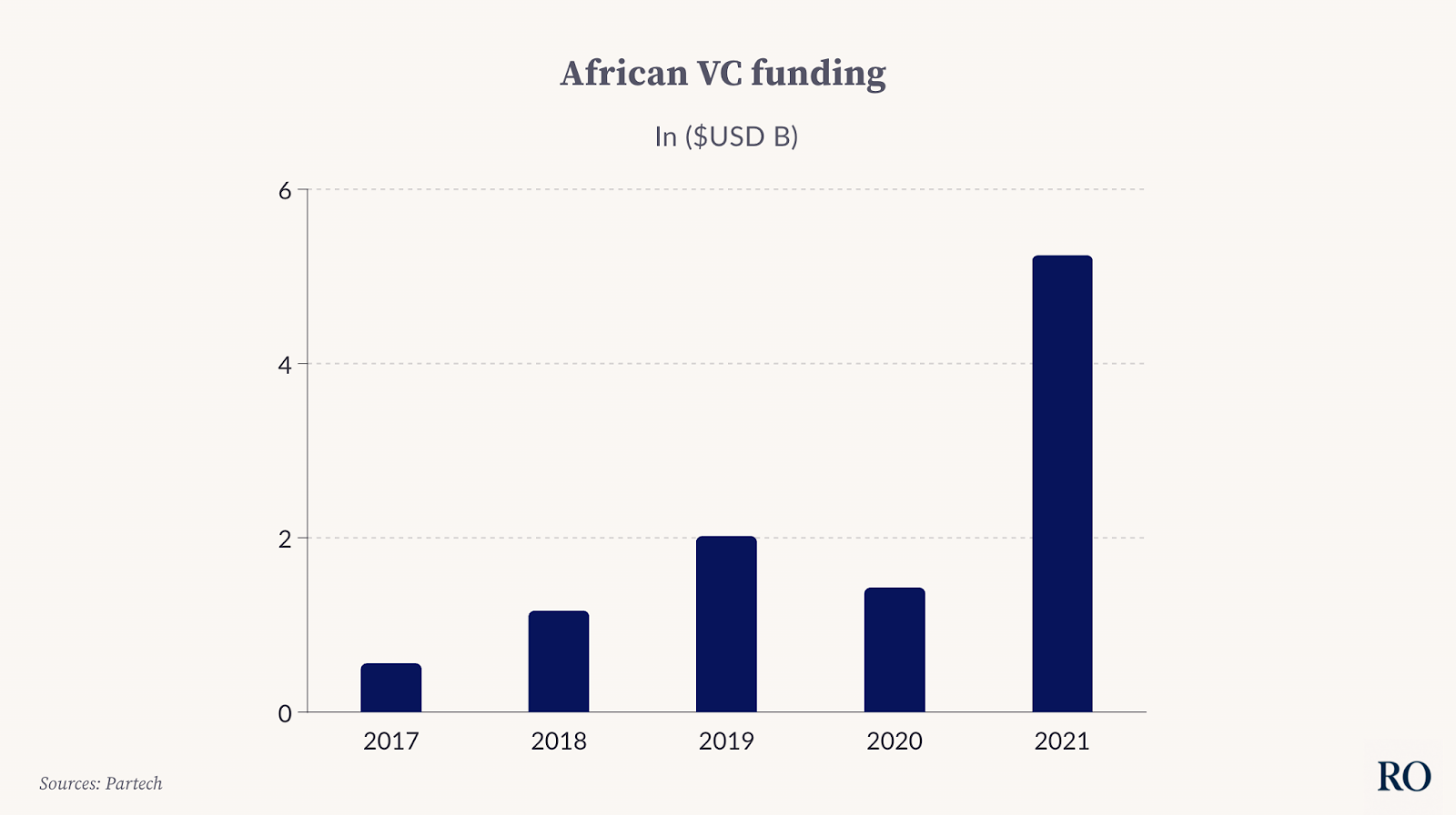
Source: Partech 2021 Report
Surfing the wave, Mobility 54 and Samurai Incubate Africa both closed larger second funds of USD ~$45m and $18.6m respectively. Mobility 54 also invested in Samurai as an LP.
It may seem odd for Mobility 54 to be an LP in a fund it seemingly competes with.
A bit of context. Mobility 54 generally pushes for term sheets that contain aggressive clauses concerning items such as ownership percentage and board seat allocations. Samurai's more lenient terms allowed Mobility 54 (and by extension, Toyota Tsusho), to gain exposure to startups of interest without breaching Mobility 54’s investment rules.
Samurai’s second fund came with dry powder earmarked specifically for 7-10 follow-on investments from an anticipated pool of 30-40 seed stage bets.
Founding CEO Takuma Terakubo wasn't involved with fund II. Months earlier, Terakubo announced the public launch of his new VC firm, Uncovered Fund, with a maiden fund size of USD $15m. Explicit reasons for the departure have never been made public.
In a 2021 interview to Africa Business Insider, Terakubo shed light on some philosophical differences between his previous and new firm:
“We do not make scattered, one-shot, small investments, but rather we provide long-term growth support, including follow-on investment.”
On paper however, Uncovered Fund I and Samurai Incubate Africa Fund II are similar:
- Fund size ($15m Vs. $18.4m)
- Target sectors (fintech, health, logistics, mobility, agritech)
- LP base (Japanese high-net-worth individuals and corporations)
- Core thesis on building the Japan-Africa bridge
AAIC and Kepple Africa Ventures also leveraged the 2021 momentum to raise larger new funds, but with some twists. We shall elucidate those “twists” later on.
Struggles and pivots
The period from 2022 onwards until today (2026) has been challenging. 2021’s VC funding tsunami evaporated globally off the back of rising interest rates in America. Africa wasn’t spared. Startups were forced to pivot from growth-at-all-costs with minimal runway to profitability, the new prerequisite to secure funding.
Samurai Incubate Africa would find itself among numerous funds on the continent to be critically impacted as institutional investors globally reallocated their portfolios away from venture capital.
Their Fund II was deployed across a wide range of startups that have mostly gained minimal further traction or meaningful follow-on funding. The last publicly-recorded investment was in mobility fintech Hakki Africa’s Series B, itself a follow-on round for Samurai Incubate Africa after first joining the cap table during the 2022 Series A raise.
Hakki Africa has since continued to thrive, achieving profitability and upping its valuation through a Series C round announced in April 2025. Maybe this final publicly recorded fund deployment will unlock the fairytale power law distribution outcome.
As of January 2026, Samurai Incubate Africa has no new investments or signals of a fund being raised. As we heard through the grapevine, it seems that the firm has faded into ‘zombie fund’ status, among many other emerging fund managers with vintages from the early 2020s. With a ten year fund life, the firm’s second fund can continue to collect management fees for years to come until the fund winds down.
No new management fees is effectively a slow death by asphyxiation. However, a Hakki Africa IPO, which has been hinted at in their most recent capital raise, may provide a Lazarus rising moment for the fund.
Uncovered Fund found itself on a different trajectory.
Uncovered Fund’s first fund also had many investments achieve no subsequent follow-on funding or other milestones. Just logos on the portfolio section of a website fading away.
In venture capital, this is a normal, healthy phenomenon. The adage that “any fund with a write off rate below 40% hasn’t taken enough risk”, ever present on Linkedin newsfeeds, explains it. Extreme outliers are what drive acceptable risk-adjusted returns in this high risk asset class. A single investment often is the driver of successful fund performance. Go big or go home. The 'Babe Ruth effect'.
For Uncovered Fund, that trajectory-changing investment could be in Togo-founded superapp Gozem.
Originally a ride hailing app, the Covid-19 pandemic saw Gozem expand into logistics and e-commerce as it raised a USD $2.6m seed extension in early 2021, (with Uncovered Fund participating), followed by a Series A round later that year. In the years since, product line expansion has been complemented by geographic expansion across Francophone Africa, funded by successive capital raises, most recently $30m in 2025.
As of January 2026, Gozem is still listed on the website of Uncovered Fund as a portfolio company. From what we gather, this is one of the strongest hopes for Uncovered Fund I to deliver the desired return on investment to LPs.
Amidst a continually challenging fundraising environment, Uncovered Fund announced a new fund in in August 2025. Christened the Uncovered Monex Africa Investment Partnership (UMAIP), the USD $20m is a joint venture with Monex Ventures, the CVC arm of Japanese fintech conglomerate Monex Group.
Monex Ventures had previously been an LP in Uncovered Fund’s maiden fund. In tandem with being an LP, Monex Ventures had also previously invested directly in Africa-oriented, Japanese founder-led agritech Degas and the aforementioned Samurai Incubate Africa portfolio company, Hakki Africa.
As for why Monex is putting its weight behind the UMAIP, Terakubo noted that they have “long been interested in investing in Africa and are looking to leverage Japan’s financial strength to support African fintech and crypto-related companies.”
A key component of this ‘leveraging’ of ‘Japan’s financial strength’ is a debt arbitrage play whereby UMAIP will raise debt in Japan (where interest rates remain low by global standards) and finance African portfolio companies with fintech dimensions.
RO Insights: blending venture debt and venture capital.
Venture capital funding in Africa has regressed from the peak times of 2021-2022.
Venture debt funding has taken a wildly different trajectory increasing from USD $350M in 2019 (17% of total venture funding) to $1.6B in 2025 (41% of total funding).
Amidst this boom, African VC funds including Camel Ventures have begun to incorporate venture debt offerings alongside their traditional bread and butter of venture capital.
Mahmoud El-Zohairy, Managing Partner at Camel Ventures, explains why below:
“VC is high-reward but high-risk. VD is a bit lesser-reward, but a bit lesser-risk. It’s a risk-adjusted approach that fits well with our LPs. In both cases, we’re betting on Egyptian tech startups, a sector I’m bullish on.
VD allows you to return money to your LPs faster. This has been one of African VCs’ greatest challenges. They have struggled to return money to their LPs in part due to the continent’s limited exit opportunities. VD mitigates that problem.
We have Egyptian banks as LPs, so including a financial instrument (lending) they understand and relate to makes us attractive.”
Excerpt from On venture debt in Africa, originally published in The Realistic Optimist
Terakubo also spoke of a vision to “bring opportunities for acquisitions from Asian companies, particularly Japanese corporates, into the African ecosystem” which may help address African VCs’ perennial quandary regarding its thin exit markets. With a cash-rich LP base featuring Japanese financial institutions, trading houses, automotive companies, and logistics firms, potential acquirers for UMAIP portfolio companies have skin in the game.
However, such acquisitions have minimal precedence as of yet. AAIC Fund I and Samurai Incubate Africa Fund II also had similar LP bases powering the same thesis that didn’t really materialise.
UMAIP’s ability to deliver on that will be interesting to track over the coming years. The Japanese debt financing arbitrage play has a comparatively stronger track record, albeit in other asset classes. The "Mrs Watanabe" phenomenon is an apt exemplification of such. The mounting weight of African venture debt within the ecosystem provides further reason for optimism.
Preceding Uncovered Fund’s pivot to the joint venture model was Kepple Africa Ventures.
Kepple’s first fund had been a moderate success as a proof of concept with the headline homerun being an investment in Moniepoint. Oui Capital, which invested in the same round as Kepple, has since exited for a 53x ($150,000 to $8M) return. While yet to exit, Kepple’s Fund I is likely sitting on a paper return with a similar multiple.
It is understood Kepple has quietly been able to create some small scale exits, but the first fund has yet to have a major cash-returning liquidity event for its LPs.
Within this context, Kepple Africa Ventures launched a new fund in 2022, structured as a joint venture with African private equity firm Verod, creatively named Verod-Kepple Africa Ventures (VKAV). Like any marriage, it can be speculated that the union may have resulted in compromises being made. Both firms moved into foreign territory, with the fund’s mandate being Series A/B startup investments.
Asked to provide insight about the reasoning behind the merge, a spokesperson for VKAV told us:
“The fund was established to combine the hands-on value-creation discipline of private equity with the asymmetric risk-reward lens of venture capital - building a VC platform with a PE mindset.
The rationale was clear: scaling companies from Series A onward in African markets requires more than capital. It demands operational depth, disciplined governance, structured financial planning, and active support across strategy, talent, and capital structuring.
In environments where ecosystems are still maturing, companies often need institutionalization earlier than their global counterparts. More critically, the exit experience embedded within private equity firms provides a distinct advantage, and is a core muscle required to convert growth into realized returns.”
VKAV’s thesis was sparked by the increasing gap being left open between seed stage and late stage (Series C+) capital raises, a ‘missing middle’ of sorts.
Here’s VKAV again:
“Between 2019 and 2021, seed-stage funding in Africa accelerated significantly, fueled by both local and international capital. However, the availability of growth-stage funding did not scale at the same pace.
This widening disparity underscored a structural bottleneck in the ecosystem - and highlighted the urgent need for dedicated Series A+ capital to support companies transitioning from early traction to scalable growth.”
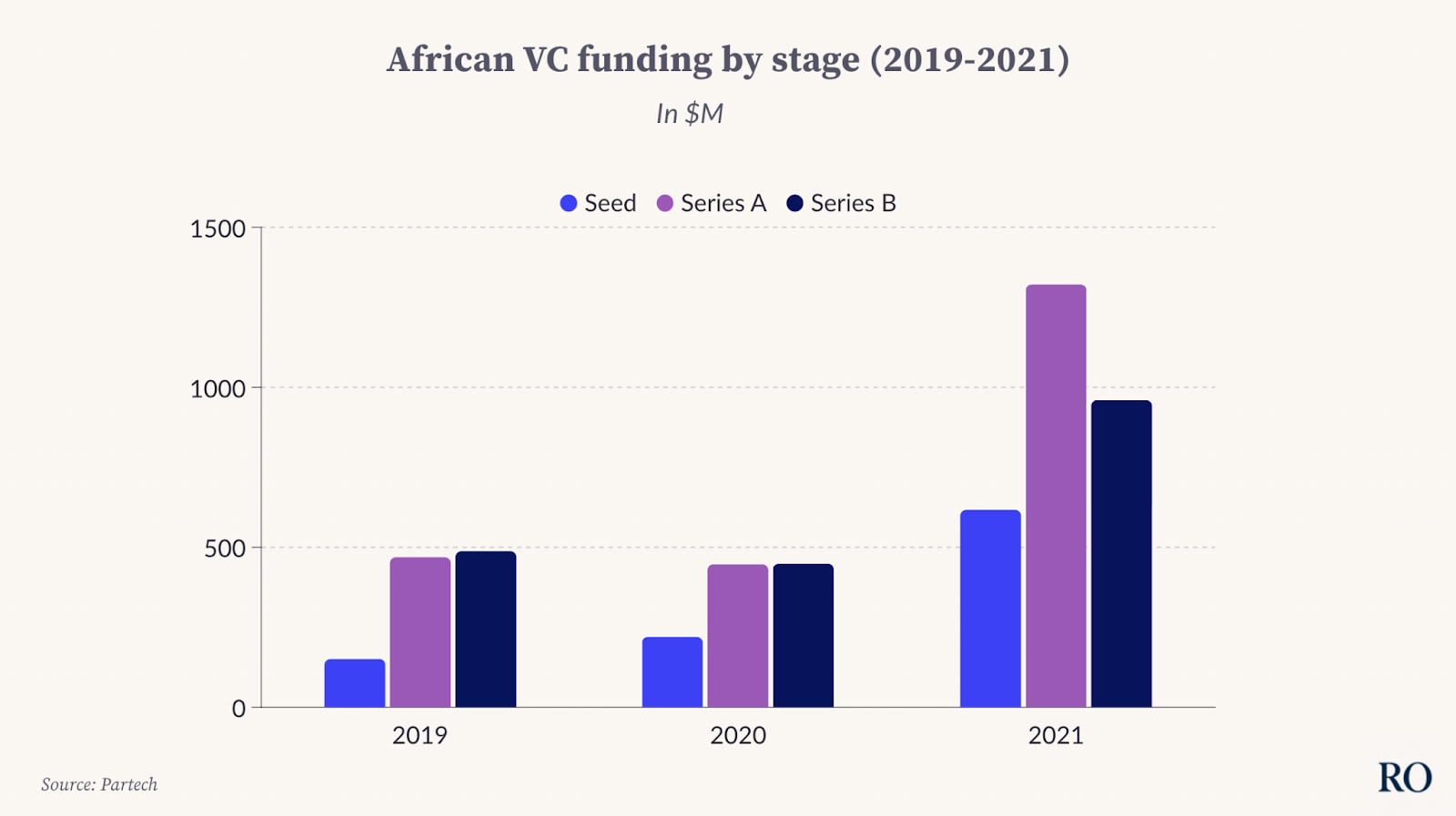
Source: Partech 2021 Africa Tech Venture Capital Report
At its core, two competencies are needed to be a successful venture capital firm:
- The ability to source investments containing unrealized alpha.
- The ability to engineer cash generating exits.
The Verod-Kepple partnership appears to combine both.
Kepple’s ascent as one of Africa’s most prolific investors has built out the investment sourcing muscle.
Verod as a storied private equity firm has developed the capability to routinely engineer exits on private African investments, most notably through the sale of Daystar Power Group to Shell.
Many of the ‘usual suspects’ backed the inaugural VKAV fund, including Toyota Tsusho and SBI Holdings. They were joined by other Japanese firms investing in an Africa fund for the first time, such as Taiyo Holdings. Non-Japanese LPs included Nigeria’s SCM Capital and undisclosed family offices.
VKAV Fund I fell short of its original USD $100m target with a final close of $60m in April 2024. Missing its $100m target by 40% is always a subpar outcome, but not one that should be treated as a leading indicator of subsequent fund performance.
A year later, news would break that one of VKAV’s first investments, mobility startup Moove, was working towards closing a new capital raise at a USD $2bn valuation. That would be a 2.5x increase on the existing valuation of $750m, which itself is a substantial markup on the valuation VKAV first bought in during Moove’s Series A (a valuation which we couldn’t verify).
AAIC’s second fund
AAIC has also had similar swings during the same period. Expanding the investment mandate to loosely healthcare-adjacent plays such as remittances (which finance healthcare expenses) gave rise to investing in Chipper Cash, which later hit a USD $2bn valuation at the tailend of the 2021 bubble peak.
Riding the momentum into 2022, AAIC announced the first close of Africa Healthcare Fund 2 (AHF 2), mostly backed by Japanese healthcare players. AHF 2’s April announcement came with a grand declaration that the targeted final close would be USD $150m.
A relatively paltry second close of ~$40m was disclosed in October 2023, months after AHF 1 flagship investment Chipper Cash was reported to have had its valuation cut by 70%. Peaks and troughs of VC on display.
Operating on a smaller scale than envisioned, AAIC found some tailwinds through portfolio company Gozem, the same startup that has been propelling the Uncovered Fund. More recently, AAIC has returned to its original thesis investing in 2025 in Moroccan AI fetal ultrasound analysis platform DeepEcho that is in the latter stages of American regulatory approvals.
Outside of AHF 2 activities, AAIC has also returned to its agriculture roots, operating a 1,760 hectare plantation in Tanzania as a private equity holding and being a ‘strategic advisor’ in the brokering of a deal between a Japanese conglomerate and Nigerian oil magnate.
Neither of the latter are LPs in AAIC’s VC funds. Neither of these have any clear connection to the thematic of healthcare in Africa for AAIC. Instead, they’re reflective of the firm’s other business lines of asset management and ‘strategic consulting’.
AAIC has always been an oddity. This idiosyncrasy feels both symptomatic of ruthlessly pursuing unexpected opportunities and reflective of the strategy of diversification many global Japanese firms have long pursued (remember the trading houses we spoke about earlier).
Fund performance appears to be below desired benchmarks with a third VC vehicle seeming unlikely. AAIC should still be viewed as one of the first true foreign believers of African startups, injecting over millions of $USD into the continent across all of its ventures.
What about Mobility 54?
Toyota Tsusho’s Mobility 54 is also likely to leave a similar legacy as an energetic early believer.
Across its two funds, a total of 17 investments were made, combined with a myriad of operational partnerships with portfolio companies. None of these investments have come close to unlocking the full potential of strategic value envisioned.
Among the most high profile shortcomings was Sendy, which received additional non-Mobility 54 investments directly off the balance sheets of Toyota Tsusho and CFAO alongside a suite of partnerships, before going into administration.
Sendy’s bankruptcy itself isn’t damaging. It's part of the game of investing in startups for both independent and corporate VC outfits. As a CVC, financial returns itself aren’t necessarily Mobility 54’s prime concern. Rather, what matters is unlocking new sources of innovation for parent company Toyota Tsusho to embed in its operations.
Case in point is Mobility 54 portfolio company BasiGo. Since Mobility 54’s investment in 2022, BasiGo has seen its funding continue to climb. That’s great for independent VCs on the cap table such as Novastar Ventures, but Mobility 54 likely still would have viewed this investment as somewhat of a failure, as Toyota Tsuho has been boxed out of forming operational-focused partnerships by Chinese competitors (chiefly BYD).
Under new CEO Teppei Maki, sources have flagged that Mobility 54 in 2025 has since pivoted from capital deployment to taking a more ‘hands on’ approach with a select few portfolio companies, following a period of "reflection" about the suitability of the CVC model. Simultaneously, Toyota Tsusho subsidiary CFAO Healthcare provided a rare exit event for the African startup ecosystem, acquiring pharmaceutical chain GoodLife.
Like AAIC and Samurai Incubate Africa, Mobility 54 should be viewed as an ambitious pioneer that tried speeding up the inevitable convergence of African innovation and Japanese enterprise. Their general thesis (African mobility as a greenfield of innovation), also shared by Uncovered Fund and Kepple, has been proven correct. The mixed financial performance of these firms is ultimately a reflection of a lesser spoken fact: power law dynamics govern not only individual VC portfolios but also the performance spread of VC funds as a group.
Finance theory aside, the pivot by some members of this cohort to joint venture operating models has been revitalising. The longevity of the joint venture model itself is still to be confirmed. But it has, at a minimum, provided a bridge to remain operational during a prolonged fundraising trough.
Creative, wide collaboration as a core component of Japanese actors’ involvement in the African startup scene extends beyond VCs. This collegial ethos has also infused the Japanese founders building startups on the continent.
You can read part II of this RO Long Read here.
If you’re reading this, you are likely an RO paid subscriber and will receive part II straight to your inbox.
If you have somehow figured out a way to read this without being an RO paid subscriber, make sure to grab your subscription on our website (€9/month) to receive part II.
Disclaimer: we have done our absolute best to verify the veracity of all facts we mention. If you find errors, please email tim@realisticoptimist.io