

Dear reader,
Isn’t it a shame that solid startups, creating value for customers and generating revenue, lack funding options because their market isn’t “VC-scale”?
Are founders bound to choose between “bootstrapped” and “VC-backed”?
This Manichean dilemma is a human construct. The 10+2 VC fund model was created by humans, imperfect as we are. It is completely in our power to change it or tweak it if it doesn’t work. The VC industry seems to forget that sometimes.
The Realistic Optimist has already published a few articles that challenge the “classic” VC model, such as Adapting VCs to emerging markets and Raising a VC fund in local currency.
Today’s article is a continuation of this topic. Below is an exclusive 3,000+ word interview with Alyune-Blondin Diop, a principal at LoftyInc Capital, a pan-African VC.
Alyune recently co-authored a white paper challenging the classic VC fund structure for Africa.
In this article we speak about:
- The frustration that led him and his co-authors to write the white paper.
- Which of his initial hypotheses were validated and disproved.
- What fund structure would Alyune choose if he had $20M at his disposal.
- How LPs have reacted to the white paper.
- The role of government-linked LPs in the African context.
- Debunking the notion that Africa’s ecosystem has “no exit opportunities”.
- Rethinking DFIs’ role on the continent.
This article is available to RO paid subscribers only, because producing quality, independent writing costs money.
RO paid subscribers work at Endeavor Catalyst, Speedinvest, Seedstars, Sturgeon Capital, i2i Ventures, InDrive, Goodwell, Alaya Capital, VKAV, Octerra Capital, Shorooq Partners, Cento VC, Razor Capital, and more.
You can join them below. An RO subscription unlocks access to our entire library (100+ articles) as well as 1 new weekly RO article delivered to your inbox.
Biography
Alyune-Blondin Diop is a principal at LoftyInc Capital, a pan-African VC fund. Prior to LoftyInc, Alyune was an investment associate at Joliba Capital, a generalist private equity fund that mainly focuses on SMEs in Francophone West and Central Africa.
Alyune recently made waves by co-authoring this white paper, which challenges whether the ‘traditional’ VC fund structure is adapted to Africa or not.
The white paper was co-authored with Kartik Sharma (Launch Africa), Diego Arias García (signalworks), and Desirée Pettersson (SET Ventures).
In this exclusive RO interview, Alyune explains the impetus for writing the white paper, what he and his co-authors found, and what potential solutions they came up with.
Why did you write this white paper?
It stemmed from a place of frustration.
I was frustrated with marketing a financial product (ED: the VC, 10+2 model) that I didn’t really believe in. Spending two-three years fundraising for a vehicle you know doesn’t unlock the best value for LPs and founders takes a toll. This white paper is a quest to find solutions.
It is often said the African VC asset class underperforms and doesn’t generate competitive returns. In my view, the problem isn’t the companies themselves but rather the underlying financial product this asset class has locked itself into.
We wanted to flip the table and imagine new financial products that could unlock real, repeatable commercial returns for African tech.
You interviewed multiple African GPs when writing the white paper. What’s their overarching mood?
The term “inflection point” is used ad nauseam in our sector, but this is what we’re reaching.
The first generation of African GPs started out as angels a little over a decade ago and are arriving at the end of their first funds’ cycle. Performance across the board is simply not great, except from a few outliers.
The second generation of African GPs, both the OGs launching their second fund and new blood, are questioning how business is done. Some select GPs have had notable success and exits, and some are now even refraining from taking development finance institution (DFI) money.
The ecosystem is changing and deeply reflecting on what the path forward is.
Which of your initial assumptions were validated or disproved?
We started out with three main premises:
- The classic VC fund structure is too tight timing-wise (~10 years), meaning VCs have to return their funds before their portcos can achieve meaningful growth, scale, and therefore exit. This leads to suboptimal returns.
- The classic VC ethos of betting on rare extreme outlier performance leaves many good African companies unfunded, as they aren’t considered “VC scale”. Even though those companies could yield consequential financial returns.
- If we take the classic VC definition, are there enough of these “VC-backable” companies in Africa to justify the millions flowing into the asset class?
We mostly validated the first two premises, but rethought the third one to ask ourselves: how do we define what a “VC-backable company” is in Africa?
Today, African companies’ “VC-backability” is gauged with the same metrics as they are in Silicon Valley. That makes no sense. Market fundamentals between Africa and the US are worlds apart. Financial success metrics can’t be uniform across both.
As we state in the white paper:“The African innovation landscape is, in fact, largely physical-digital (phygital), where digital
platforms are inseparable from the physical systems that enable them.
Andela, for example, initially positioned as a remote work platform, succeeded only after investing heavily in training, human capital infrastructure, and global delivery systems.
Moniepoint, scaled financial inclusion not just through software, but by deploying thousands of point-of-sale terminals and agents to build last-mile payment infrastructure.
Moove’s fintech model is anchored in vehicle ownership and asset management, blending software with physical fleet logistics.
These models thrive precisely because they combine digital leverage with physical execution, but that combination takes longer and costs more to scale. This causes two problems:
(1) VC return expectations (10x in 10 years) are often unrealistic with how value is created in such businesses.
(2) Founders frequently use expensive equity to finance working capital or asset expansion due to the absence or scarcity of cheaper, more appropriate alternative instruments, leading to eroded ownership and constrained follow-on capacity.”
We sought to find out how we could tweak the African VC model to be able to fund more African companies, rather than searching for the few African companies that fit the US-designed VC-backable mold.
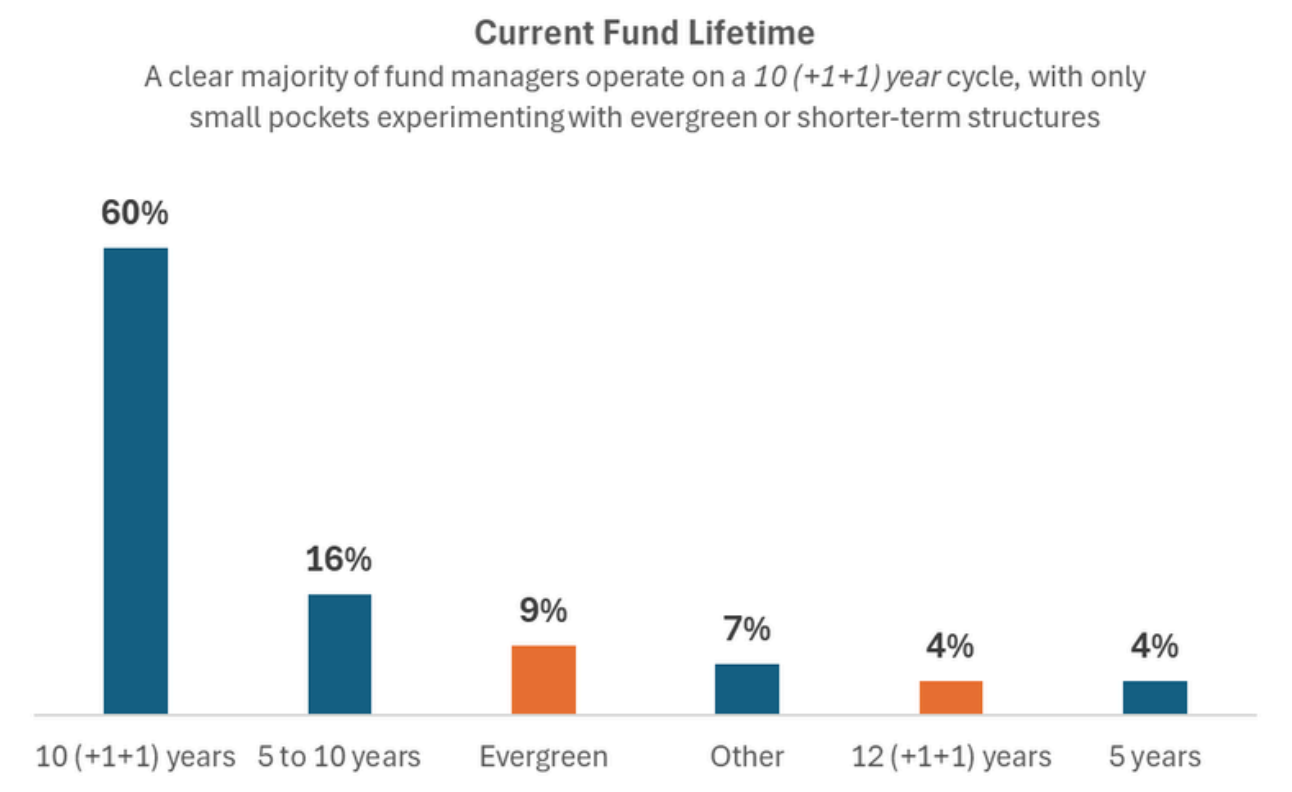
Source: Rethinking Venture Capital for the African Market
Someone commented on the white paper saying:
“Paystack exited in 5 years. Flutterwave hit unicorn status in 5 years. Andela scaled globally in traditional VC timeframes. Are we backing genuinely venture-scalable businesses or forcing VC into models better suited for growth equity?”
Aren’t you avoiding what a VC is supposed to do, which is to find these rare, unique companies early?
If Africa had a large dormant pool of potential unicorns, they would exist whether African VCs found them or not. Exceptional founders find their way to scale regardless of who wants to back them. The truth is that these companies are few.
We shouldn’t dwell on this minuscule number of supposed dormant hyper-scalers. I’m more worried about the great African tech companies that don’t get funding because they don’t fit the mold African VCs have imprisoned themselves into.
By trying to optimize for unicorn-like returns, African VCs miss out on potential alpha by passing on great companies. The value lost in that regard is superior to the value gained if these VCs were to find 1-2 more of these hyper-scaling exits.
If you had five LPs entrust you with $20M, no strings attached, what fund structure would you put in place?
I see three options.
The first would be a secondary fund, with a 15-20 year fund life, for companies that have raised VC money but did not manage to hyper-scale and rather built solid, profitable businesses. I’d enable founders to clean up their cap table from existing VCs by buying these VCs’ shares (at heavy discounts, as these assets are usually written-off).
We’d have a pocket for primary investment in these companies, to turbocharge the companies we become shareholders in. We’d generate returns from a mix of dividends, founder buy back through redeemable instruments, and a few selected exits, mostly to private equity funds.
The second would be a growth fund, also with a longer timeframe (evergreen or holding model). We’d aim to take 15-20% positions in fast-growing companies and push for an aggressive M&A strategy. In Africa, it seems like we’ve erased international IPOs as an exit route. This is because the revenue threshold for these liquidity events is high. These revenue thresholds can be attained via intelligent roll-ups of various, solid, complimentary African companies.
The third bucket would be a venture debt fund as there is a big shortage across the continent (ED: African venture debt has increased from $350M in 2019 (17% of total venture funding) to $1.6B in 2025 (41% of total funding)).
Venture debt allows you to generate forecastable liquidity while staying exposed to the extraordinary upside that tech investing grants you.
What about publicly-listing the investment company itself? This would allow LPs to come in and out when they want, for you to hold your positions longer (Berkshire-Hathaway style).
This is a bit too complex, as most African stock markets don’t have enough liquidity. Enabling retail investors to invest in your fund also means opening up a whole new world of regulation.
But you have a point. We can embed that ethos within a private market structure. One example would be a long-term holding model. Think a 20-30 year fund, with an initial 10-year lock-up period, but where LPs can decide to exercise their liquidity in specific windows subsequently.
RO Insights: publicly-listing an investment fund.
Africa Eats is a fund investing in African SMEs.
They’ve decided to list their investment companies on the Mauritius stock market, to enable investors to come in and out as they wish. This allows Africa Foods to hold its investments for very long periods of time, enjoying the fruits of compounding.
This structure comes with challenges. Here’s how Luni Libes, co-founder of Africa Eats, explains:
“The process isn’t difficult, it’s just a ton of paperwork. More than anyone ever imagines.
More than listing, the bigger challenge is liquidity. Stock markets are liquid when there are a lot of buyers and sellers. They are illiquid if you want to sell a stock today that no one wants to buy today.
Market makers act as a smoothing mechanism: they have a pile of cash and are always ready to buy or sell specific stocks, generally at a small premium, to make sure the markets run smoothly. We take this for granted in Western stock markets, but the Mauritian one had this problem when we listed. There wasn’t enough liquidity.
To solve for this, we had to create a separate company, Tuesday Markets, the first equity market maker in Africa.
[...]
There are few retail investors on Mauritius’ stock market, in part because that stock exchange doesn’t have an app. This makes the process for buying and selling stocks antiquated and byzantine, meaning most investors are institutions.
Tuesday Markets built an app to help with this. It even offered to white-label the app to local stock brokers, who didn’t want it. It’s a Catch-22 situation: there are few retail investors because there is no app, and no one wants an app because there are few retail investors.
Today, most [Africa Eats] shareholders are HNWIs and family offices, with a dozen or so small institutional investors mixed in. The largest shareholder is Realize Impact, an American 501(c)(3) public charity that helps turn philanthropic capital into impact investing.”
Excerpt from Africa Eats, Berkshire Hathaway for African SMEs, originally published in The Realistic Optimist
You list various, creative fund structures in the white paper. How have LPs reacted to this?
It’s important to understand that the conversation has to be holistic. This isn’t a matter of slightly tweaking the fund timeline or the free structure. We need to think this over from scratch.
The level of interest depends on the type of LP (family office, HNWI, pension funds, DFIs…). Every LP will tell you they’re interested. They’re smart enough to see that the current fund structure isn’t adapted, and they have the performance numbers to prove it. But changing it implies rethinking their entire investment thesis and risk assessment methodology. That’s a heavy lift. I encourage LPs to do risk assessment on the financial product level on top of the basic market risk assessments they do. That should prove our point.
DFIs are good candidates for rethinking fund structures. Venture capital is a sliver of their overall activity. They’re already invested in other fund structures, for infrastructure projects, blended finance… But all of this takes time, lobbying, and bold GPs willing to painfully pitch a new product.
Many local LPs are unfamiliar with the VC asset class. They know African markets better than foreign LPs. Isn’t it easier to pitch them new, locally-relevant fund structures?
There are challenges around this, mainly surrounding currency. Taking on local LPs usually means taking in local currency. This means exposure to capital controls regulation. Most African VCs invest in multiple countries, making this potentially treacherous terrain.
The model can work if you’re focused on a single country. Camel Ventures in Egypt (ED: which The Realistic Optimist wrote about here) raised a venture debt + equity fund in local currency for example. Africa Lighthouse Capital raised from a few pension funds, its primary investor being the Botswana Public Officers Pension Fund (BPOPF). They’ve invested largely in Botswana.
If we’re being fully honest, African GPs haven’t done enough groundwork on stewarding local LPs into the asset class. DFI money was always perceived as easier to get.
RO Insights: raising a VC fund in local currency.
As Alyune points out, a multi-country, local currency fund might be tricky, but a single-country fund is doable.
In Pakistan, sAI raised its fund in Pakistani rupees rather than in $USD.
Here’s how managing partner Ahsan Jamil explains the rationale behind that choice:
“It’s very simple. Investing $USD into startups making revenue in Pakistani rupee makes for a tough equation. If the rupee depreciates, the startup’s corresponding $USD revenue takes a hit. In that case, the startup has to maintain its already ambitious VC-scale growth trajectory, but also has to grow faster than its currency depreciates. It’s stressful for the investor: they see their portcos’ $USD valuation crash, and are incentivized to push founders to grow at unrealistic rates.
This pressure is an immense psychological weight on founders, who can end up making aggressive, non-sustainable strategic decisions. Sadly, it can ruin what could’ve been a great company, but that is now burdened with an unattainable task. It can also severely bruise those who could have been fantastic founders.
To make things worse, Pakistani startups’ exit attractiveness is almost entirely dependent on their revenue. In Silicon Valley, the market is so liquid that a startup can grow fast, barely make money, and find exit options (secondaries, M&A) by pitching how valuable the data they’ve accumulated is.
That isn’t the case in Pakistan. The market for exits is scarce, and the only way to be attractive is to have strong revenue growth and healthy unit economics. Having those KPIs measured in a currency that’s way stronger than the currency your revenue is in is complicated.”
When asked about why Pakistani GPs keep raising their funds in $USD, Ahsan said:
“Because it’s really hard to find local, Pakistani investors for a VC fund. This asset class is brand new here, and most investors fail to understand the illiquidity and uncertainty of a VC investment. Since the ecosystem is young, we also don’t have a ton of success proxies to point to.
On the other hand, international investors are more likely to understand the VC asset class, have seen home run returns in other markets, and are thus more likely to take a chance on a Pakistani VC.
Pakistani VCs that raised $USD didn’t make an unconscious strategic mistake, but contended with the lack of local options by raising money where they could, despite the currency caveat.”
Excerpt from Raising a VC fund in local currency, originally published in The Realistic Optimist
What about government-linked LPs? Surely, they’re more flexible on the fund structure than purely commercial investors?
Yes, that’s an encouraging trend happening in various countries.
In Nigeria, the NSIA backs local funds (both VC and PE). In Tunisia, Smart Capital does the same. In Egypt, MSMEDA is an important funder.
The Moroccan ecosystem in particular has been truly transformed by public impulsion. Where the ecosystem was today versus a decade ago is astounding. The Mohamed VI fund has been crucial there.
Government-backers still invest way too little money, but it’s definitely trending in the right direction. As I mentioned earlier, I think African GPs haven’t been proactive enough in educating these government entities about the asset class. In contrast, local private equity funds have deeper relationships with these government LPs.
The other important actors here are local multi-laterals, such as Afreximbank and the Africa Finance Corporation (AFC). These institutional backers need to recognize where they sit on the value chain. Their role is to empower local GPs early so that they can then raise private capital. These institutions already pour a lot of money into infrastructure projects. More money should be directed towards tech and connectivity as well.
To wrap up this point: yes, government-linked backers are crucial for the continent’s asset class and investment is growing. African GPs need to be more proactive in getting them on board, and these backers need to make more ambitious financial commitments to the sector.
As you alluded to, foreign (mostly Western) DFIs have been a mainstay of the African VC scene. As the African VC scene grows, what role do you see them playing, if any?
One has to recognize that the DFI world is profoundly changing, the USAID earthquake being a case in point. In Europe as well, aid funding is trending downwards.
DFI capital is taxpayer money. If Western taxpayers stop seeing the point of it (reasons for which range from economic austerity to straight-up bigotry), DFI money will decrease. African GPs shouldn’t treat DFIs as a permanent source of capital. If anything, they should capitalize on it while it’s still here.
I’d like to be in this ecosystem long-term. I don't think we should replace or “kick out” DFI money, but rather use it as it should be: truly catalytic.
DFI money has a broader mandate than pure financial returns. This should be leveraged. DFI money should be early, risk-taking money that enables African GPs to then go on and raise private capital (similar to government-linked LPs).
Today, that is not the case. DFI money comes with way too many strings attached to be catalytic.
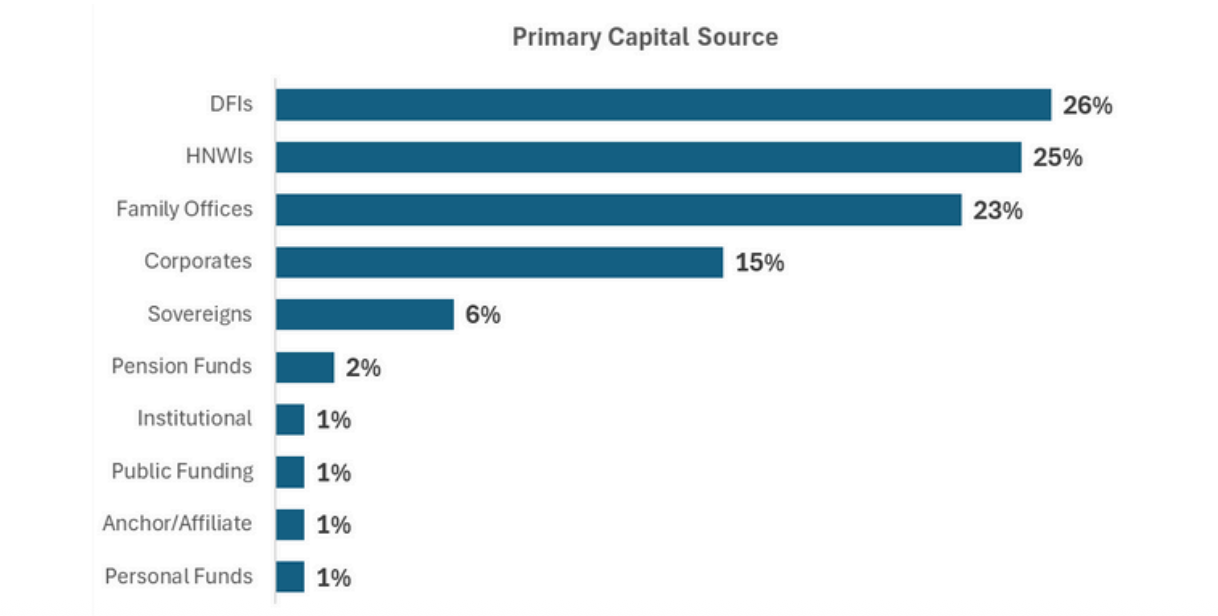
Where African GPs raise funds (by # of LPs, not $ raised).
Source: Rethinking Venture Capital for the African Market
What do you mean by the “strings attached” that come with DFI funding?
Every DFI has its own agenda, shaped by the institution/government that backs it.
For a GP, the complexity comes from taking money from multiple DFIs, with different mandates that might clash. Negotiations around limited-partner agreements (LPAs) become tortuous.
Let’s make this concrete. Imagine you’re an African GP seeking DFI LPs.
A French DFI will say you can’t invest in Mali and Burkina Faso because the new governments there are hostile to France’s interests. On the other hand, a local Nigerian DFI will tell you they only want their money invested in Nigeria. You envisioned a pan-African fund, but you need their money, so you set up a double-accounting system to make sure their specific money only flows to Nigerian investments. Then, an international DFI bars you from investing in Uganda because of Uganda’s position on LGBTQ rights. Lastly, another DFI says you can only invest their money for African expansion. You then have to explain to your Egyptian portcos that they can’t expand to the GCC with your money.
Oh, also, your DFI LPs bar you from recycling capital or investing past year 8, which means you can’t double-down on your winners and thus lose out on alpha.
This doesn’t even include DFIs’ ESG considerations, which bring a flurry of external audits and reporting requirements for both the fund and portcos.
Ensuring every DFI’s mandate co-exists within one fund and one investment thesis requires intense fund gymnastics, which closes doors and slows down GPs. This complexity means DFI money doesn’t act as the “catalytic” capital it was supposed to.
Peering over this whole discussion is Africa’s exit opportunities for these tech companies, which many say are too thin. What’s your take?
As an ecosystem, we’re great at being vocal about the bad things, not so much being vocal about the good things.
Yes, exit depth isn’t where it should be. But the narrative is over-simplified as African being a barren desert for exits. That’s simply not true. Some people have made a lot of money from this asset class. I’ve seen multiple African VCs enjoy fund-returning exits. Oui Capital, which exited its Moniepoint investment for a 53x ($150,000 to $8M) return, is an example. Speaking for LoftyInc, we’ve earned several double-digit DPI exits from our investments in Moove, Flutterwave, Reliance Health, Andela…
Stears and Ventures Platform recently launched the Stears-VP Liquidity Index, which tracks exits in African private markets. Although nascent and far from being complete from a data standpoint, I encourage the reader to dive deeper into those numbers to see where exits on the continent really stand.
Nowhere is this unjustified negative narrative more blatant than in the Jumia case.
Reading the financial press today often depicts Jumia as a bad investment, a struggling company. Jumia is an African-based company that went public in the US. It created crucial tech and logistics infrastructure on the ground. It launched cycles of learnings and knowledge that benefit the ecosystem today. Jumia is an indisputable success. I’ve even overheard people say Paystack (sold to Stripe for $200M+ in 2020) was a subpar outcome.
This attitude leads the ecosystem to minimize its successes. There haven’t been a ton of these exits and that’s normal. In the grand scheme of things, this asset class is brand new here. We have inherent, tricky infrastructure constraints we’re working through. We’re still designing financial products that make the most sense for us.
We should celebrate the successes we’ve had despite these conditions, rather than lament the fact we don’t have Silicon Valley’s exit velocity and volume.
RO Insights: exit benchmarks for a new ecosystem.
As Alyune said, African VC is nearing the end of its first generation of funds. For these first-generation GPs, showing LPs a local “track record” of tech startups exiting was impossible, because there were none.
LATAM’s VCs face a similar conundrum. For founders, conversations with them can also be frustrating, as they themselves have no local exit benchmark they can point to either.
Sebastian Ruales, co-founder of Colombian energy startup Bia Energy, advocates for a simpler approach to this. Here’s how he explains:
“A lot of investors worry about the lack of liquidity. I honestly believe that if they invest in companies that are reinventing industries, taking market share, producing revenue, and satisfying clients, liquidity will follow.
Investors should focus on that rather than trying to find “benchmarks” of similar, VC-backed exits in LATAM. The ecosystem is so young that many startups (such as us) are simply the first to do it. You won’t find a satisfactory local benchmark pool.”
Excerpt from Bia: reinventing Colombia’s energy market, originally published in The Realistic Optimist
Disclaimer: all internal company metrics shared in this article are claims from the interviewee. They have not been independently verified. Do your own due diligence.
The Realistic Optimist’s work is provided for informational purposes only and should not be construed as legal, business, investment, or tax advice.