

Dear reader,
The Realistic Optimist usually writes about startups with a direct, tangible impact on their national market. Think a Tunisian neobank, a Mexican digital auto-insurance, or a Kenyan EV startup.
Today, we transgress our own rules.
We justify this rare trangression by the universal nature of the topic at hand. Kaphera, the subject of this article, specializes in sovereign data sharing.
Behind this admitedly dry jargon hides a simple concept: how do companies share their data with suppliers, partners, clients, and public authorities? And vice-versa?
While this data sharing is crucial for topics ranging from R&D to compliance, it often happens haphazardly. Every data-sharing agreement means new negotiations, messy Excel sheets to track, endless follow-up emails to send...
For companies, this data-sharing inefficiency becomes a serious problem when regulation such as the EU's Digital Product Passport ask them to seriously up their game.
In this interview with Kaphera's co-founder, Mehemed Bougsea, we cover:
1) How a service business turned into a SaaS one.
2) How Kaphera commercializes an open-source framework.
3) How Kaphera positions itself as the philosophical opposite of Palantir.
4) Kaphera's novel steward-owned structure.
5) Why a seemingly less "commercial" company structure can yield better "commercial" results.
6) Why new EU regulation acts as a propellant for the business.
7) Kaphera's various public-private partnership use cases.
... and much more.
Biography
Mehemed Bougsea is the co-founder of Kaphera, a startup helping organizations share their data with clients, suppliers, and public institutions safely. Kaphera’s product enables companies to customize how and which data they share with others, retaining their data sovereignty.
Kaphera is making around €250K in ARR. They are currently closing their pre-seed round, aiming for a €1M close by February 2026.
Prior to Kaphera, Mehemed founded Think-it, a software development agency. Kaphera is a natural evolution of recurring themes his team worked on. He is based between Tunisia and Germany.
What did you see at Think-it that led to Kaphera’s creation?
Think-it is a data infrastructure service company. We specialize in developing sovereign data spaces for organizations, enabling them to share data with partners safely, responsibly, and at scale. We have a deep bench of excellent software engineers, most hailing from Tunisia.
We worked with BMW Group on its strategic Cloud Data Hub. We helped connect BMW employees to crucial data from their own organisation, as well as from their suppliers, public services like the weather, etc. The BMW team needed that data to work on themes ranging from R&D to compliance.
In that quest, the lack of a sovereign data sharing standard hindered us. We’d have to renegotiate data sharing agreements with each third party independently. Even once an agreement was reached, different third-parties shared data in different ways, with different levels of accuracy, formats…
As we looked to standardize this, we stumbled across the Eclipse Dataspace Connector (EDC), nowadays known as Eclipse Dataspace Components, an open-source framework initially proposed by a postdoc from Fraunhofer Institute in Germany. The framework was theoretical but brilliant, and we got to work on putting it in practice.
EDC has become the leading open-source standard for sovereign data sharing, used across Europe and increasingly adopted globally in the US, Japan, Australia… We became lead committers to the open-source project. Word of our expertise got around, and we were approached by other companies that wanted to "operationalize" the EDC protocol for their own organizations.
Instead of starting from scratch every time, we sought to turn EDC integration into a deployable piece of software (while keeping it open-source). That piece of software is the Kaphera product.
RO Insights: the service and product hybrid.
For an early-stage startup, starting with a service business acts as an immediate cashflow generator and serves as a continuous market research function.
Insights the team gleans in its product business can become the base on which a new product is built. Once the product is launched, keeping that hybrid service / product positioning can be powerful.
Pattern, a MENA-focused delivery-tech startup, has both. Here’s how co-founder Yahya Humayun rationalizes that strategy:
“At its core, Pattern builds SaaS platforms for high-growth sectors such as F&B (food and beverage) — enabling brands to launch their own apps, loyalty engines, and operations dashboards.
Alongside this, Pattern Labs — the services arm — partners with global companies across telecom, mobility, and retail to design and deliver complex software systems. This arm is a strategic flywheel: it drives cash flow, sharpens product instincts, and creates privileged access to real-world operational problems.
This hybrid structure helps Pattern move faster, build smarter, and de-risk product bets — all while staying close to the market.”
Excerpt from Pattern: delivery & loyalty-tech for MENA’s restaurants, originally published in The Realistic Optimist
Can you explain, in layman’s terms, what Kaphera’s product does?
We're the cockpit for an organization’s data sharing, helping them share data securely with partners, suppliers, or internally, without losing control.
Our product lets organizations set rules once for how their data can be used. Sharing then happens automatically according to those rules instead of seeking permission every time.
Where we're heading: imagine a simple toggle next to ChatGPT or Claude. "On" means you're plugged into your business ecosystem's data. When you're solving a problem, Kaphera quietly watches. If relevant data from a supplier or partner could help, it proactively suggests: "I found data that might be useful here. Want it?" All the complex infrastructure happens invisibly. The user gets better answers.
We're turning data sharing from a technical headache into an invisible superpower for decision-making.
You position yourself as “what Palantir could’ve been”. What do you mean by that?
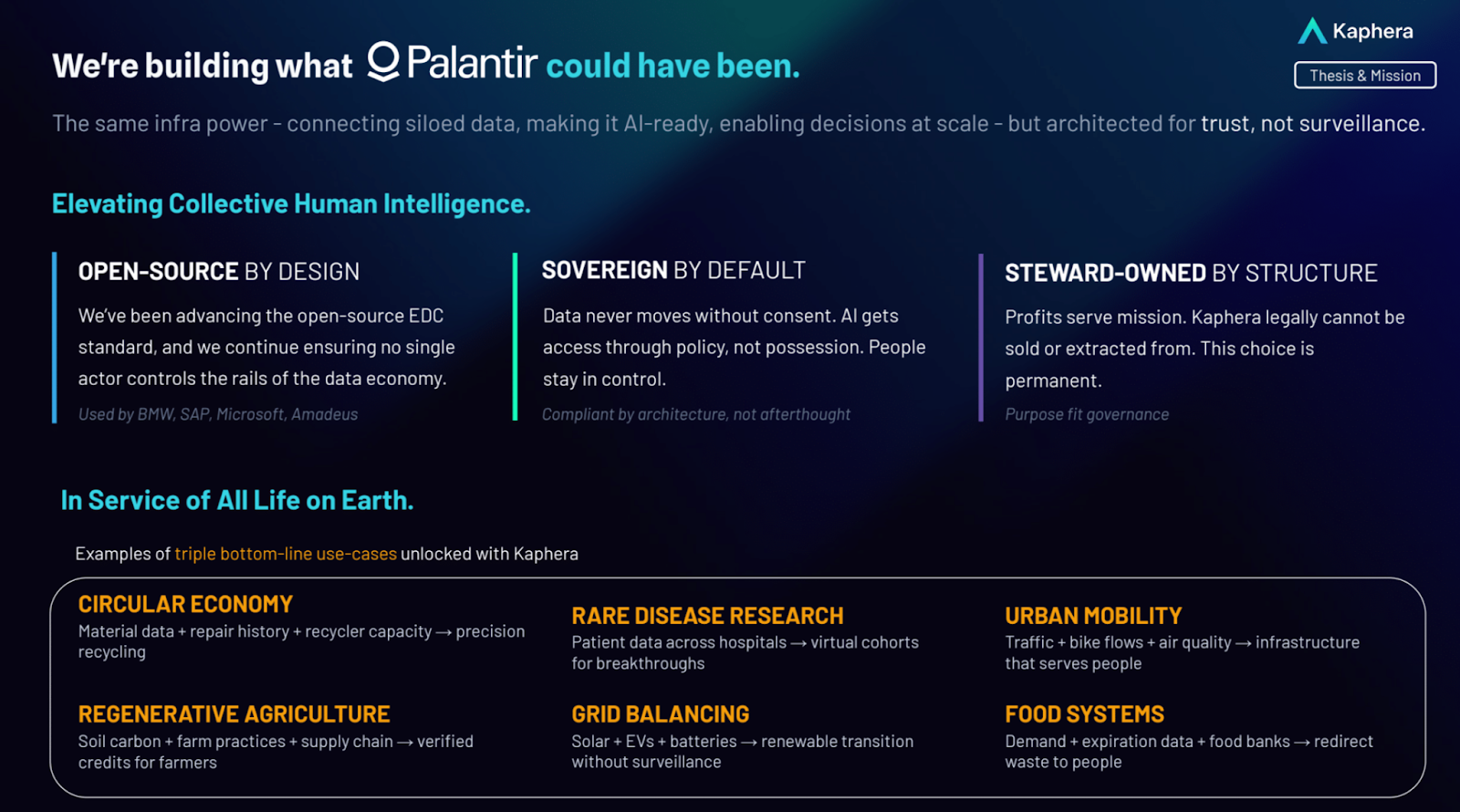
Palantir and Kaphera help companies do the same thing: connect siloed data.
The difference is that Palantir does it in a blackbox manner, while our product uses an open-source protocol. Palantir’s blackbox structure ensures vendor lock-in. We don’t, since the documentation for the framework we use is public.
That doesn't mean our clients’ data becomes public. Our infrastructure is open-source, but the data stays completely private and under their control. In fact, it's more secure than with blackbox systems, because our security mechanisms are transparent and auditable rather than hidden.
The informed reader will also know that Palantir has a reputation for surveillance-based projects. We believe the mix of a blackbox product applied in a mass surveillance manner is societally nefarious. We’d rather unlock siloed data for mass trust and collaboration.
More broadly, we think that the power of connecting siloed data should be unleashed to benefit society, not bolster Palantir’s shareholders’ net worth. That’s also why Kaphera is structured as a steward-owned company.
What does a steward-owned company structure imply?
Kaphera’s primary goal is to achieve a defined mission, instead of solely growing shareholder returns. That mission is inscribed in stone. No one can change it. A steward-owned structure also bars any possibility of the structure’s hostile takeover. Kaphera legally cannot be acquired by another party, unless it's by an organization that shares its mission and values.
Second, investors who aren't operationally involved as stewards (ie: individuals picked by Kaphera’s leadership who are tasked with ensuring the company’s mission stays the course) can profit from Kaphera's success, but they have no say over governance or operations. They make money in two ways: regular dividends as the company grows, and selling their shares to others.
As Kaphera becomes critical to data sovereignty, demand for shares can come from multiple sources. Enterprises who depend on our infrastructure and need to ensure it can't be acquired by competitors. EU institutional investors with mandates to support European strategic autonomy. Corporate venture funds hedging against tech oligarchy, and retail investors betting on data sovereignty as a defining geopolitical shift. Secondary markets on regulated platforms will let early investors sell at market prices.
Third, safeguards exist to protect against rogue founders. If the founder goes rogue, a trustee organization (which I co-founded, but whose governance is decentralized) has a veto right, which it can exercise only if it feels the company’s original mission is being violated.
How have investors reacted to this steward-owned structure?
Reactions have been mixed. Traditional investors who want conventional structures have been skeptical. But some visionary investors have responded very positively.
They see not just the societal impact potential, but a clear competitive advantage. The governance structure itself is the product's credibility. When we tell enterprises their data stays sovereign and secure, the steward-owned structure proves we mean it.
You said that your “infrastructure is open-source”. How do you commercialize something that’s open-source?
The EDC protocol itself is open-source, as its entire documentation is fully public. Companies can, if they desire, send their own team to read that documentation and build an EDC product internally. Or, they can buy a Kaphera subscription and integrate it as a plug-and-play solution.
It was important to us to avoid IP’ing what has historically been an open-source project. Our belief is that the open-source nature of the project will make the framework gain legitimacy. The resulting number of companies wanting help to implement it will yield a sufficient commercial opportunity for Kaphera’s product.
We've watched VC-backed competitors monetize open-source projects by adding vendor lock-ins and then seeing their growth suffer. We didn't want to follow that. We decided for Kaphera to be steward-owned, open-source, and ensure any acquisition must be strictly mission-aligned.
In this specific realm of data infrastructure, it's one of our strongest competitive advantages. Enterprise clients trust us because of our steward-owned nature and everything that implies. When you're asking companies to route their most sensitive data through your infrastructure, a transparent, principled, mission-centric governance becomes an essential part of the product’s value proposition.
Source: Kaphera deck
Your deck states that regulation is a commercial propellant for Kaphera. How so?
The European Union (EU) is implementing laws that oblige companies to access accurate data from their supply chain.
Take the EU’s Digital Product Passport, for example. Quoting from the EU itself, it “aims to enhance transparency across product value chains by providing comprehensive information about each product’s origin, materials, environmental impact, and disposal recommendations”.
Companies in automotive, fashion, manufacturing, and energy (just to name a few) now face an imperative to access granular, live data on their suppliers, their own clients, etc. This used to be absolute drudgery: companies would query these third-parties for data, and would spend hours scrambling over emails, Excel spreadsheets, manually updating the data…
The infrastructure for sovereign data sharing is simply not ready for the scale at which it is now legally required. Kaphera’s product helps companies do that.
Regulation is a commercial propellant indeed, but companies have a commercially-minded reason to do this anyways.
When an automobile company becomes aware of a faulty part, it issues mass vehicles recalls, costing it millions of dollars. If it knew exactly which cars were faulty (thanks to efficient data sharing between the supplier and its own factory), it could save money by issuing a more constrained and precise recall.
RO Insights: the lag between regulatory application and commercial benefit.
Some startups benefit from the application of a new law, which can make their product “mandatory”.
However, there is often a lag between the vote of a new regulation and its application. For the startup, this creates a “Valley of Death” of sorts, where it has to hold on until its product’s regulatory-boost kicks in.
Bibak, which provides reusable containers for corporate canteens, went through that period. Here’s how co-founder Lucas Graffan explains:
“A couple of years ago, the French government passed the AGEC law, which encourages the circular economy transition and takes stronger prohibitive stances against single-use plastics.
Bibak strongly benefits from this regulation. Environment-forward companies can’t rely on the status quo’s goodwill, they need regulation forcing the status quo’s hand. Thankfully, the AGEC law has been voted so it’s quite immune from day-to-day political instability.
However, there’s always a lag with new laws. The law is passed, then the government gives actors a couple of years to comply… we still heavily lobby the government (alongside other actors) to make sure the law is applied swiftly and effectively.”
Excerpt from Bibak: building the circular economy in France, originally published in The Realistic Optimist
What are the most prominent use cases for the Kaphera product today?
The first is precision supply chain recalls for the automotive industry (what I just mentioned). The Kaphera product enables manufacturers like BMW to trace faulty components through supplier networks in real-time. This transforms broad recalls of tens of thousands of vehicles into surgical interventions of just a few hundred, saving millions in operational and reputational costs.
The second is federated AI Training and verification cost-sharing for the media industry. We help major German publishers (ARD, ZDF, RTL) train AI models together without sharing their actual data. The AI processes the data where it lives (at each publisher's servers), rather than the data moving to where the AI lives. This solves the legal/IP concerns that prevent media companies from pooling their content for training.
We also help these media organizations pool their fact-checking work on AI-generated videos and images together, making it a shared utility rather than an individual cost center. This helps smaller outlets maintain a fact-checking rigor they couldn’t afford by themselves.
The third is automated carbon tracking for the manufacturing sector. Here, we help companies track their carbon footprint across complex, multi-partner value chains. In doing so, companies can automate standardized CO₂ emissions reporting from raw materials to the final product. This ensures compliance with upcoming EU regulations like the Digital Product Passport.
Source: Grand View Research
Another interesting use case for Kaphera is public-private partnerships (PPPs). Can you expand on that?
Sharing siloed data is essential for smart city infrastructure to function. We're supporting data space infrastructure across several European cities.
Rotterdam's Open Urban Platform uses digital twins (virtual replicas of the city) for urban planning and mobility.
Barcelona's M3 Mobility Data Space (which we're taking over mid-2026) connects major public transportation organizations to share data for congestion detection, smart lighting... Mobility is often the first data space use case cities implement because the data isn't highly sensitive, the providers are often publicly owned, and the use cases are clear.
Another example (which we’re working on) is building a microbiome library with a Dutch foundation. This connects soil health data, biodiverse agriculture practices, and public health research. As regional partners contribute their soil data while maintaining ownership, this shared resource can inform food regulation and public health initiatives.
A last example would be BMW sharing rainfall data. Modern BMW vehicles have sensors that detect rainfall to operate their automatic wipers. Through secure data-sharing infrastructure, this sensor data can be aggregated and shared with local firefighting departments.
This could turn every connected vehicle into a mobile weather station providing real-time rainfall information across the road network. Firefighters can use the data to see which areas have recently had rain versus which are still dry and at higher risk for fires. This helps them make quicker, smarter decisions about where to focus their efforts.
These projects are in early stages, ranging from kickoff phase to formal confirmation.
In essence, private corporations collect vast amounts of niche data, at a scale public actors cannot replicate. Kaphera enables those private corporations to share select data with public actors while maintaining their data sovereignty, which improves public action.
This also works the other way around: private corporations might gain from historical data that public actors house. Kaphera, once again, enables public actors to precisely configure how and what data private corporations are allowed to tap.
Our bet is that this symbiotic, dynamic sharing of data between private and public organizations is going to become the new normal (and lead to immense socio-economic progress).
What’s been your biggest strategic mistake?
We incorporated in Ireland instead of a country with stronger institutional support for steward-owned companies, like the Netherlands or Germany.
Those countries offer derisking guarantees for early-stage investors, making it easier and faster to raise capital. Ireland doesn't have that infrastructure yet. Many advisors pushed us toward Delaware to ease US fundraising, but we decided against it. We're positioning as neutral global infrastructure, which means adhering to GDPR and European standards. Europe's institutions are also more resilient to hostile takeovers than other jurisdictions, including the US. That matters for generational infrastructure.
Ireland still works. English-speaking jurisdiction, global talent access, proximity to European and US businesses in Dublin. We have the right governance structure. I just underestimated how much institutional readiness matters when building something unconventional.
You, personally, have a strong environmental conscience. Kaphera’s product is heavy on AI. How do you conjugate AI’s environmental impact with your own conscience?
It’s the dilemma I ponder about most. I haven’t found a definitive, clear-cut answer to it. The complexity of the topic probably means I’ll probably never find a satisfactory one.
For me, Kaphera makes previously invisible data visible. In theory, more visible data raises consciousness and resulting action on topics such as the climate crisis. We’re already seeing an exemplification of that with the EU’s Digital Product Passport: Kaphera helps organizations tap private data, which is then made public by law.
Hopefully, this better informs the company itself and forces it to change, as the visibility of consequences makes better long-term decisions clear and necessary. Downstream, the public nature of that data will lead to consumers commercially punishing companies that don’t abide by their social or ecological values, forcing the company to either change its ways or go out of business.
It’s a topic I’m not ethically comfortable about and that’s healthy. I do sincerely believe, however, that the philosophical ethos that drives Kaphera (steward-owned, open-source, focused on societally-beneficial projects) will render our own use of AI a net positive for the environment.
Disclaimer: all internal company metrics shared in this article are claims from the interviewee. They have not been independently verified. Do your own due diligence.
The Realistic Optimist’s work is provided for informational purposes only and should not be construed as legal, business, investment, or tax advice.