

Dear reader,
Some of the most successful technology companies today are Australian. Atlassian, Canva, Airwallex and Afterpay all came out of an ecosystem with a fraction of the venture capital available in the US or UK.
This mismatch, of venture capital fundraising to startup output, is what this article discusses. Below is an interview with Ben Grabiner, co-founder and general partner at Side Stage Ventures, an early-stage fund in Australia.
We explore why Australian founders tend to think globally from day one, how a small domestic market shapes the companies they build, and why the country's biggest constraint may no longer be its ability to produce great startups, but the amount of capital available to fund them.
Enjoy!
Biography
Ben Grabiner is the co-founder and general partner at Side Stage Ventures, an early-stage, Australia-focused seed fund. Since starting in 2022, Side Stage Ventures has deployed an AUD 20 million ($14 million) Fund I, investing in 24 companies. The firm is currently investing out of Fund II, AUD 56.5 million ($40 million).
Ben is from the United Kingdom. He previously worked as an investor at early-stage VC LocalGlobe in London before co-founding Platoon, a music company that discovered and developed emerging creative talent. Platoon was acquired by Apple in 2018.
You went from being an investor, to a startup founder, then back to an investor. What’s that journey like?
I grew up in London and joined Saul and Robin Klein (after they left Index Ventures) to start LocalGlobe as the first employee. It gave me a front-row seat into what it takes to build a world-class venture firm from the ground up.
After that, I decided to start my own company, Platoon. Platoon focused on discovering and supporting emerging creative talent when streaming and online music distribution were just starting off. We built something meaningful and Apple acquired the business in 2018.
Following the acquisition, I split my time between the UK and Apple’s US office. That experience was incredibly valuable because it gave me an inside view of how one of the world’s best companies operates and scales.
In 2021, I moved to Australia in the middle of COVID. What immediately struck me was the quality of the founders and companies here (Canva, Atlassian, Afterpay, Linktree…). Despite these companies, the broader Australian startup ecosystem felt relatively early. That created a compelling opportunity.
Side Stage Ventures began organically. A group of founders, including the team behind Linktree, started investing their personal capital into the next generation of Australian founders. We started off as a founder-led syndicate. Over time, we transitioned Side Stage into a dedicated seed fund.
What drew you to conclude that the Australian ecosystem was early?
Initially, it was more instinctive than analytical. It came from meeting founders and investors. The clearer picture emerged later when we further examined the Australian startup ecosystem.
One of the most striking findings was how capital-efficient Australia is. For instance, Australia has produced similarly successful software companies than the UK, despite raising much less capital. Over the past 25 years, the UK has attracted more than $200 billion in venture capital investment. Australia, by comparison, has attracted less than $40 billion. Yet, Australia has produced multiple decacorn companies (ie: a startup that has reached a $10B valuation or exit).
That stood out to me because VC is a game of producing outliers. If you can generate exceptional companies with a fraction of the capital available to others, you're doing something remarkable.
As we began investing, I met Australian founders building exceptional companies that weren't widely known. It reinforced the view that there was a deep pool of talent operating below the surface.
At the same time, it was obvious that the Australian ecosystem was early. In the United States, there were thousands of high-quality seed funds. In Europe, there were hundreds. In Australia, there were probably only around ten operating at a comparable level.
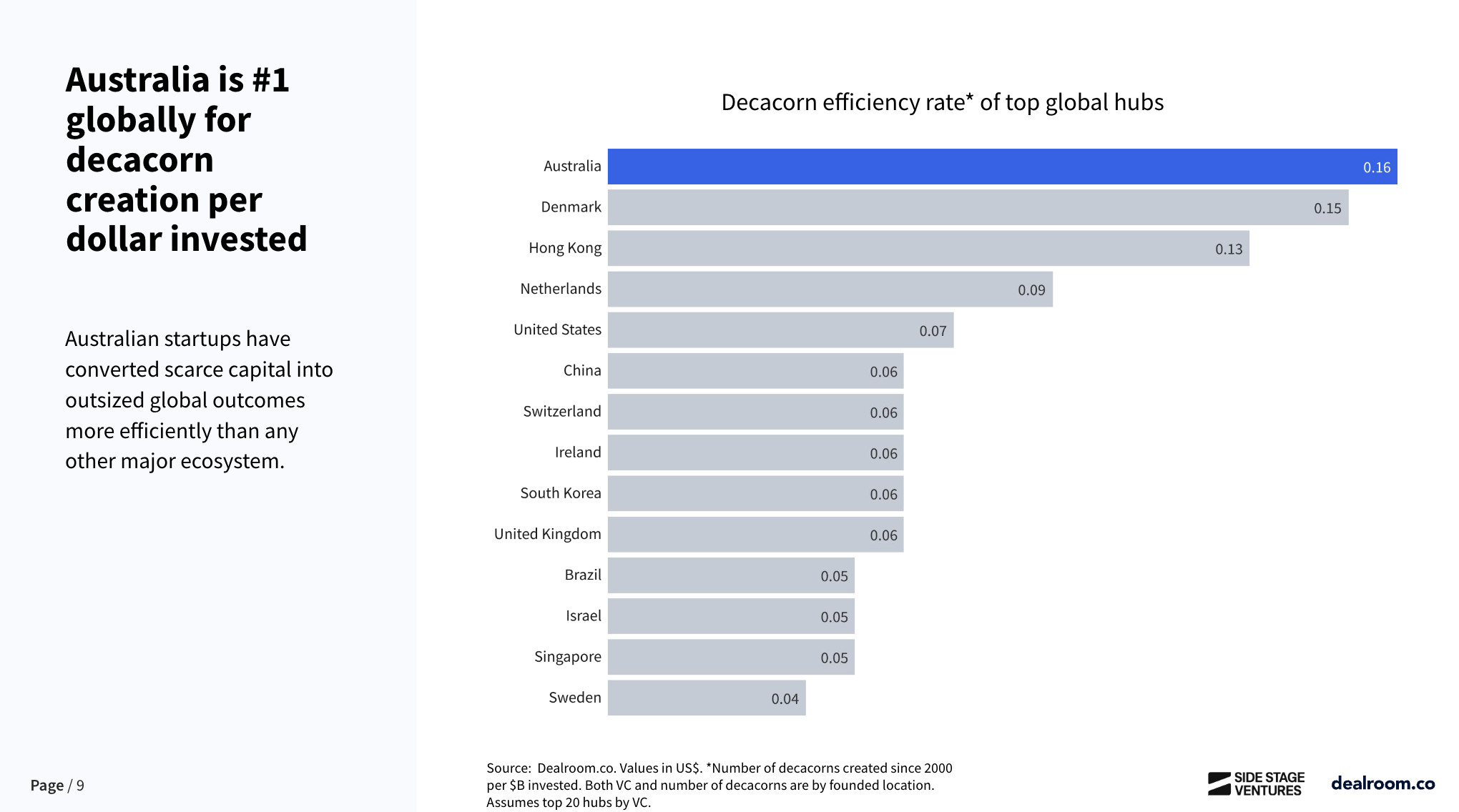
Source: SideStage Ventures’ Australia Outliers Report 2026
Why do you think Australia has been so capital efficient?