

Dear reader,
Today’s article is an interview with Bela Gupta.
Bela is the co-founder of edamama, a mother and baby care company in the Philippines. edamama has raised $30mn since its inception in 2020. They’ve developed a community of over 2 million parents in the Philippines. Starting as an online e-commerce platform, edamama has expanded to offline stores and launched bean, a baby care brand.
In this article, we speak about:
- Why did baby and mother care represent a specialized e-commerce opportunity?
- When should a successful e-commerce platform expand to physical stores and launch an actual product?
- How to scale an e-commerce platform in a country with a strong mall culture?
- What verticals did edamama expand into, to grow its TAM and customer LTV?
- Baby care has a natural endpoint. How does edamama retain mothers after motherhood?
- How is baby care product discovery changing?
Biography:
Bela Gupta is the founder and CEO of edamama, a mother care company in the Philippines. Founded in 2020 as an online store, edamama has since expanded into physical retail and launched its own brand, bean. The company has raised $30 million and serves over 2 million parents.
edamama (incorporated in 2019) is not to be confused with Ed-a-mamma, a children’s fashion company based in India.
Before founding edamama in 2020, Bela was the founder and CEO of AdSpark Philippines, a digital marketing technology company. She previously served as the co-founder and COO of Groupon Thailand, where she led the launch and operations of the company’s social e-commerce platform in the country.
You worked in e-commerce, digital marketing, and venture. How did those experiences shape edamama?
I moved to the Philippines at a time when media budgets were shifting to digital, and the way people consumed information and discovered brands was rapidly changing. On the consumer side, in a matriarchal society like the Philippines, advertisers consistently wanted to target mothers because they were seen as a gateway to the entire family.
These insights crystallized when I became a mother myself. This combination of professional insights and personal experience made me realize how compelling the market could be.
What gap in the Philippine mother care/baby care market led you to start edamama?
My own journey of going through pregnancy, building a nursery, and raising a child in the Philippines engendered a fragmented buying experience. Surveying other parents made it clear I wasn’t alone.
If you searched online for child care products, most options were large marketplaces with very little curation. That created a major trust gap. For new parents, safety and authenticity matter as much as price. Online marketplaces felt chaotic and didn’t reinforce trust among parents.
Offline retail did not solve the problem either. The Philippines is mall-centric, but there weren’t enough one-stop destinations for baby care in malls. Parents would go to one store for gifts, another for essentials, and another for larger baby products such as strollers. The buying journey was inconvenient and scattered.
That fragmentation created the opportunity for a single, specialized store, both online and offline. That idea became the foundation for edamama.
From the beginning, the vision was for edamama to be omnichannel. However, before raising significant capital, we launched online because it felt like the most practical way to begin.
How did the lockdown affect edamama’s early adoption?
We launched our app in March 2020. That timing was fortunate. If we had started with physical stores, the business probably wouldn’t have survived the lockdown.
During the pandemic, we were classified as an essential service because we sold diapers, milk products, and other child care products. People urgently needed our products delivered to their homes. Instead of struggling to convince mothers to adopt the platform, demand accelerated much faster than we expected.
The real challenge was keeping up with demand. We were still very scrappy at the time. The app existed, but much of the backend was manual and still under construction. Fulfilling orders in a strict quarantine environment was one of the hardest things we have ever done.
When did edamama expand into physical stores?
We opened our first physical store in 2023, three years after starting the business. For the first two years, we were online only because the Philippines still had varying levels of lockdown, which would’ve negatively affected a physical store.
Before launching physical stores, we ran tests with pop-ups and expo formats. We launched our first expo in 2022 and continue to run it today.
An “expo” (short for exposition) is an event held up to three times a year, where 250+ brands come together under one roof for a three-day mega-sale. edamama organizes these events end-to-end, monetising through booth rentals, sales commissions, and brand sponsorships, with each expo attracting up to 15,000 new parents.
These experiments helped us understand customer demand and refine the concept before opening a full store. Once we felt confident, we launched our first standalone store in 2023. Today, we operate ten stores—eight in Metro Manila and two outside the capital (in North Luzon and Cebu City).
What lessons have you learned about expanding from online to offline retail?
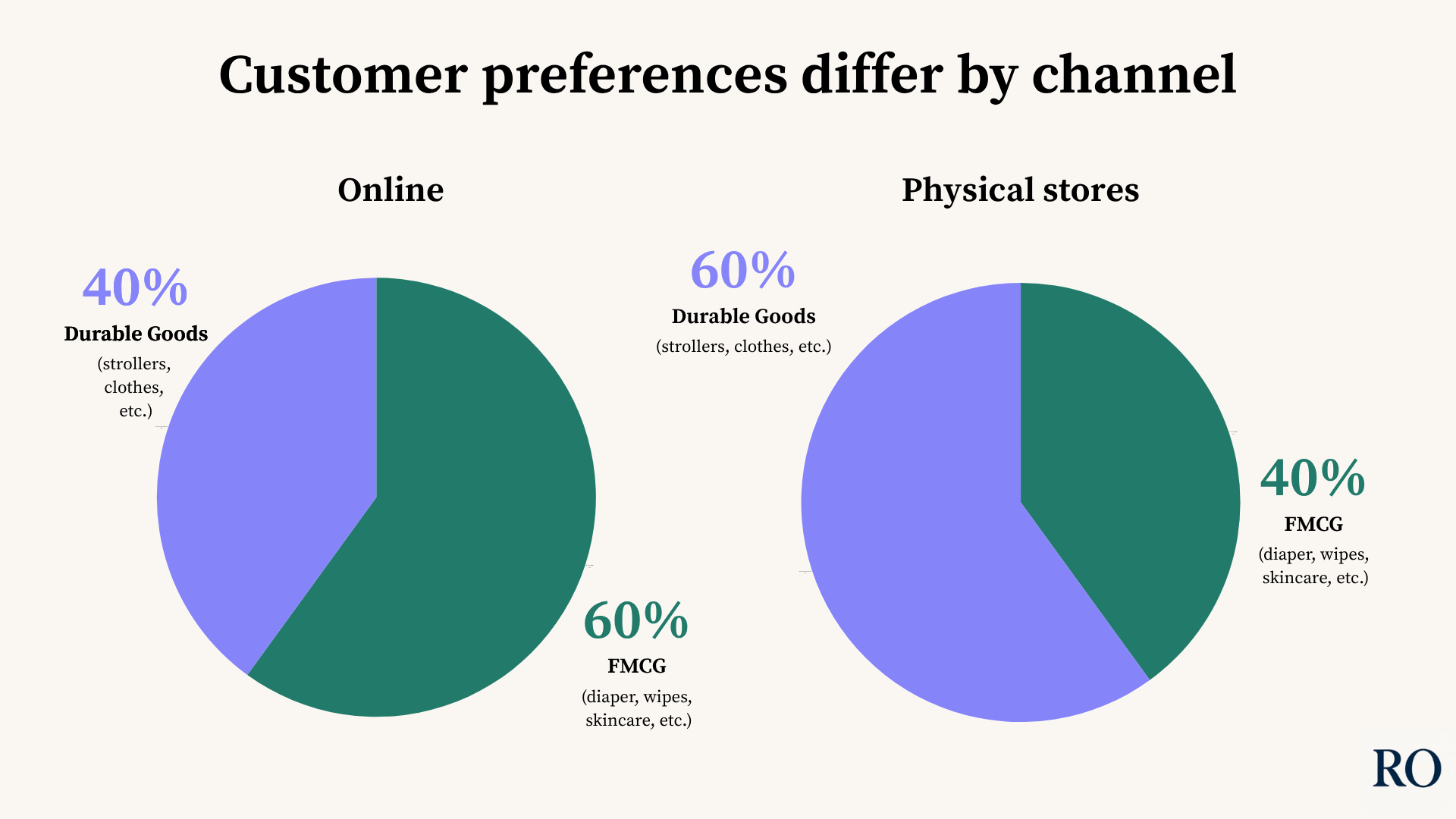
Each channel needs to offer distinct product offerings based on customers’ preferences.
What people buy online is not always what they buy offline. For instance, our customers tend to buy tried-and-tested products online (FMCG products like diapers, wipes, and skincare). Offline purchases are bulky, high-value items like strollers, which customers like to test out before purchasing.
A key lesson for us was to avoid operating both channels in silos. Many companies create separate teams for online and offline retail. We did that initially as well. Only recently did we merge the two so that the company operates as a single, omnichannel platform.
Customers experience one brand. To deliver that, the organization needs shared priorities and overlapping KPIs.
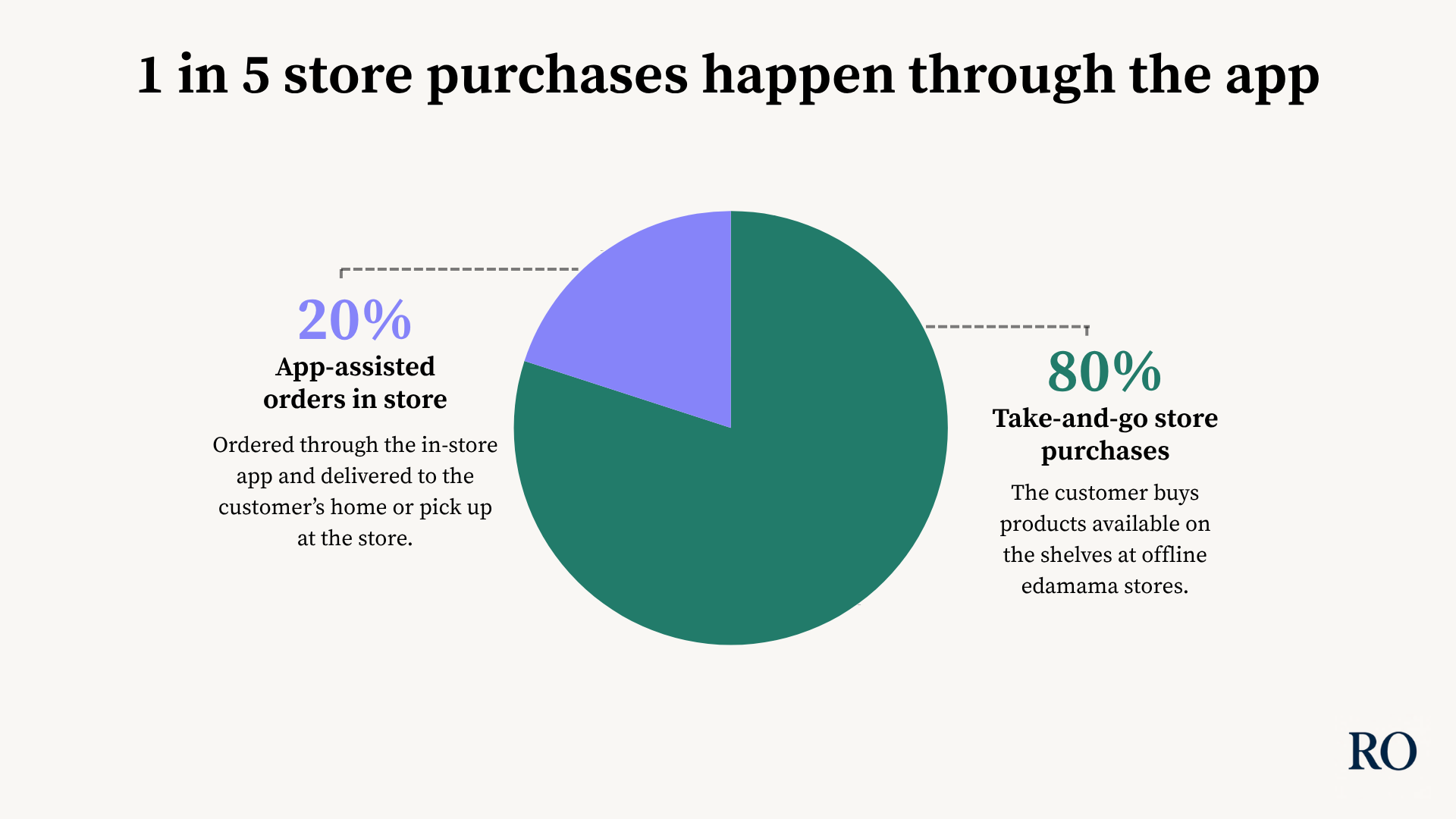
Operating an app-first strategy allowed us to build a community and brand loyalty before expanding to offline stores. Today, 20% of our in-store sales come from customers ordering through our in-store screens (with the product delivered to their homes, or to the store for an in-store pick up).
These screens are essentially the app in a large-screen format, enabling a “limitless aisle” experience. Given that our stores average around 100 sqm, in-store app ordering helps us extend inventory beyond physical constraints, drive incremental sales, and increase awareness and adoption of the app.
What is edamama’s revenue mix, and how do you see it evolving?
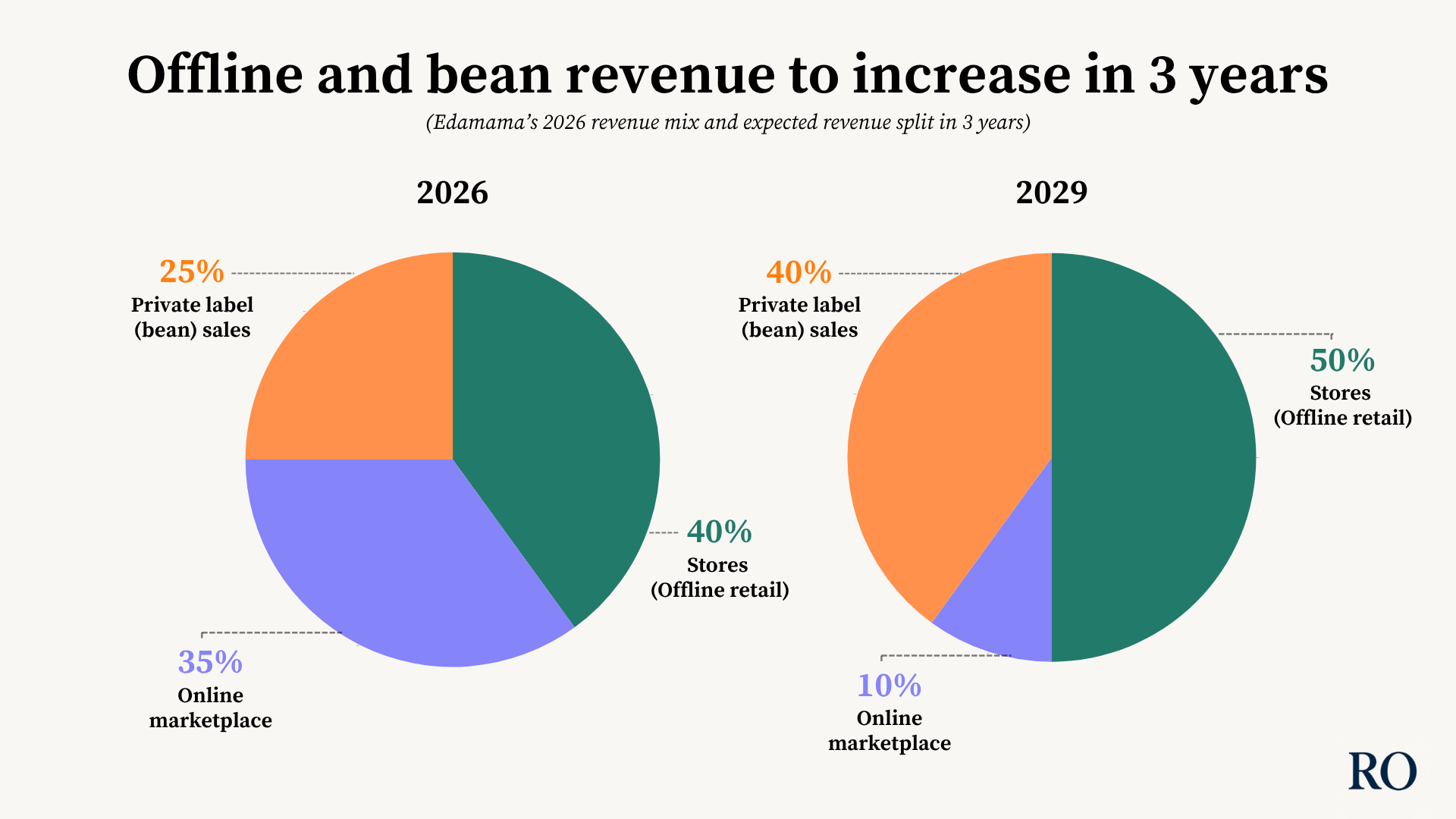
Today, the business has three revenue verticals.
Physical stores account for about 40% of revenue. Online contributes roughly 35%. Our own brand, bean, makes up the remaining 25%.
Over the next three years, we expect the mix to shift further towards offline and bean. Physical stores will likely grow to more than 50% of the business. Revenue from bean should increase to around 40%. Online will remain important, but its share will drop to 10% of revenue.
This direction reflects what we have learned over the past five years. Doubling down on physical stores and direct-to-consumer products appears to be the most sustainable path for the business.
There is still significant room to expand on both fronts (offline and bean). We currently operate only 10 offline stores. There is considerable white space to grow our offline footprint. At the same time, bean is only two years old and already contributes about 25% of revenue.
Why does the pivot to offline make sense?
I wouldn’t call moving to offline a pivot as much as it is an evolution of our business. Online has allowed us to build reach, awareness and a very loyal base of customers. But our vertical demands a more experiential approach to retail where products can be felt, tested and better understood before they’re purchased. Our stores allow for that high touch, immersive customer experience.
Offline allows us to expand channels to where Filipino customers are. The development of the private label has helped improve margins and deepen our connection with customers.
Let’s take diapers for example. For e-commerce this has historically been a loss leader category. The introduction of our own diaper brand allowed us to more than double our margins for this category. We still carry a wide range of diaper brands, but the category now operates more sustainably with healthy unit economics. Private label expansion therefore became a very logical pathway of growth for us and we now offer bean products across several categories.
RO Insights: the Filipino mother is the most valuable consumer in the room
The edamama story is the story of the Filipino mother as a consumer category.
Mothers in the Philippines are not just buyers of baby care products. They are the primary purchasing decision-makers for the entire household (for food, healthcare, personal care, and increasingly, financial products). Brands have understood this for decades, which is why mother-targeted marketing has long commanded premium ad spend.
What changed in the last five years is that the infrastructure to serve mothers in a direct, curated, and trustworthy way was built.
edamama shows that baby care is the highest-trust entry point into that relationship.
Once a mother trusts a platform with her newborn's diapers, the path to skincare, pet care, and school supplies are natural extensions. edamama did just that, steadily expanding the LTV of its loyal customer base.
How do you sell bean?
Besides edamama’s own online and offline platforms, we sell bean products through our partner channels.
Offline, it’s sold through supermarkets (like Marketplace and Shopwise), department stores, drugstores (like South Star Drug and St Joseph’s Drugstore), and specialty retailers (like Toys”R”Us, and Robinsons Department Store). bean is also available online via Lazada, Shopee, and TikTok Shop.
What products do you sell under the bean brand?
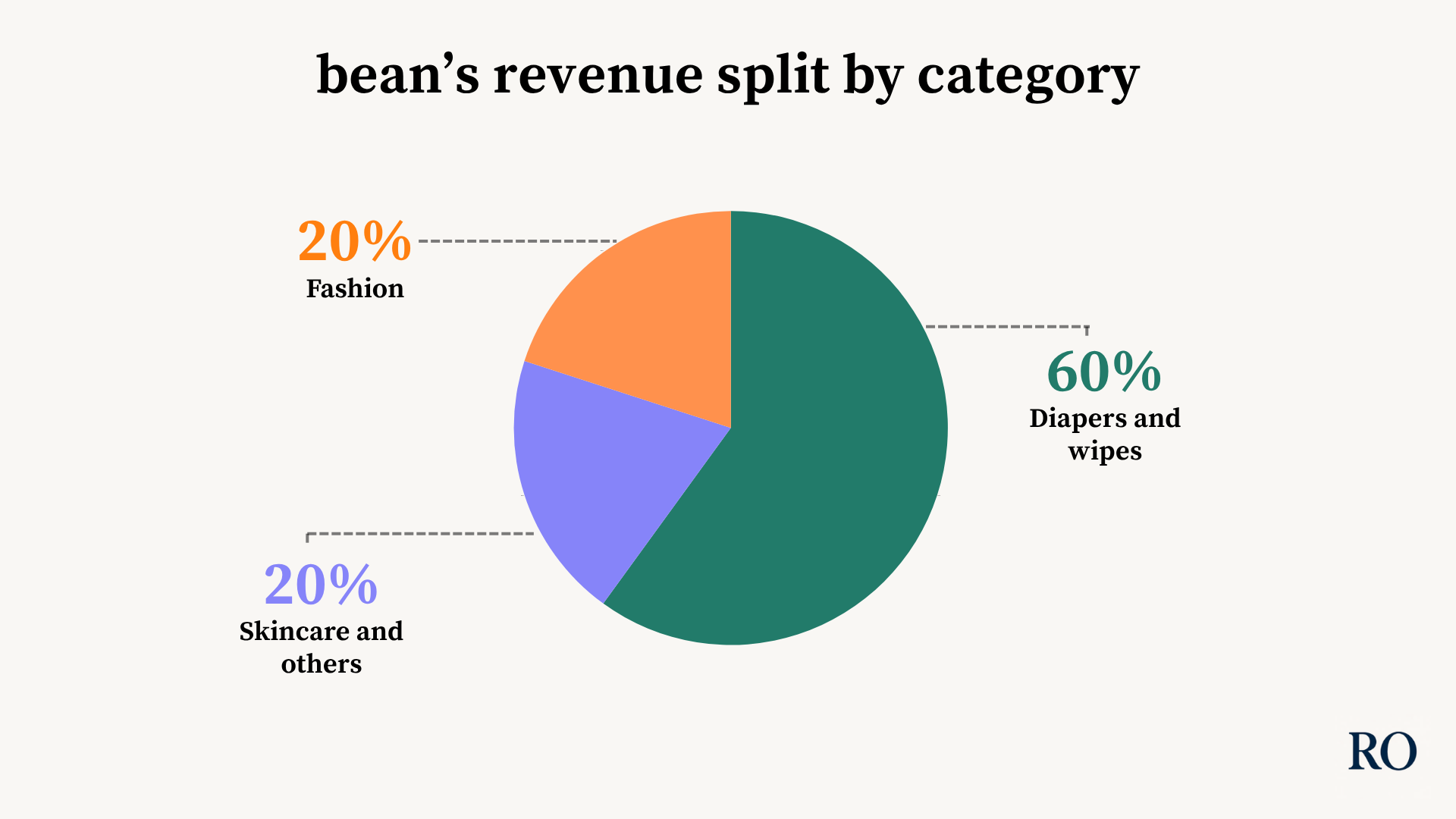
bean currently focuses on three main categories: diapers, skincare, and fashion for babies and young children.
Diapers and related products (wipes, cotton essentials, etc) are the largest category and account for about 60% of bean’s revenue. The rest of the revenue is from baby skincare products and fashion.
How do unit economics compare across edamama’s three verticals?
All three pillars have positive unit economics. We have been very disciplined about maintaining healthy margins across each of them, and that is one reason the business is operationally profitable today.
The bean business has the strongest economics because we control the intake margins. As a third-party retailer, there is always a ceiling on how much you can expand margins. bean helps break that ceiling.
Offline retail is also healthy because it requires far less marketing spend. Online is expensive given the high cost of customer acquisition and performance marketing (primarily Meta and Google ad spends).
E-commerce in the Philippines has also become highly discount-driven. There are essentially two dominant marketplace players competing aggressively (Lazada and Shopee), and the country still has a strong mall culture. Consumers do not always default to online for convenience. Often, they choose whichever option offers the best discount.
That dynamic makes online profitability more challenging. This is especially true for a platform like us (a vertical specialist), competing against large marketplaces with deeper pockets.
RO Insights: overcoming poor customer experience in e-commerce
Established e-commerce platforms often struggle with providing consistent and high-quality customer experiences. This can be due to complex logistics and reliance on third-party sellers for example.
This creates an opportunity for new entrants to differentiate themselves by prioritizing customer satisfaction.
DealCart, an e-commerce platform in Pakistan, addresses this by taking full control of the customer journey, from inventory to delivery, and focusing on essential goods.
Ammar Naveed, founder of DealCart, explained:
“We [DealCart] own the customer experience, because we buy our own inventory in bulk, store it in our warehouses, and dispatch it ourselves. A common complaint about Daraz [a large Pakistani e-commerce company] is their poor customer experience, which we wanted to challenge by managing the end-to-end experience. Additionally, Daraz is focused on higher ticket items such as electronics and fashion, while we've carved our niche in groceries and everyday necessities.”
Excerpt from DealCart social commerce in Pakistan, originally published in The Realistic Optimist
Baby care has a natural endpoint as children grow older. How does edamama think about retaining customers beyond the child’s early years?
edamama’s focus is on the mother’s journey from pregnancy to the first eight years. During this customer lifecycle, our goal is to provide useful products.
Spending is most intense from pregnancy through the first two years, when parents are buying essentials and preparing for a newborn. After that, purchasing becomes steadier and more focused on replenishment. In that phase, we position edamama as a partner for school-related needs (especially during back-to-school periods), and as a gifting destination (during holidays).
The other categories we explored (beauty and pet care) are to extend our existing relationships with customers.
Which socio-economic segments does edamama primarily target?
The Filipino central bank has defined consumer categories based on income levels. Most startups and investors in the Philippines use this categorisation to define their target market.
edamama focuses on households in the A to broad C socio-economic classes. This includes rich, upper-income, upper-middle, and lower-middle households. We do not see segments D and E as sufficiently addressable for our business.
Within A to C, the market is already substantial. This group represents roughly 11–12 million households in the Philippines. The bulk of this comes from the upper middle (~4.3 million households), which have a monthly income of ₱44,000 ($730), and lower middle (~7.5 million households), which have a monthly income of ₱22,000 ($360).
This is the core consumer base edamama is building for: digitally engaged, young families with rising purchasing power.
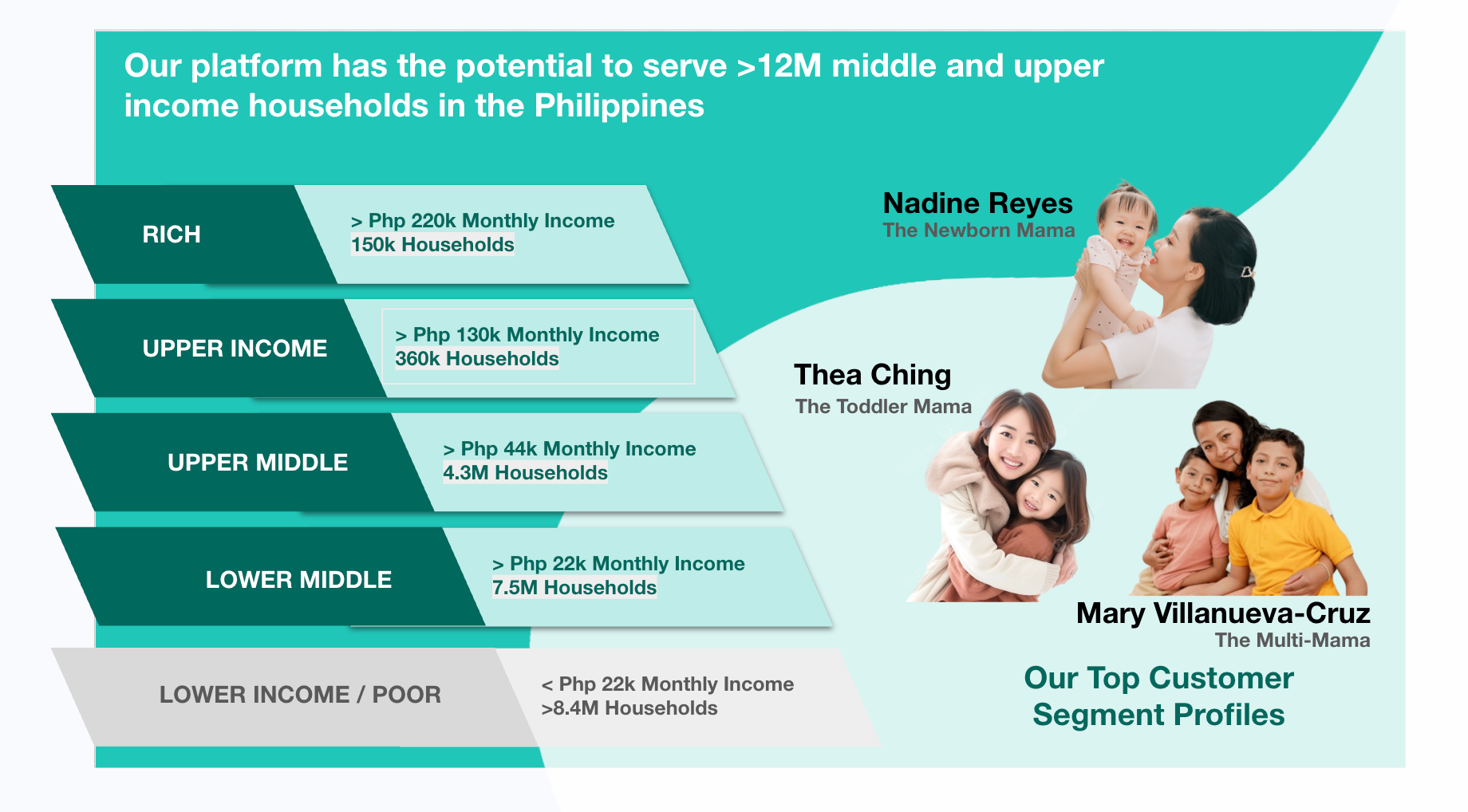
Source: edamama’s internal slides
RO Insights: segmenting consumers in the Philippines
In the Philippines, both companies and investors often segment consumers using a simple framework: income-based social classes.
This framework is widely used by startups and investors to define target markets.
For example, Kaya Founders, a seed-stage VC in the Philippines, focuses on companies building for two segments: A and B, which are convenience-focused power users, and C, which are value-focused mass-market consumers.
Raya Buensuceso, the managing director of Kaya Founders, explains how this framework creates “viable pathways” for businesses:
“For startups, this creates two viable pathways to build a meaningful business. Startups can either build for the top ~5% or for the mass market. But “the mass market” in the Philippines has very different spending power from the mass market in the US or China.
Some industries, and the different companies serving them, illustrate this difference.
In coffee, the premium option is the $3 per cup Starbucks, while the mass-market equivalent is something like Pickup Coffee, which sells coffee at $1 per cup. In mobility, Grab costs $4–10, while motorcycle taxis like Angkas are closer to $1. You can build for either segment, but the key is aligning price points and unit economics.
We have made investments in both kinds of businesses.”
Excerpt from The Filipino ecosystem, explained by a Filipino VC, originally published in the Realistic Optimist
Are you expanding outside the Philippines?
We’re looking at markets where there’s a gap in affordable childcare solutions. Some are developed markets, and some look more like the Philippines. We’re still undecided.
How is consumer behavior among young mothers in the Philippines changing?
Today, discovery and product consideration are increasingly digital-first. In the past, recommendations typically came from family members or doctors. Now, validation through social media plays a much larger role in shaping what parents buy.
This shift has weakened the dominance of some long-established brands. A good example is Pampers, which has long been synonymous with diapers and is now exiting the Philippines this quarter. I cannot comment on the specific reasons, but it reflects a broader trend. Brand loyalty is no longer guaranteed. If mothers find a product that better meets their needs and offers better value, they are willing to switch.
At the same time, local brands are gaining traction. Multinational companies often follow a standardized approach, selling the same products across markets with only minor adjustments. Consumers are increasingly looking for solutions designed specifically for Filipino needs. We have seen this firsthand with bean. Many customers take pride in using a local brand that understands local pain points and offers both product fit and value.
This shift is not limited to baby care. It is happening across consumer categories. Loyalty now has to be earned and constantly maintained. Discovery has also changed dramatically. With platforms like TikTok and the rise of content-to-commerce, people are often more influenced by recommendations from other mothers online than by traditional authorities.
That shift in trust and discovery dynamics creates a major opportunity for localized brands.
RO Insights: what does Pampers' exit from the Philippines mean?
Pampers is exiting the Philippines. It is a signal worth reading carefully.
The diaper category is one of the most habitual, highest-frequency purchases a young family makes. And one that edamama caters to.
This category requires trust, price-pack alignment, and an understanding of how Filipino mothers (particularly in the C income segment) make purchasing decisions. Multinationals have historically competed on brand equity built through decades of advertising. That equity is eroding.
What is replacing it is a combination of social validation and local fit. Discovery for young Filipino mothers has moved decisively to TikTok and peer communities. Recommendations from other mothers in online groups now carry more weight than any television campaign.
In this environment, a local brand that shows up in the right format, at the right price, with the right endorsement from a trusted voice in the community, can displace an incumbent that took decades to build.
Data from Bain on SEA consumer trends corroborates this. Local and regional brands now command over 50% of FMCG value across Southeast Asia. The Philippines is one of the markets where the top players are losing ground fastest to challengers. Multinationals built for standardized global markets are finding that the Filipino consumer is increasingly unwilling to accept a product designed for someone else.
What was the common pushback you faced while raising capital?
The Philippines receives less venture attention compared to markets like Singapore, Indonesia, or Vietnam. This forced us to pitch the market and the company.
We often had to explain why the Philippines was an attractive opportunity. That surprised me because the fundamentals are strong. The country has a population of around 100 million, a young demographic profile, and significant growth potential in consumer technology.
Another concern was the lack of large technology exits historically. That made some investors cautious about the ecosystem. The situation is improving now as more capital flows into the market and a few notable deals and exits emerge (Gojek’s acquisition of Coins.ph, PayMongo, and Sprout Solutions’ respective fundraises, etc.).
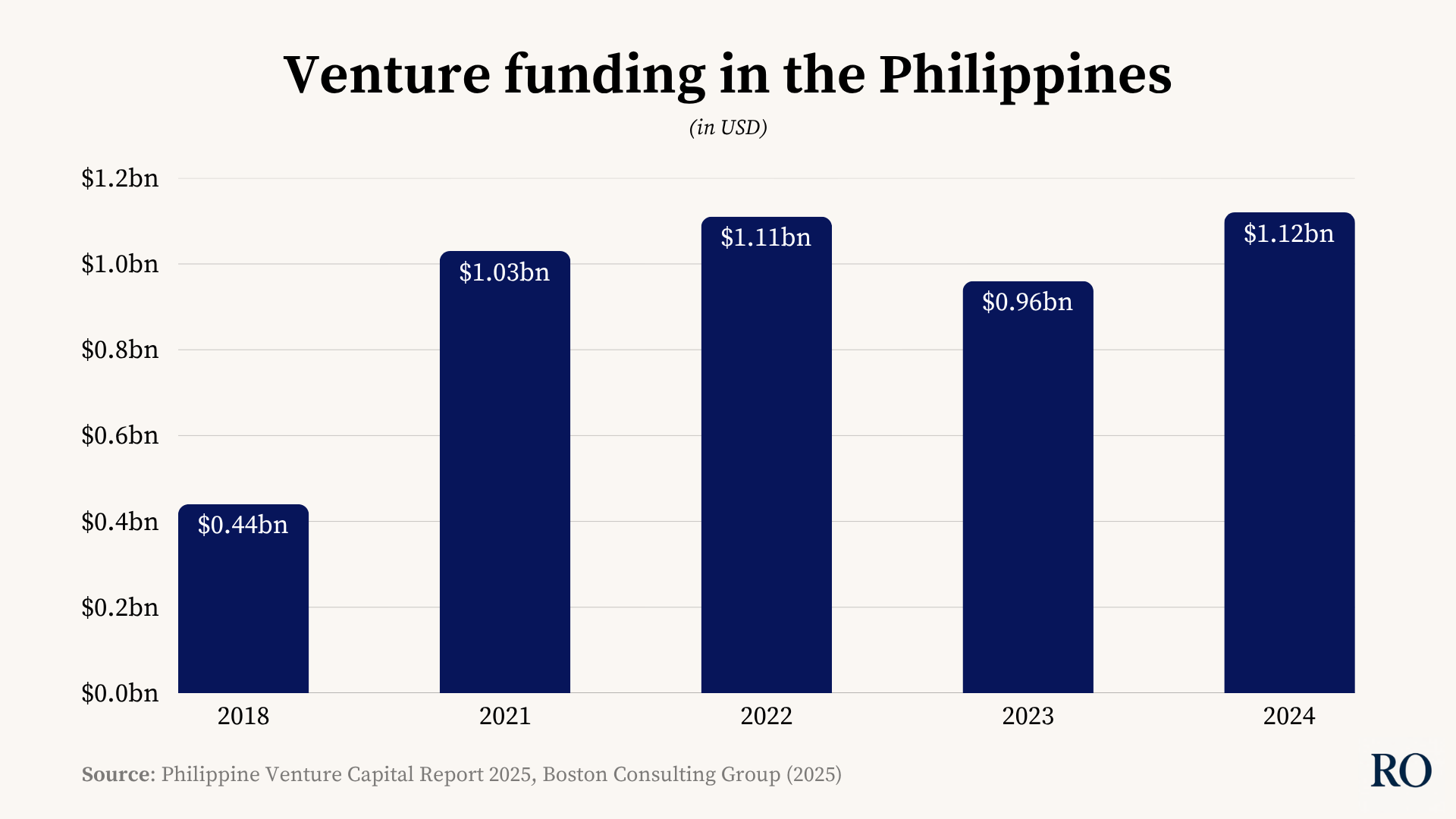
Source: Philippines Venture Capital report 2025, BCG
For edamama, investors questioned the capital intensity of e-commerce. Marketplaces in India and Southeast Asia have raised billions to scale. The key question from investors was how we would reach profitability despite those dynamics.
What are the biggest misconceptions investors have about the Philippines?
One common perception is that consumer spending power is limited. While there are real income constraints, this has led many investors to believe that only hard-discount or everyday-low-price models can succeed. In practice, that is not entirely true. Filipino consumers are willing to spend on products that offer clear value, especially when it comes to trusted, well-designed, and locally relevant brands.
Another concern relates to the ease of doing business. Investors often worry about regulatory requirements, foreign ownership rules, tax structures, and broader geopolitical considerations. These factors can create hesitation. While these challenges exist, they are manageable with the right local understanding and partners.
There is also the question of exits. Some investors assume the Philippines is not large enough or does not have sufficient addressable demand to produce major outcomes. However, sectors like baby care and consumer goods more broadly are large and growing, with strong underlying fundamentals.
Often, these misconceptions come from investors who have not spent enough time in the market. Once you are on the ground, you begin to see both the scale of the opportunity and the specific problems worth solving. For patient early investors, the upside can be significant.
Disclaimer: All internal company metrics shared in this article are claims from the interviewee. They have not been independently verified. Do your own due diligence.
The Realistic Optimist’s work is provided for informational purposes only and should not be construed as legal, business, investment, or tax advice.