

Dear reader,
When you turn on the lights in your room, seldom do you think of the labor, engineering, design, conflict resolution, and daily maintenance that went into your city's electricity grid.
Same goes for payroll. The web of companies, software, and underlying humans that careen your salary to your bank account every month is obfuscated. When your salary doesn't land though, the importance of that payroll infrastructure becomes salient. For people living paycheck to paycheck, faulty payroll infrastructure can yield devastating consequences.
Cercli, a UAE-based startup, is laying the digital pipes that makes payroll (and other HR processes) run smoothly in MENA. They recently raised a $12M Series A.
Below is an interview with its co-founder and CEO, Akeed Azmi. In it, you'll find:
1) What Akeed's experience at two of MENA's largest startup successes (Careem and Kitopi) equipped him with for Cercli.
2) The holistic MVP Cercli had to construct (companies don't "test" a new payroll software for fun).
3) Cercli's YC experience, and what they took from it.
4) Why Cercli has no "official" prices for any of its products, and how it set up its sales strategy.
5) Cercli's international expansion strategy.
6) How Cercli differentiate themselves from their global, bankrolled competitors (Deel, Oyster, Rippling...).
... and much more.
Biography
Akeed Azmi is the co-founder and CEO of Cercli, a UAE-based startup helping companies run their local and remote payrolls, HR, onboarding, compliance, expenses and more.
Cercli recently raised a $12M Series A. Over the past year, Cercli has scaled revenue more than 10x and now processes over $100 million in payroll for businesses across 50 countries.
Prior to Cercli, Akeed was head of operations at Careem and director of global growth & expansion at Kitopi.
You worked for two of MENA’s breakout startup successes (Careem & Kitopi). What did that experience equip you with?
A tangible understanding of what building such companies takes. The grit and perseverance I experienced at Careem and Kitopi displayed what the table stakes for building exceptional companies were.
Specifically, both experiences stressed the importance of pursuing a bigger why. Organizations that last are purpose-driven. Careem’s societal purpose is enshrined in its company culture and gives its team resilience during difficult periods.
My co-founder, David, is ex-Careem ( which is where we met). We sought to replicate this ethos in Cercli through our own “alignment memo”. This memo doesn’t even mention our product. It crystallizes our purpose, which is “unlocking the potential of people and their organizations”.
I also learned how to scale delicate operations. At Kitopi, we delivered food en masse. Mistakes meant potential sanitary risks and endangering our customers’ health. Cercli is similar. If someone is living paycheck to paycheck, messing up on their payroll puts them in serious trouble. There is zero margin for error.
What’s Cercli’s genesis?
I used to be blissfully unaware of how clunky and messy payroll systems could be, especially at larger enterprises.
During a leadership meeting in a former role, I realized we were using decades-old ERP software to pay our staff. It is nonsensical for any large enterprise to use tools built for a manufacturing era prevalent 50 years ago. Not paying staff on-time had a serious impact on these people’s lives. Using bad software increased the chances of that happening.
As I dug deeper, it became clear that the problem was widespread, both at large enterprises and medium-sized operations. Nobody had built localized digital rails for MENA’s HR processes such as payroll, compliance, expenses, and leave management.
This became the inspiration for Cercli.
What problem did you tackle first?
An “MVP” for us meant something more comprehensive than is customary.
Companies don’t just “test” a new payroll software for fun. That software is so engrained into their workflows and daily operations that they need a compelling reason to switch.
We co-built the first product alongside our customers. We sent engineers to look over their shoulders as they went through their HR motions. We sketched interactive Figmas, for prospects to play with. When those Figmas looked like something they would actually use, we coded away.
You went through YC. Is it as good as the lore purports it to be?
Two positive influences spring to mind.
First, YC pushed us to sign contracts with early prospects. Not letters of intent (LOIs), not design partnerships, but priced contracts. This was a great propellant. Getting someone to pay drives you to the root of their core problem.
Second, YC is founder therapy at scale. Going through the program allows you to meet founders from all stages, being vulnerable, at a volume you can’t find anywhere else.
Cercli now offers various products (payroll, application tracking systems, compensation management, etc…). How have you structured pricing and sales?
No prices are listed on the website.
For the same product, what a customer is willing to pay varies according to the product’s salience to their current situation. That is how a market works and it would be wasteful to restrict ourselves to a single, imperfect price.
Cercli is building a platform of adjacent and complementary products. Rather than trying to prescribe a limited solution to any given situation, our sales team can recommend the most suitable product to the prospect at hand. That luxury of choice builds immediate trust with the customer. From there, there is scope for our sales team to expand the commercial relationship by gradually offering other, related products.
For example: if a German customer is hiring engineers in the UAE, we can enter the account with our localized payroll product. Once trust is established, we can offer that customer our application tracking system (ATS) to handle those engineers’ applications.
This is beneficial because our CAC is one-shot. Once we’ve entered the account, additional revenue gained from additional products comes at virtually no acquisition cost to us.
RO Insights: pros and cons of "bespoke sales"
Every Cercli sale is different. This makes standardization harder, but potential customer loyalty stronger.
Prima, a Mexican startup providing manufacturing services for large clients, has a similar approach. Here’s how Juan Pablo Ramos, Prima’s co-founder, explains its pros and cons:
“Our prospects are making consequential procurement decisions. Sales cycles are long, technical, and complex. They require contractual sophistication and financial engineering.
We’ve assembled a team of senior and experienced business development executives. Additionally, we’ve built a deep network of commercial ambassadors composed of industry veterans. That boosts the generation of trust, this industry’s bread-and-butter.
Contrary to a classic SaaS product, every sale is different. We don’t come in with a product, run a demo, and get the prospect to buy. We’re either competing on an RFQ, or granularly scoping a new project with a client. Metrics like CAC and LTV are hard to measure. Establishing a repeatable and predictable sales process is difficult. On the flip side, once you deliver a project on time and in full, that same client will likely place future orders.”
Excerpt from Prima: revitalizing Mexico’s manufacturing industry, originally published in The Realistic Optimist
Which product was hardest to build?
There is some recency bias here but I would say payroll.
Building a payroll product is a never-ending, iterative process. Labor laws change. An employee’s days off need to be reflected in payroll, but a company’s days off policy evolves. There are endless permutations to account for.
What’s been your biggest product flop?
I am happy to say that we are still too young (or perhaps too lucky!) to have experienced a major product flop.
We protect ourselves by co-constructing our roadmap with customers. Customers can reach us (and me) anytime via WhatsApp, Slack, email…. Our governance structure is also built to minimize risk, as we have a customer advisory board. We are deeply embedded in our customers’ workflows. That is a superpower and derisks our operations.
A good yardstick we like to use when crafting our roadmap is asking customers: if you had $1M to build internal tools, what would you build?. Answers to this question are a good starting point.
We also use our own product internally for our own HR purposes. This yields useful ideas. We don’t extrapolate these dogmatically though, since our business isn’t wholly representative of the ICP breadth we serve.
What does it mean for Cercli to “open” a new country?
Our thinking here is different from a food-delivery app, for whom “launching” a new country implies a local team, local drivers, local marketing, local restaurants, etc.
With regards to international expansion, we follow a similar strategy to our product roadmap. If a customer has (for example) payroll requirements in Iraq, we will assess the situation and execute for that client specifically and rapidly rather than spending months on laboured market-entry planning. If a market opportunity for further scaling presents itself, we will pounce on it. If that requires new, more substantial infrastructure to be built and new partnerships established, we’ll undertake those.
We don’t pursue knee-jerk, half-baked new market launches like some startups did during ultra-low interest rate days.
RO Insights: international expansion for enterprise clients
“International expansion” can mean two very separate things for a B2C and a B2B startup.
While a B2C startup “launching” in a new country generally implies a physical presence and localized marketing, a B2B startup can be pulled into new geographies by virtue of its clients’ global presence.
Akeed alluded to this. Bibak, a French startup that replaces single-use plastics with re-usable containers, adopted a similar mentality. When serving corporate canteens, Bibak might simply follow its clients’ desire.
Here’s how Lucas Graffan, Bibak’s co-founder, explains:
“We’re lucky to have large corporates within our client base, many of whom have offices around the world. Following them around is an evident expansion path as well.”
Excerpt from Bibak: building the circular economy in France, originally published in The Realistic Optimist
Who’s your ICP?
We use a scorecard for this, adapted to where our product currently stands. We are targeting regional, mid-market/enterprise companies who are poorly served by their legacy HR or ERP software.
Payroll is a huge market where essentially every employed worker is “TAM”. We currently serve anyone from banks, startups, marketing agencies, recruiting firms, nurseries, and more.
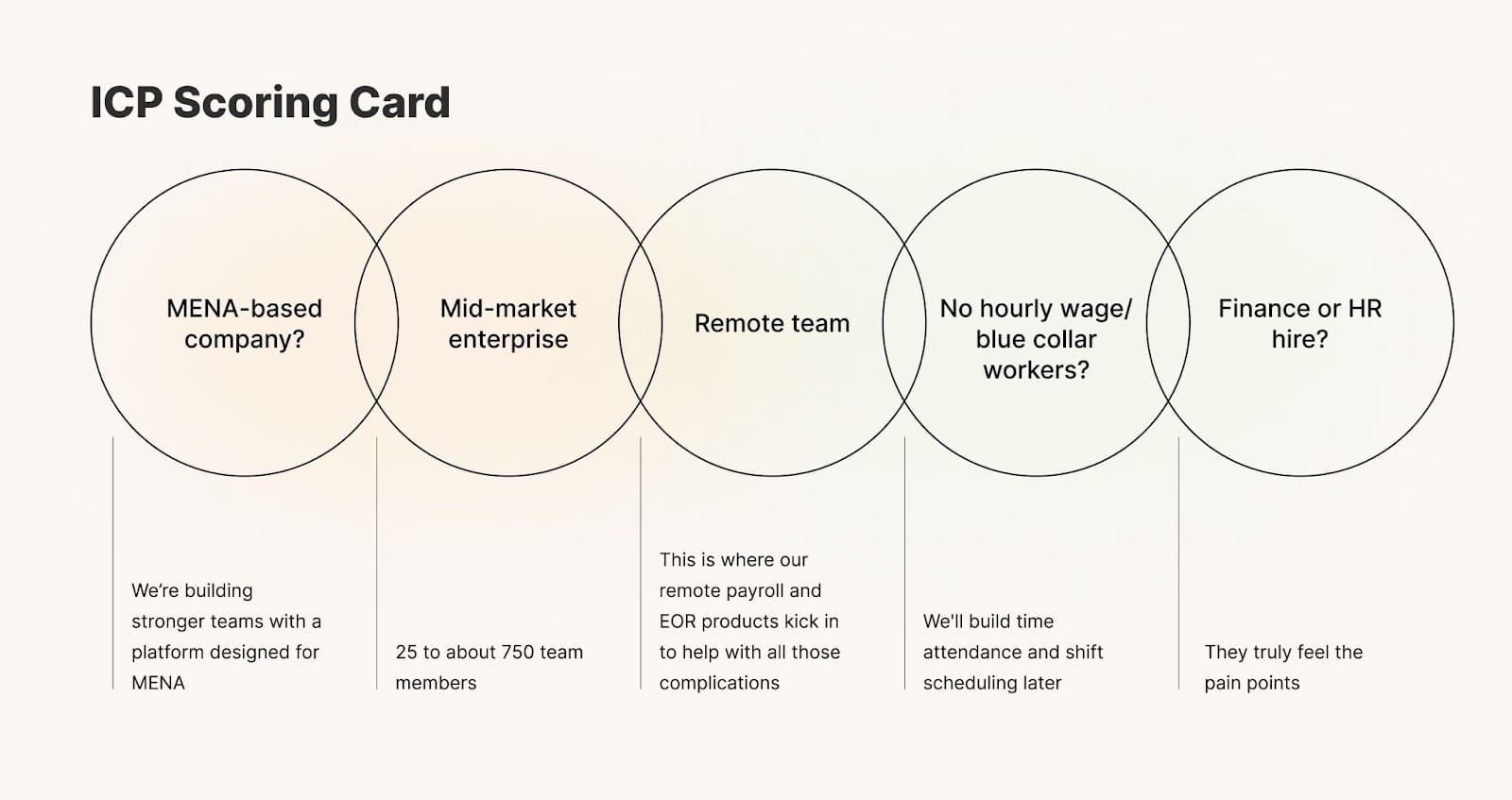
Cercli’s ICP scorecard
How are you differentiated from better-funded, massive HR tech players (Deel, Oyster, Rippling)...
A company being global in nature doesn’t mean it always wins. Uber was a global concept, but Careem scaled in MENA, Grab scaled in SEA. There is plenty of localization that global players simply can’t construct from scratch every time they enter a new market. Global payroll is a $100 billion market after all, growing at over 6% a year, which leaves plenty of room for other players (such as Cercli) to build great companies.
Payroll is even more localized than ride-hailing due to labor law intricacies and tax peculiarities. Cercli is building the MENA compliance engine which these global players haven’t touched yet.
That being said, our goals are both local and global. Naturally, we want to be a market leader in our (original) home markets. But with the MENA region’s robust economic growth and its companies successfully exporting and operating across different continents, we automatically become a global player ourselves.
Some customers switch to us from the players you mentioned because our products are more contextually-relevant. We are intent on laying the HR “plumbing” for the region.
One of your Series A’s goals was to accelerate Cercli’s shift to an “AI agent-native” product. Can you elaborate?
HR tech is a magical space. It is both enduring (individuals and organizations will always exchange value) while perfectly suited for AI disruption.
Actions and decisions taken in HR operations are context-dependent. A person desires time-off; but how much time have they already taken? An enterprise wants to hire somebody; what bank do they use and how can we pay them? We need to let go of this person; what’s a relevant compensation package? These decisions are crafted on an individual basis.
AI enables context to be baked in. Our customers can now easily query the context required for a particular decision, rather than scavenging through their tools to find a specific piece of information.
Agents push the cursor further, by enabling agents to carry out contextually-relevant actions on a customer’s behalf. For example, an AI recruiting agent can tailor their recruiting and outreach approach based on the entirety of the company’s HR history (what types of profiles worked out, which didn’t, etc).
What’s your thorniest operational challenge?
Scaling our (human) hiring process while maintaining the intentionality of our early days. I’m still involved in every recruitment process.
On hiring: what are you doing differently now than in the early days?
A couple of things.
First, really stress testing if we’ve earned the right to hire someone. We have a series of internal metrics which help guide our hiring of the next person in a team or function (e.g. revenue, product build, % of payslips/users), so we can measure headcount additions and be sure we definitely require them.
Second, having a clear metric of success for people you hire. Lacking one breeds frustration on both sides.
Third, reducing the importance of logos. I now index more heavily on whether a person has a founder personality or not (early employees need to be founders in spirit) rather than where they worked before. We’re intentionally recruiting people who see Cercli as a training ground for their own future company.
Fourth, being confident in our alignment memo as a filter. In the early days, I beat myself up when some qualified people refused our offer. I have now realized that if our alignment memo is written truthfully, people who turn down our offers simply aren’t a good fit for the company regardless of their qualifications.
What’s your strongest held opinion?
We believe the age of the traditional ERP is dead. These systems were built for the manufacturing economy of the 80s and not today’s modern workplace. Enterprises have historically shelled out millions for legacy ERPs such as Oracle or SAP, that are primarily purchased to solve accounting/finance needs. Or, they use the likes of Workday and manage all aspects of payroll via aggregators, BPOs, internal hires…
AI foundation models and agents have breached the moat that kept ERP systems of record safe for decades. We can now clean and structure data automatically, meaning system migrations can be done faster. That collapses implementation time and cost, which was the very friction discouraging customers from ripping out Workday, SAP or Oracle-era deployments.
We know a major opportunity exists to build up into this lucrative, all-but-untouched segment (with localization as a wedge) and to displace the 800 pound ERP gorillas in the room.
Your Series A was led by Picus Capital, a European fund. This was their first investment in MENA. How have foreign investors’ opinion of the region evolved?
Countries in MENA are startups of their own. They are building, in 30 years, what other countries took 300 years to set up. The speed of change is dizzying.
Foreign investors are realizing the enthusiasm with which governments are pushing innovation, especially in the GCC. Laws are changing, capital is invested, foreign funds and talent are courted.
The MENA region is flourishing economically, reaping more and more ecosystem dividends every year. MENA’s first golden generation of modern entrepreneurs have grown their ventures, successfully exited, and have started to reinvest in other projects. That recycles capital, inspires the next generation of entrepreneurs who can identify with role models, and attracts more talent to the region.
Disclaimer: all internal company metrics shared in this article are claims from the interviewee. They have not been independently verified. Do your own due diligence.
The Realistic Optimist’s work is provided for informational purposes only and should not be construed as legal, business, investment, or tax advice.