

Dear reader,
The Realistic Optimist recently spoke with Richmond Bassey, the co-founder of Bamboo, a Nigerian fintech startup.
Currently sporting over 2M users, Bamboo has enabled many African retail investors to invest in public equities (US & Nigeria) and fixed-income products (ie: bonds) for the first time.
According to Richmond, Africa houses 373M people with investable income. They've still got a long way to go.
In this exclusive RO interview (clocking in at 4,000+ words), we discuss:
- Bamboo's genesis
- Bamboo's original & current tech + legal 'stack'
- How Bamboo manages USD - Naira conversions for its users
- Why Bamboo opened Nigerian stock market investing (and the reasons behind the Nigerian stock market's recent boom)
- Richmond's view & advice on regulatory matters
- Bamboo's B2B arm
- Bamboo's growth strategy
... and much more.
Please enjoy.
Biography
Richmond Bassey is the co-founder and CEO of Bamboo, a Nigerian fintech startup.
Founded in 2019, Bamboo enables African retail investors to invest in US stocks, Nigerian stocks, Naira savings, and fixed-income products such as Nigerian treasury bills and USD fixed return. They also launched a B2B vertical to enable institutional investors and corporates to utilize its infrastructure.
In 2022, Bamboo raised a $15M Series A. Bamboo operates in Nigeria, Ghana, South Africa, and is preparing its expansion to Kenya. Bamboo has 2.3M users (40% of which are active investors) and has processed over $1.3B since inception.
Prior to Bamboo, Richmond was chief of staff at Helium Health, a leading Nigerian healthtech startup.
What problem is Bamboo solving?
I’m part of a specific class of Nigerians: urban, young, digitally-savvy, with disposable income I want to invest.
When I started thinking about Bamboo, the Nigerian stock market was still reeling from the 2008 financial crisis and its performance was weak. In 2019, yields on Nigerian government bonds crashed. Compounded with the Naira’s depreciation, most forms of local investing were either disappointing or a loss-making venture for Nigerian retail investors.
My friends in the UK had access to platforms like Robinhood and Freetrade, which enabled them to invest in the US stock market. I wanted to invest in it too, but couldn’t do so from Nigeria.
I sought to understand why. I realized that there weren’t any laws barring Nigerians from holding foreign securities. Rather, the infrastructure to facilitate such transactions didn’t exist.
My co-founder and I spent 12-18 months figuring out the legal, technological, and operational framework that would make this possible. We launched Bamboo in October 2019.
What was the “stack” you needed in order to launch Bamboo?
We needed three components. These three components existed but hadn’t been assembled for our specific use case. To be frank, Bamboo couldn’t have existed ten years prior, as the components we needed didn’t either.
The first component was digitally KYC’ing Nigerian retail investors. Around 2014, the Central Bank of Nigeria (CBN) introduced the Bank Verification Number (BVN) system. This enabled companies such as Bamboo to KYC Nigerians, digitally, using their bank verification number.
The second component was digital payments, to enable transactions from the app. Local startups such as Flutterwave and Paystack provided such a service, so we partnered with them. They integrated nicely with the BVN system.
The third component was digital custody. In other words: once a Bamboo user placed a trade, who actually carried out that trade with the US stock market? For that, we partnered with DriveWealth, a brokerage-as-a-service platform which specializes in opening up the US stock market to non-US investors.
As a “bonus” component, we paid close attention to UX and design. This has become one of Bamboo’s enduring core principles and we obsess over crafting a clear, seamless user journey. This is a differentiating factor given poor digital UX in legacy Nigerian banking institutions.
Why didn’t products like Bamboo exist before?
There’s the fact that no one had assembled the components I mentioned above.
There’s also the fact that Nigerian retail investors weren’t seen as a “lucrative enough” customer segment. Brokers and wealth managers were much more interested in institutional capital and high-net-worth-individuals (HNWIs).
I don’t blame them. The Nigerian retail investor market was battered after the 2008 financial crisis and it would take immense organizational skills to serve them. Only tech people experienced in designing digital consumer products could solve this. Brokers and wealth managers simply didn’t have the required skills.
This created an opportunity for tech product people like myself.
You explained what Bamboo’s initial “stack” was. As you’ve scaled, how has that stack evolved?
First, international expansion to Ghana and South Africa has led us to integrate with government-backed KYC systems in those countries. We’ve also expanded the digital payment partners we work with to accommodate for more payment methods. We’re launching East Africa soon, which has different digital payment rails we’ll have to integrate with as well.
Second, we’ve recently secured our own broker-dealer license in the US (the first African company to do so).
This matters on two levels. Operationally, it reduces dependence on third-party partners and gives us direct control over the product and economics of U.S. market access. We've been able to cut down our US trade execution costs and improve our gross margins from about 45% to 85% primarily because of the license.
It also expands the range of products we can offer, since we're no longer constrained by what a third-party broker will support. For example, we now partner with Velocity to open and clear trades for corporate accounts. Strategically, it unlocks a B2B model where licensed brokers across Africa can use Bamboo as the infrastructure to offer U.S. securities to their own clients, turning us from an app to a platform.
Third, we’ve built our own internal FX trading desk. We have to ensure that our users can convert Naira into USD and vice-versa at all times.
Our “initial” stack hasn’t changed much but we’re adding depth, professionalizing it, and building redundancy.
RO Insights: startups building their own "trading" desks
Richmond mentioned that Bamboo built its own FX trading desk to fluidify the cross-currency transactions it enables. Energy startups face a similar imperative. But instead of FX, these startups need to build their own energy trading desks.
Here’s how Sebastian Ruales, co-founder of Colombian energy startup Bia Energy, explains how:
“Energy procurement is a complex science. Energy is non-fungible — it can’t be stored or moved easily.
The hardest part is balancing. Bia buys energy in bulk. If customers consume more than expected, we buy the difference on the spot market. If they consume less, we sell the excess on the spot market.
To manage this intelligently, we built an internal energy trading operation — a sophisticated engine powered by AI models, forecasting systems, and our own software suite (OliBia). The breadth of the data we use is vast. For example, we get data from the ocean floor’s soil to help us predict if it’ll rain or not. Knowing this helps us predict the price of hydro-electric power.
We typically buy slightly less than projected consumption, expecting to acquire around 10% on the spot market. We also diversify suppliers: no single supplier accounts for more than 12% of our procurement.
This trading intelligence is becoming a product in itself. Similar to how Octopus Energy built Kraken, OliBia has the potential to become a SaaS platform for other energy utilities — a new frontier we’re actively exploring.”
Excerpt from Bia: reinventing Colombia’s energy market, originally published in The Realistic Optimist (December 2025)
Bamboo users come in and out of USD & Naira positions. Who bears the brunt for any currency volatility? Bamboo or the user?
One of our perennial challenges is making sure customers have instant access to the FX they need (for example, Naira-USD and USD-Naira) as soon as they request it. We want the transaction to be instant.
When a Bamboo user sells US stocks at a profit, the FX risk is effectively managed by the user's own choices and market timing. Users fund their investments by converting Naira to USD upfront, meaning they ultimately enter the market in USD.
Upon exit, users have the flexibility to either hold their proceeds in a USD wallet, effectively sidestepping any Naira depreciation. Alternatively, they can convert instantly back to Naira at the prevailing market rate if they need local currency liquidity back in their bank accounts.
A user who exits during a period of Naira depreciation and chooses to convert back to Naira will receive fewer Naira per dollar than they might have anticipated. This is a market risk they bear as part of their investment decision.
As mentioned, Bamboo mitigates this by giving users the optionality to stay in USD and time their conversion strategically. For users who do need to convert, Bamboo works with its partners to offer competitive FX rates at all times. This ensures that whatever rate the market dictates, users are not further disadvantaged by unfavorable spreads or markups on the conversion itself.
Rates are clearly displayed on the app for the user to make their decision, we process their requests instantly, and transactions are settled instantly as well.
Bamboo now enables users to invest in Nigerian stocks. This is somewhat contrary to Bamboo’s original thesis. What changed?
We’re a YC company, so we intently listen to what users want. The Nigerian stock market has been on a tear recently. Adding Nigerian stocks was a request we often got from users. I’m glad we added it, because we have restored deep retail interest in the Nigerian stock market.
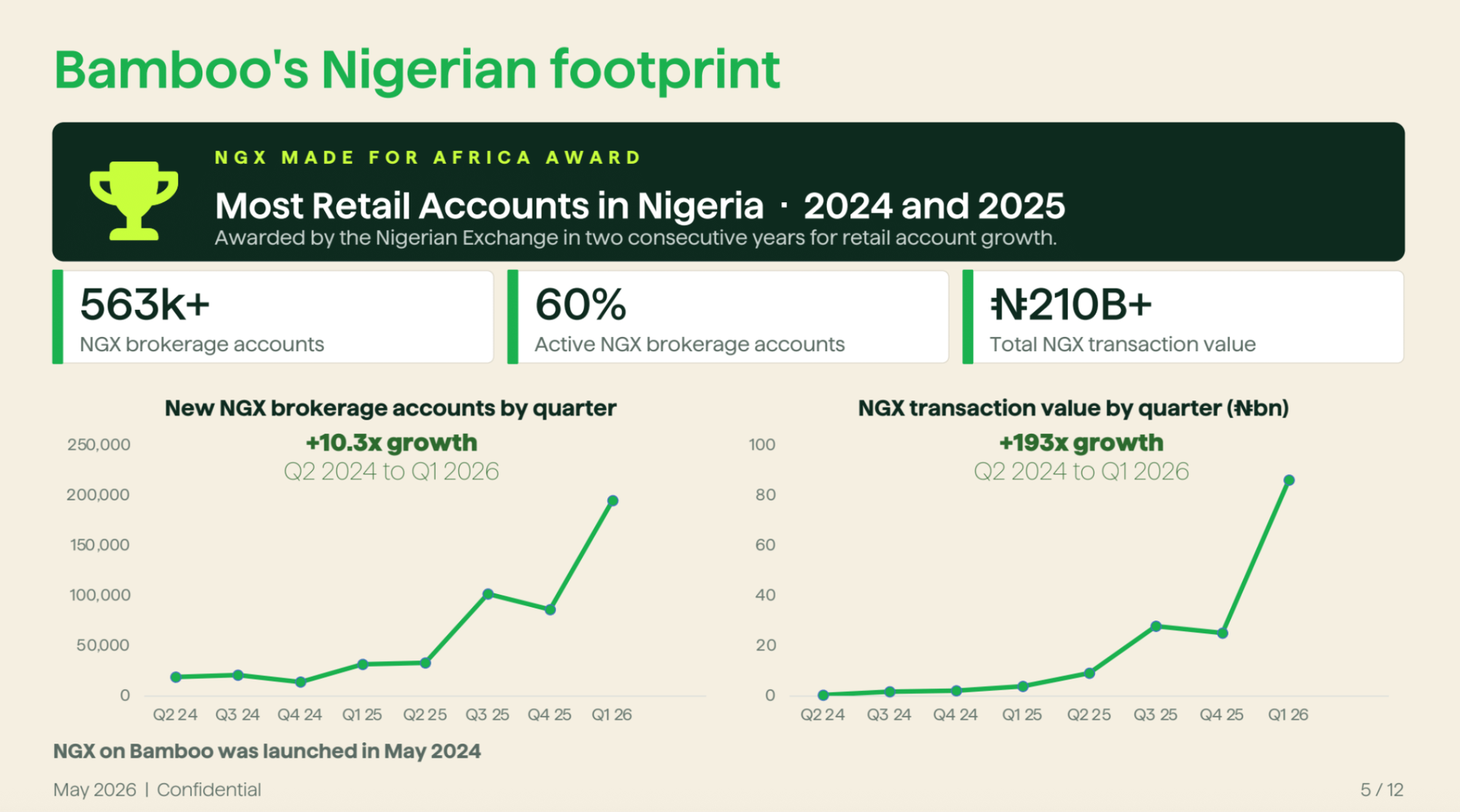
In April 2026, for the first time in history, a retail broker (Bamboo) became the #1 broker on the Nigerian stock exchange (NGX) measured by the exchange's composite measure of broker activity. This figure combines equity value, equity volume, and equity deal count across equities, bonds, and ETFs into a single weighted score measure.
Source: NGX Broker Performance Reports, April and May 2026, accessed from the Bamboo internal records archive
We’ve also expanded the breadth of Nigerian assets we now offer to include fixed income products, like T-Bills in Naira and Naira savings (where users earn more money on their spare Naira than if it was sitting in a regular bank account).
In 2024 and 2025, we got an award from the NGX as the “Trading License Holder with The Most New Retail Accounts”.
Source: Bamboo
Why is Nigeria’s stock market booming?
A few reasons.
1. The Pencom (Pension Commission) reform was the key structural catalyst. Raising the equity allocation limits for pension fund administrators (PFAs) forced them to rebalance toward equities to meet the new caps.
Because investors knew that that fresh money would flow into high-dividend banking and industrial stocks, those stocks enjoyed a rally off the news alone. Institutional money bringing their patient capital was one of the biggest and under-appreciated drivers of the rally in Q1.
2. The banking recapitalization exercise (ED: the Nigerian central bank mandating banks to fill up their coffers, including by raising money on the stock market) signaled strength in the banking sector. This brought institutional capital into Tier 1 banks and removed uncertainty about which banks would survive (in their current form).
3. The Monetary Policy Committee (MPC) finally cut rates in February, by around 50bps, on the back of cooling inflation. Equities typically enjoy a boost when interest rates fall (as fixed-income such as bonds becomes less attractive). This was combined with an improvement in earnings visibility for listed companies, since analysts could confidently pencil in declining interest costs in their forecasts.
4. Earnings + dividend season was another fundamental driver. 2025 earnings came out showing strong prints for heavyweights such as Dangote Cement and MTN. This increased desirability for such equities.
5. Finally, the reclassification by the FTSE Russell of Nigeria as a “frontier” market (effective in September 2026) is expected to trigger passive foreign inflows into the largest index constituents. It also mobilized domestic capital, who invest in index constituents expected to benefit from these future global investment flows.
All this is on the backdrop of heightened retail awareness of the market. Retail participation is now a growing contributor to the domestic participation that drives volumes on the NGX.
RO Insights: marshaling pension fund AUM into VC
Pension funds hold immense amounts of cash, which could be used to fund local innovation. The reason US VCs have so much money is, in part, because US pension funds allocate quite heavily to the VC asset class.
For countries trying to usher in domestic capital into local equities, shifting pension funds’ allocations to them is primordial. The regulatory route (ie: mandating pension funds to allocate more to equities) is one way to do it. But such mandates are more effective if complemented with empathetic hand-holding.
Amma Gyampo leads Ghana’s Venture Capital and Private Equity Association (GVCA).
In 2025, GVCA launched an industry compact to mobilize 5% of domestic pension and insurance AUM into VC/PE investments.
Here’s how Amma explains what putting those goals into practice require:
“Pension funds manage people’s savings. They are extremely cautious investors, understandably so. The venture capital asset class has specific quirks (long periods of illiquidity, “J-Curves”) which make pension funds uneasy.
We’re designing alternative investment vehicles that assuage these worries, whilst still getting them to allocate to venture capital.
An important skill here is financial engineering and catalytic capital origination. GVCA has been spearheading this. We’ve successfully attracted international philanthropy investments that provide catalytic risk capital, which enables local funds to attract domestic institutional capital.
[...]
The African PE/VC industry needs to design investment vehicles that make the asset class attractive. We can’t ask pension funds to invest in an asset class with similar returns to the bond market, but with significantly more risk.
The innovation surrounding the fund structures we’re putting in place is some of the most exciting work we’re doing.”
Excerpt from How Ghana is stewarding local pension funds towards VC, originally published in The Realistic Optimist (May 2026)
In 2021, Bamboo (alongside other Nigerian fintechs) got their accounts frozen by the Central Bank of Nigeria. What did you derive from that experience?
At the time, regulators were trying to understand the differences between a new type of digital broker (us) and more traditional brokers.
This episode laid the groundwork for intense discussions with the regulator. These eventually led to Bamboo receiving a new digital sub-broker license from the Nigerian SEC in 2023.
Part of the criticism was capital flight, or the fact that Bamboo facilitates the transfer of Nigerian wealth abroad. How have you squared those concerns with the regulator?
The capital flight criticism, while conceptually understandable, isn’t accurate. Bamboo users have brought more foreign exchange into Nigeria than has left, countering the wealth drain narrative.
The majority of users invest using local currency. Bamboo's partners source the required USD from the parallel market rather than the official FX window, meaning the platform does not disrupt or compete with formal FX flows in the country.
Bamboo also enables Africans in the diaspora to invest in their home country’s stock market. This has driven a meaningful increase in inbound capital and investment returns flowing back into Nigeria.
Bamboo is a tool for wealth creation that strengthens Nigeria's participation in global capital markets while keeping FX dynamics largely neutral or net positive for the country.
Furthemore, withdrawals to a US bank account are not supported on Bamboo, even if you are investing in the US stock market. You must make withdrawals in local currency to a local bank account or mobile money wallet. You come in with a Naira position, you leave with a Naira position. If anything, Bamboo is leveraging the US stock market to help our users grow their wealth and repatriate the proceeds back to the continent.
What are your tips for other African fintech founders, regulator-wise?
They are partners, not enemies.
The regulator’s job is to protect investors and remove bad actors. If you come in with a novel model, you have to pedagogically engage with the regulator. You have to explain your model and co-create sensible regulation that serves both of your interests. There’s no point in adopting an adversarial position.
Many countries now have sandboxes which fintech startups can use to launch while staying close to the regulator. This avoids misunderstandings and potential trouble down the line.
RO Insights: regulator engagement is also deeply human
Richmond emphasizes the pedagogical element of working with regulators.
There’s also a human one. At its most basic level, regulators are human beings that need to trust the founders, who are also human beings. Skilled founders understand that their explanation’s technical clarity must be complemented by empathetic human connection.
Here’s how Nebras Jemel, co-founder of Tunisian neobank Flouci, explained:
“Regulation has been Flouci’s seminal topic so far.
I started Flouci straight out of Harvard. I’d spent years studying mathematics, philosophy and constructing an image of the world as a rational place. In my mind, a regulator would simply change the law when presented with a clear, logical, coherent reason to do so. How mistaken I was.
The regulatory game is a political and educational one, not a rational one. I failed to understand that. I spent too much time writing documentation about the product, explaining every nook and cranny. I realized, after a while, that what the regulator needed was to trust you, personally.
If what you’re doing is brand new, they’ll have a hard time wrapping their head around it. Rather, they have to gain the conviction that you and your team are doing this in good faith.
I have a fun anecdote: once, the Central Bank asked me for a document, which I sent. They asked me for the same one again, later on. They clearly hadn’t read it the first time I sent them. My theory is that this was a sort of “hazing” ritual, making us go through pain to prove that we were serious about building this. Remember: if your product messes up and they approve it, they are in serious reputational trouble vis-à-vis the public they are supposed to represent.
If I were to do this again, I’d spend infinitely more time and energy on fostering very human, real connections with the regulators I need on board and less time writing technical, endless reports. That being said, continuous stakeholder education is primordial as well.”
Excerpt from Flouci: Tunisia’s neobank, originally published in The Realistic Optimist (May 2025)
How does Bamboo make money?
We charge commissions on trades, generally between 1% and 1.5% (larger trades get smaller commissions). We have a minimum commission amount of $1 regardless of the transaction size.
We make money on FX spreads, when we do the USD-Naira conversions for Bamboo users.
On the fixed-income products we offer, such as treasury bills, we buy on the primary markets and sell to our users at a markup.
How have you quantified Bamboo’s TAM?
We estimate that around 373M Africans have investable income.
Our TAM methodology assumes that every adult with internet access living in urban areas on the continent is addressable. With fractional investing, such as the ability to buy T-Bills as low as ₦1,000, Bamboo has no effective minimum. We have added up the total estimated internet users across the continent living in urban areas and included an estimated urban poverty filter. The poverty rate among internet users is materially lower than national averages because internet access requires a device, a data plan, and disposable income.
Bamboo makes an average of $12 revenue per retail user per year. If we multiply that by the 373M figure, we get a potential revenue of $4.5B.
Then you have HNWIs, which we define as anyone with a portfolio value of over $50,000. We estimate that there are 1.9M of these people throughout Africa based on data from Henley & Partners 2025 Africa wealth report. We make $2,600 per year in revenue from such users, yielding an additional $5B in potential revenue.
All in all, we estimate that Bamboo has a $9B revenue opportunity across the continent. It’s important to note that acquisition strategies for “classic” retail investors and HNWIs are different.
Bamboo also launched a B2B offering. Can you tell me more about that?
We’ve spent a lot of time building the infrastructure and regulatory framework that enables Nigerian investors to invest in US stocks. This infrastructure can be useful for Nigerian financial institutions that want to enable their own clients to invest in US stocks.
The B2B arm is only 1.5% of our revenue today. We’ve partnered with two local neobanks (Wema Bank and Kuda Bank), and we’re in talks to onboard a more traditional local bank. We’re working with asset managers that want to invest in the US through a dedicated portal, which we’ve called Terminal. We’re also fielding interest from corporates, who want to invest their company’s spare treasury in the US.
B2B is a whole new business for us. Sales cycles are extremely long and growth strategies are distinct from B2C. We’ve got a team dedicated to it, but it’s required some reinvention internally.
On the B2C side, what have been your most effective growth channels?
Referrals have been our most effective growth lever so far. Users get 2.5% on their referees’ first stock trade and can earn up to $1,000 per month. Some users love to do it as a side hustle. We’ve built a “portfolio share feature”, which includes a referral link that they gladly share on X and Instagram.
We’re sometimes referred to as a “media company that sells stocks”. We’re extremely active on Youtube, we have 2M newsletter subscribers, and we have a 200K-large WhatsApp channel. We invest a lot in short-form videos. 80% of our users are first-time equity investors, so the educational component is crucial. We supplement that content with paid ads.
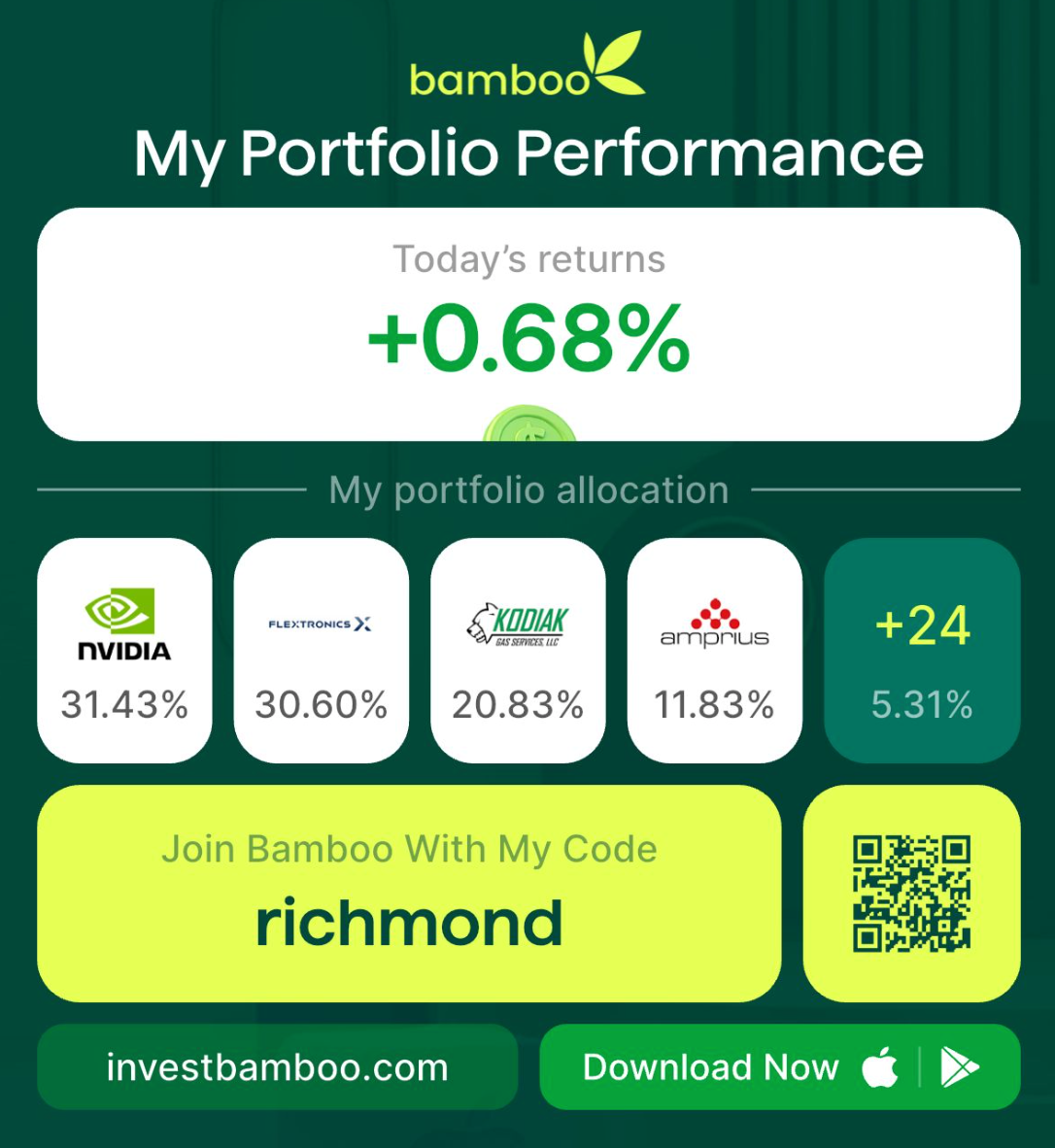
Bamboo’s portfolio share feature
RO Insights: "media-for-equity" deals
A strong, distinctive social media presence can be a cheap way for B2C startups to scale. Quality content, propelled by algorithms, can give young startups visibility they wouldn’t have the cash to acquire via paid ads.
Brazilian fintech Noh (which offers shared accounts for couples) took it one step further. They partnered with a famous Brazilian financial influencer, who was paid in equity in exchange for being a “Noh Ambassador”.
Here’s how Noh’s founder Ana Zucato explained the arrangement:
“You collaborated with a famous Brazilian financial influencer, Nath Financas. How did that come along and what does the partnership entail?
Nath emailed me on a random Friday evening. She told me she often quarreled with her fiancée about money and saw her own parents divorce because of money. She was passionate about Noh’s mission and wanted to push it forward.
Nath’s audience was exactly the persona Noh is built for: couples turning 30, that don’t have kids but have a pet, have decent salaries but aren’t “rich yet”.
We met up and settled on a media-for-equity deal, where Nath took the lead on our content strategy and production in exchange for shares. She also helps us with product development. The “envelopes” feature was her idea originally and its adoption exploded due to her endorsement and promotion of it.”
Excerpt from Noh: banking couples in Brazil, originally published in The Realistic Optimist (December 2024)
What’s been your biggest product flop?
We tried to introduce a “stock gifting” feature for Valentine’s day but it didn’t take off. We’ve got to understand how to integrate “stock gifting” as part of the Nigerian cultural zeitgeist.
What’s your thorniest operational challenge?
Bamboo’s existence and operations are dependent on a slew of third-parties.
Bamboo users are abstracted from those partners. They just use Bamboo. If one of our partners experiences downtime, our users are frustrated with us and our brand takes a hit, even though we’re powerless. For example, sometimes the BVN (the government’s e-KYC) is down, meaning we can’t onboard new users. We can’t do much about it unfortunately.
That’s why we’re deepening the stack to build redundancies. Additionally, we’re also starting to move some of the functions in-house (ie: getting our own US broker-dealer license).
Another challenge is user education. As previously mentioned, 80% of Bamboo users are first-time equity investors. Some users aren’t well-versed on the technical intricacies of investing, meaning we get the blame for stuff that’s not our fault. For example, if a user wants to sell a Nigerian stock they own but there’s no current buyer for that stock, they’ll blame us for “holding” their money even though it’s out of our hands.
We might be able to assuage that problem soon as we become a fully-registered broker in Nigeria. This will enable us to do some market making (ie: Bamboo acting as an interim buyer and seller of stocks, if there is no current liquidity on the market).
Why did you choose Ghana, a substantially smaller country than Nigeria, as your first expansion market?
It was organic. We had a bunch of people from Ghana requesting Bamboo come to their country.
Stars were aligned. The KYC infrastructure in Ghana was easy to integrate, the digital payment partners were the same, and the digital custody partner was the same. The growth strategies were also the same.
It was a no-brainer. We launched quickly and smoothly. Today, we actually only have one full-time Bamboo team member in Ghana, who focuses on customer support.
What about South Africa & Kenya?
South Africa makes sense from a commercial standpoint because the country houses a large number of HNWIs. Kenya is a large market we simply ought to be in as a pan-African business.
What’s the most common investor pushback you get?
How we concurrently manage our B2C and B2B arms, which demand two completely distinct strategies. It’s a valid point.
We’ve invested so much time into building this Africa-US investment infrastructure that I think we’d be missing out by not offering it to African financial institutions. Our current investors are giving us the benefit of the doubt and letting us test it. If we don’t see a clear strategic benefit to the B2B arm, I won’t hesitate to sunset it.
Even if it doesn’t work commercially, the conversations Bamboo’s B2B team is having with corporate prospects yield invaluable market intelligence.
What have been your worst and best decisions as a founder?
We made a few bets that weren’t fruitful. We spent a bunch of money on sponsoring local TV shows which didn’t return the ROI we hoped.
The best decision(s) I’ve made have definitely been the team my co-founder (Yanmo Omorogbe) and I have put together. We’ve surrounded ourselves with a fantastic management team, which has unsurprisingly paid out.
Disclaimer: all internal company metrics shared in this article are claims from the interviewee. They have not been independently verified. Do your own due diligence.
The Realistic Optimist’s work is provided for informational purposes only and should not be construed as legal, business, investment, or tax advice.